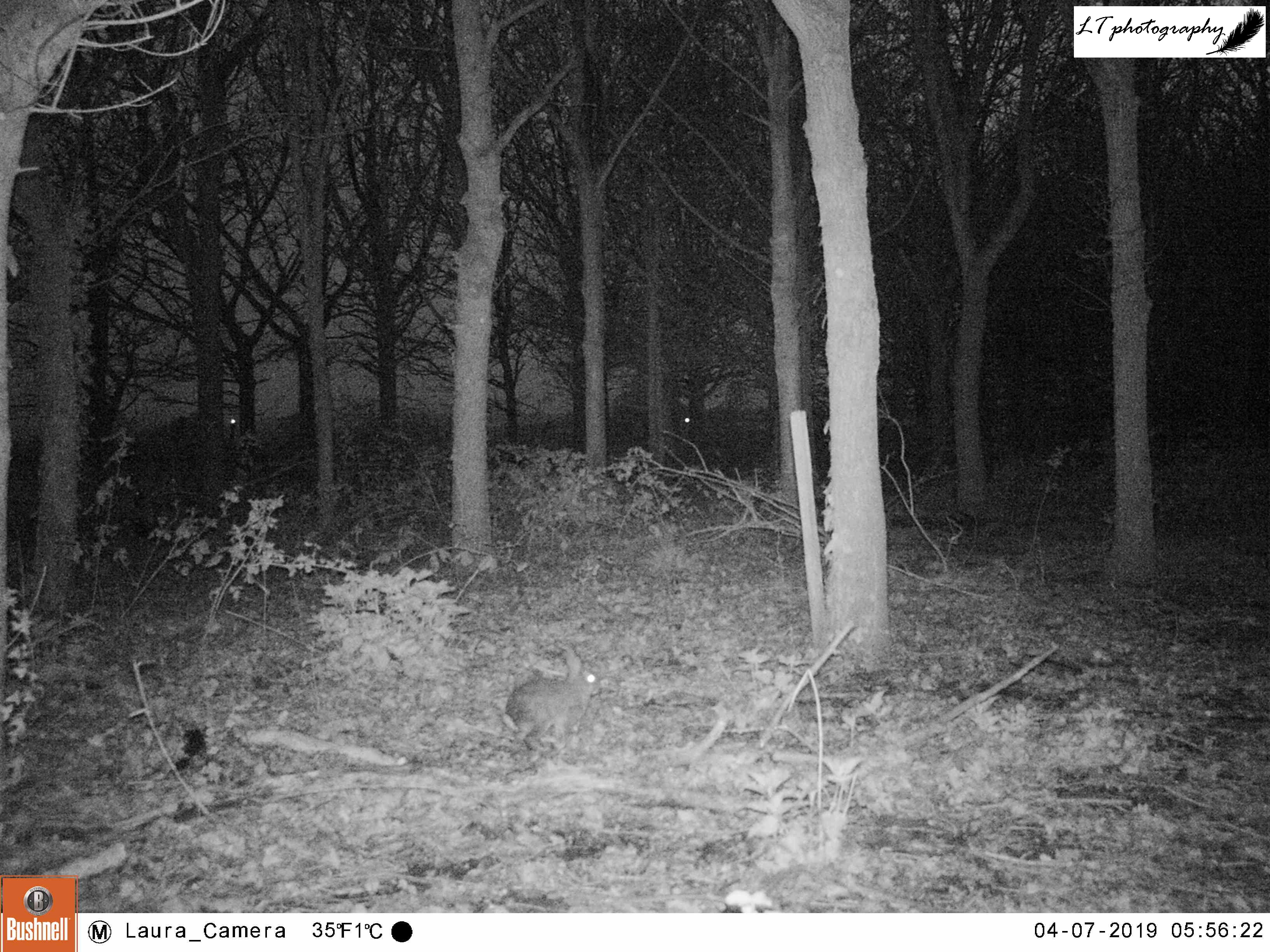
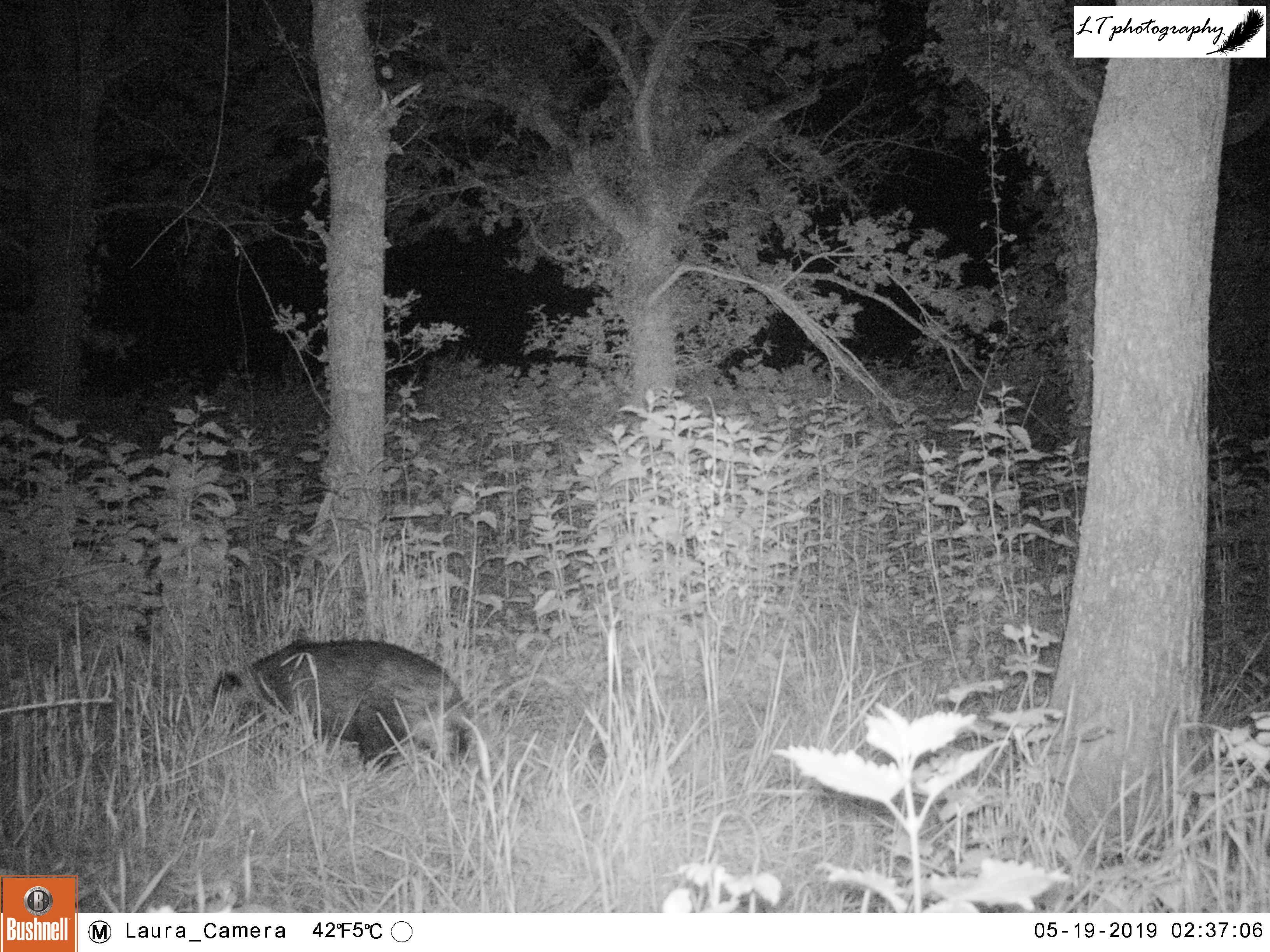
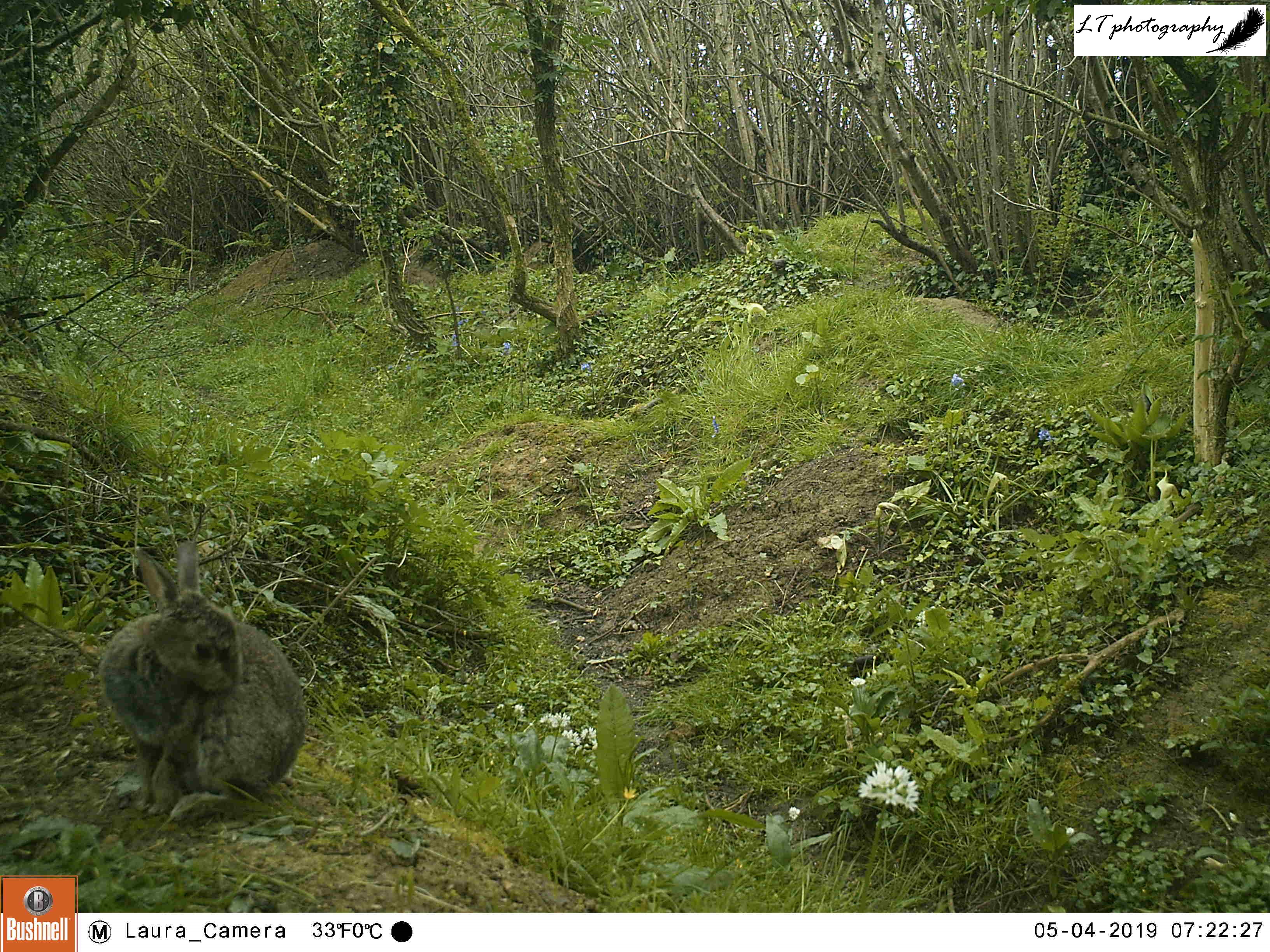
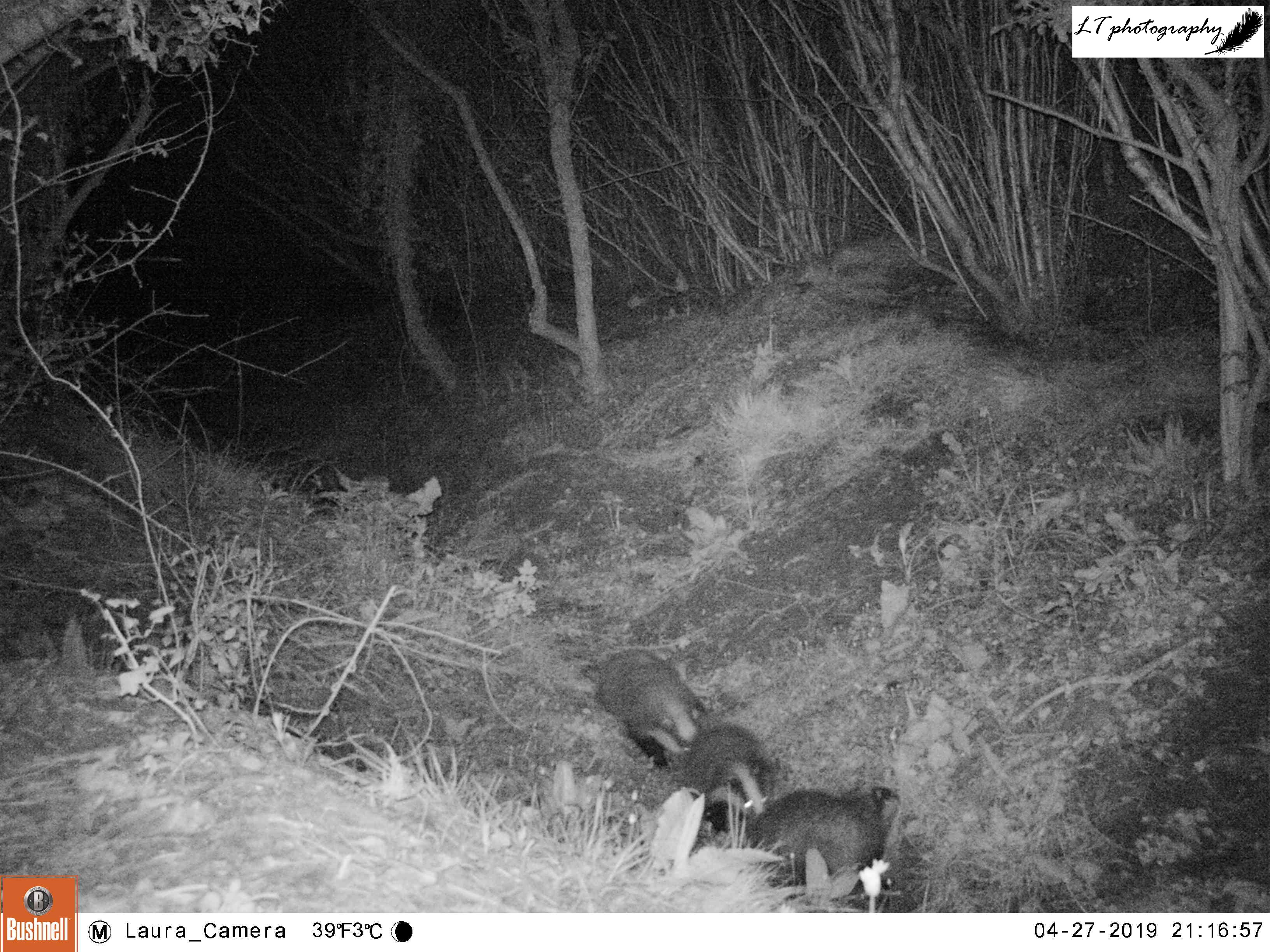
Spring Countryside Camera Trapping 2020

Through the stillness of an early morning mist, a shape appears, carefully stepping through the short undergrowth. She weaves through the trees, stopping to pick and browse as she goes. Then she stops, motionless. Ears pricked she listens out into the gloom, something catching her attention. Magnificent silhouette, the more impressive for her swollen belly, a sign of new life to come. Here she is captured, a glimpse of a world unknown, forever immortalised in a frame.

Camera traps provide a window into another world, one that is often unseen and unknown. As technology improves and efforts increase, humans are now capturing the natural world in increasing detail, observing new behaviours, and keeping track of wildlife that would otherwise be difficult to monitor. Camera traps also provide us as individuals with the opportunity to open our eyes to the world that lies outside our doors. To find out more about camera traps, how to use them, and for some inspiration, check out my ‘How to… Use and Make the Most of a Camera Trap’ post.

Since I got my camera trap a few years ago, it has become an important way for me to explore the hidden world around me. In particular, during spring 2019, I spent 10 weeks conducting camera trap surveys across 5 sites on my family’s land in Dorset. It was a lot of fun to see what species I could detect and in what numbers, whilst seeing how things changed over a period of time. For my results, check out my ‘Spring Countryside Camera Trap Surveys’ post on my blog.

Camera Trapping 2020

This year, despite COVID-19 leading to a national lockdown, I tried to utilise the time I got to spend outside to get my camera trap out as much as possible. The result was some successful and really enjoyable camera trap experiences throughout the spring, which helped to keep me going. On my adventures, I chose to focus on a mixture of 5 new and old sites, including Badger setts, a footpath, a Sycamore copse and a meadow. It was great to once again monitor the animal populations on our farm, experience new life, and to see if something interesting might turn up!

Highlights

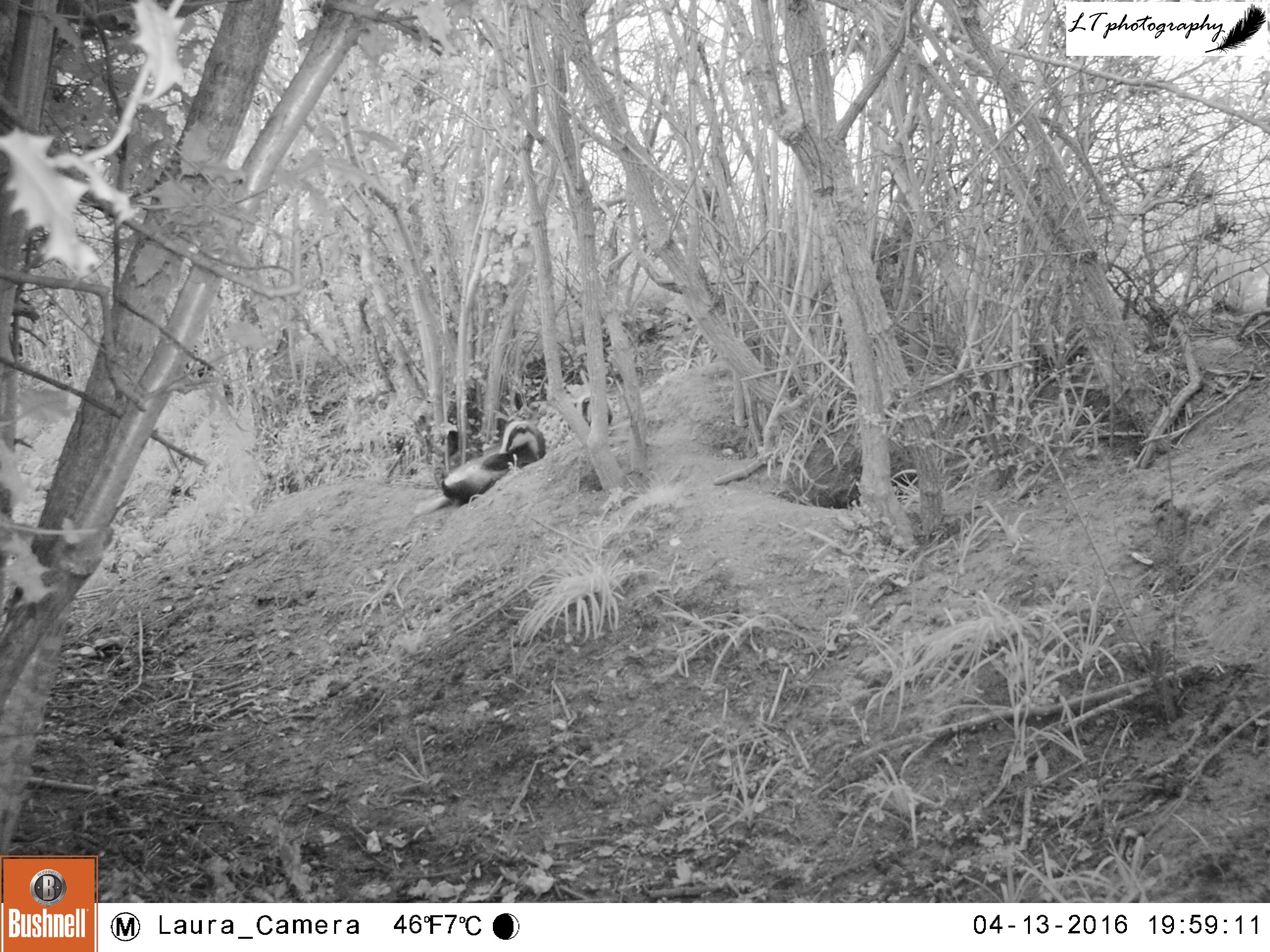
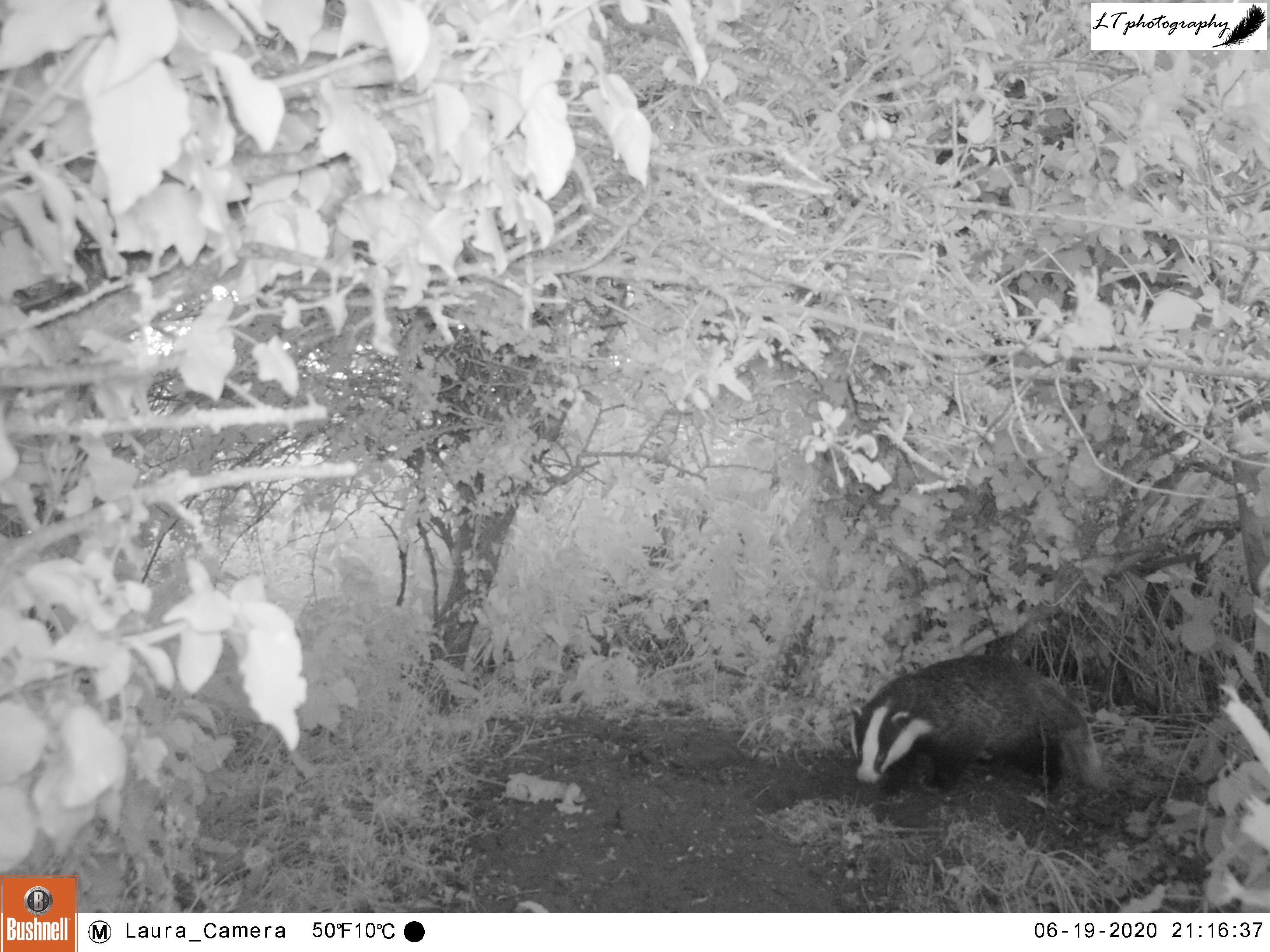
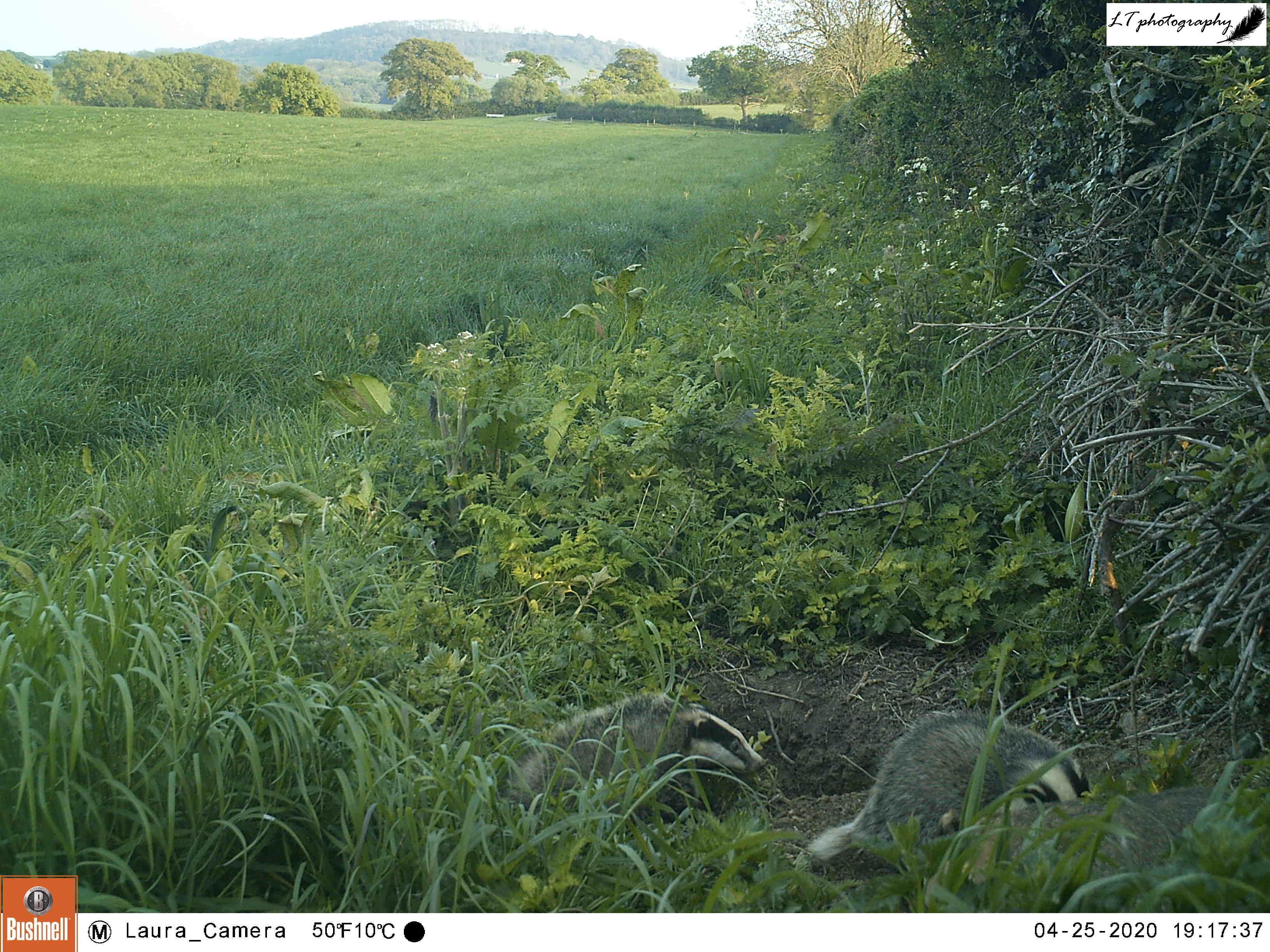
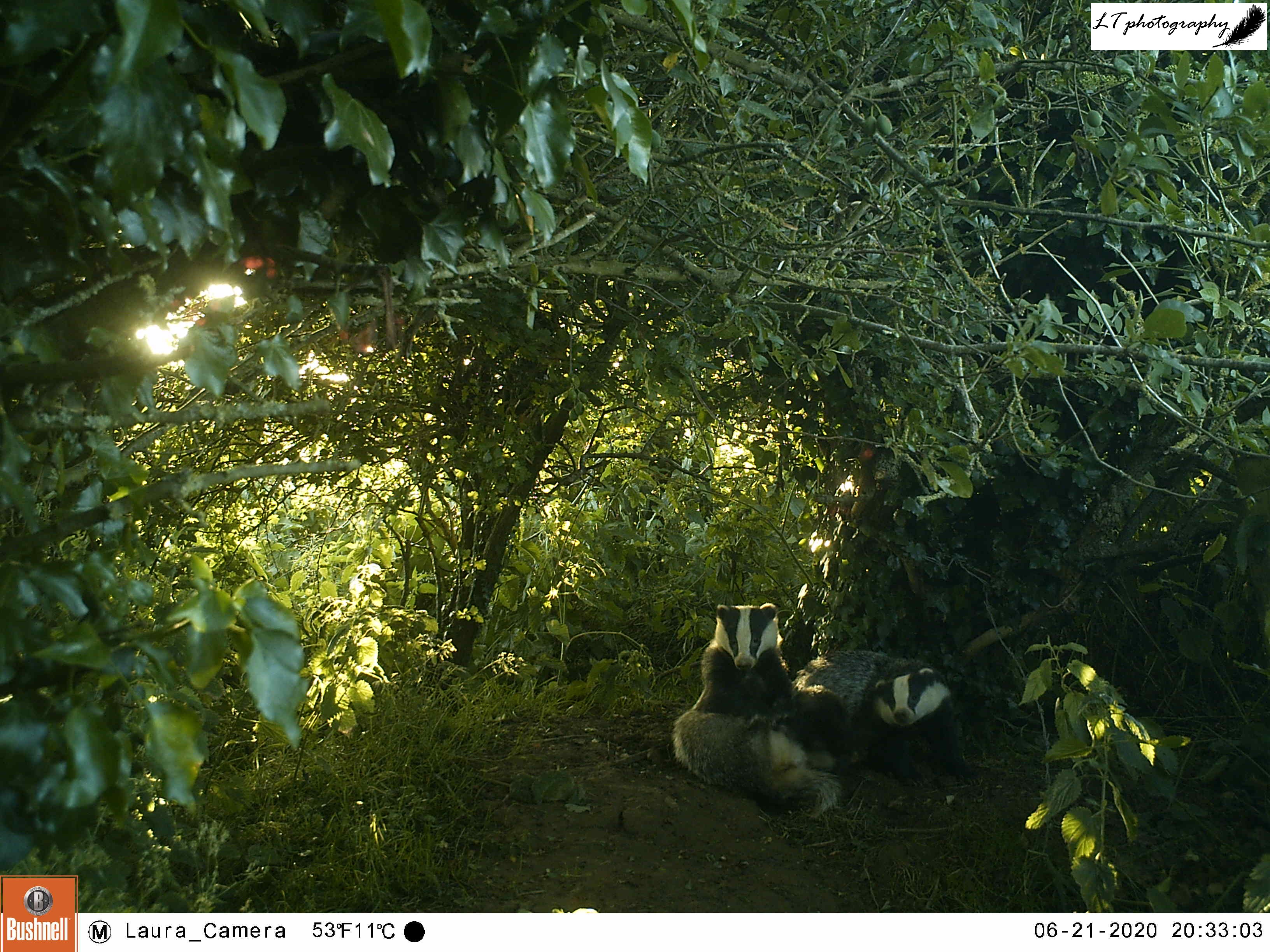
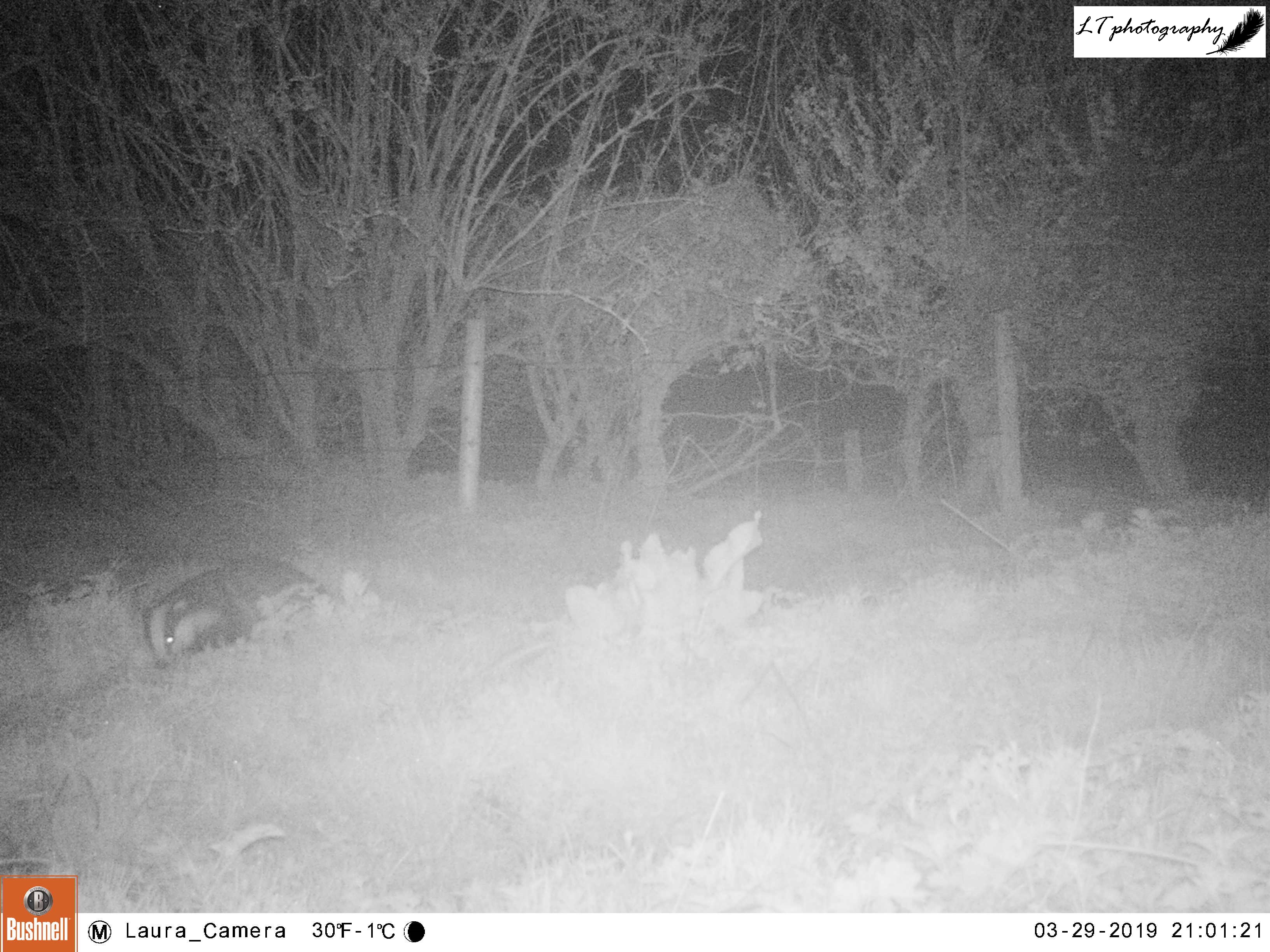
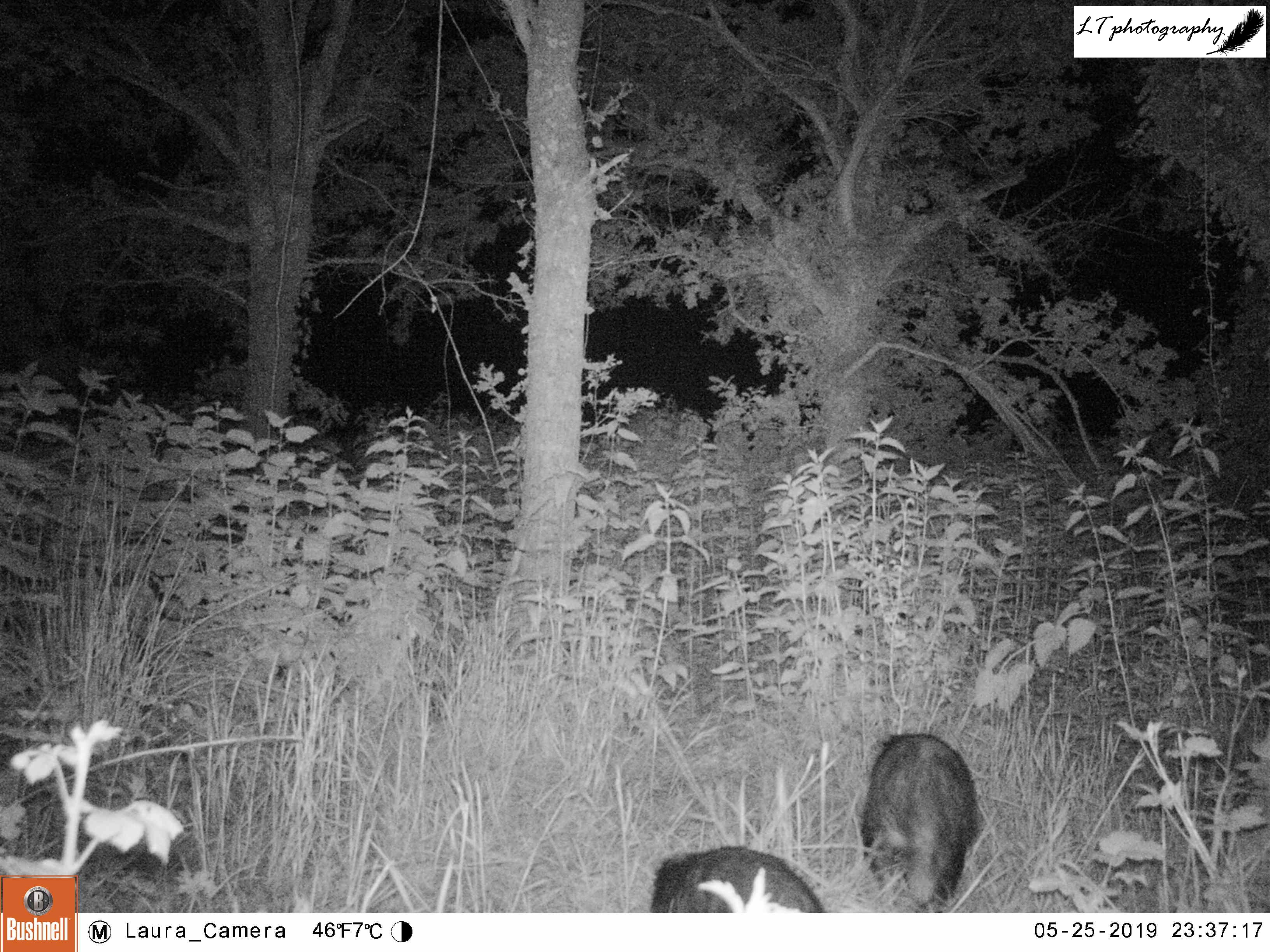
The real stars of my camera trapping this spring just happened to be our British large mammals. In particular some of my highlights involved fantastic sightings of charismatic Badgers. One of my favourites was capturing 2 cubs playing and fighting outside the entrance of a sett at all times of day in April, with a parent often popping in to check on them. I also had some great luck at another sett in June, where my camera trap captured 2 Badger cubs interacting with each other in their natural habitat, in an open area within a hedge. It was really great to see!

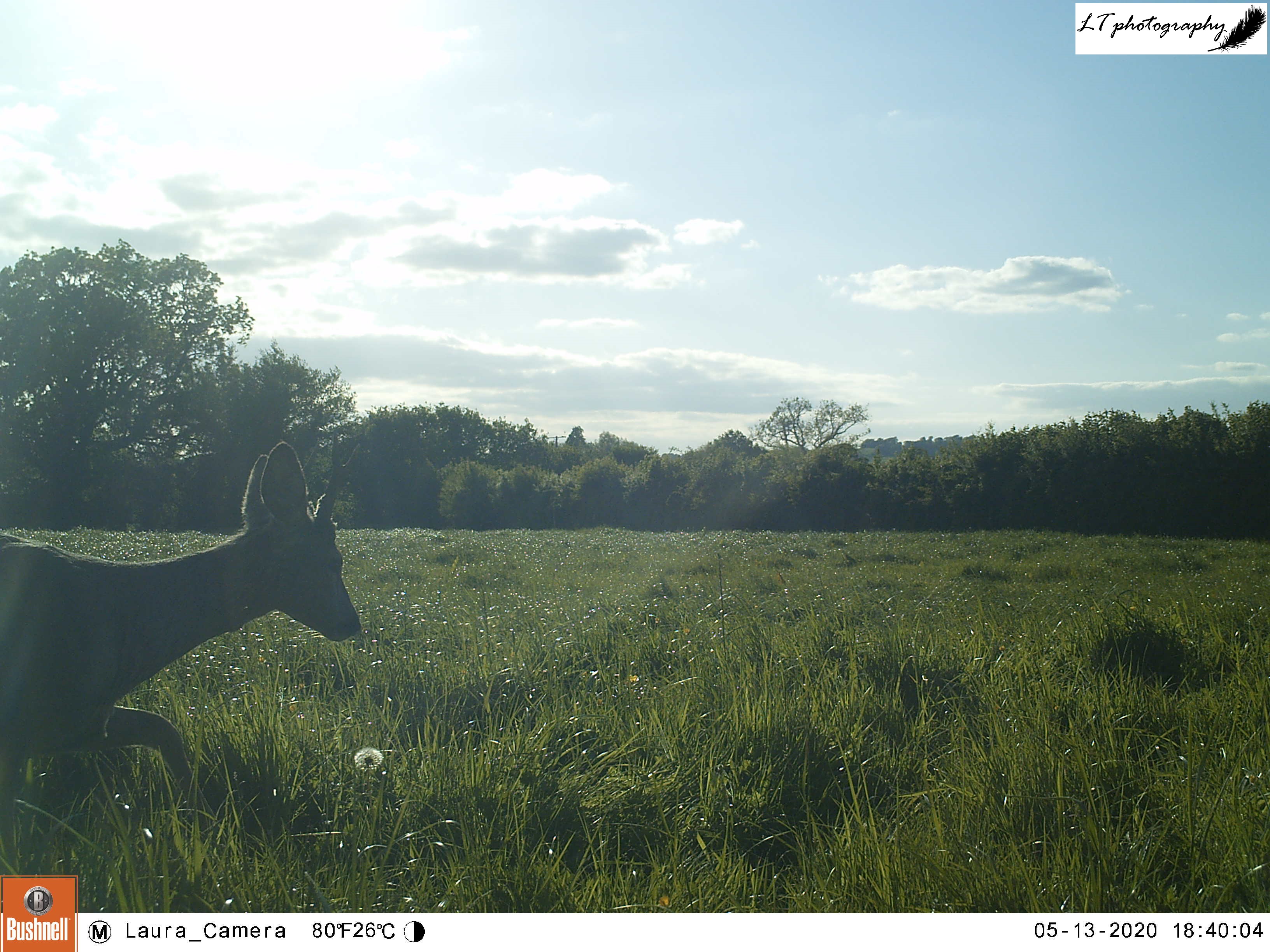
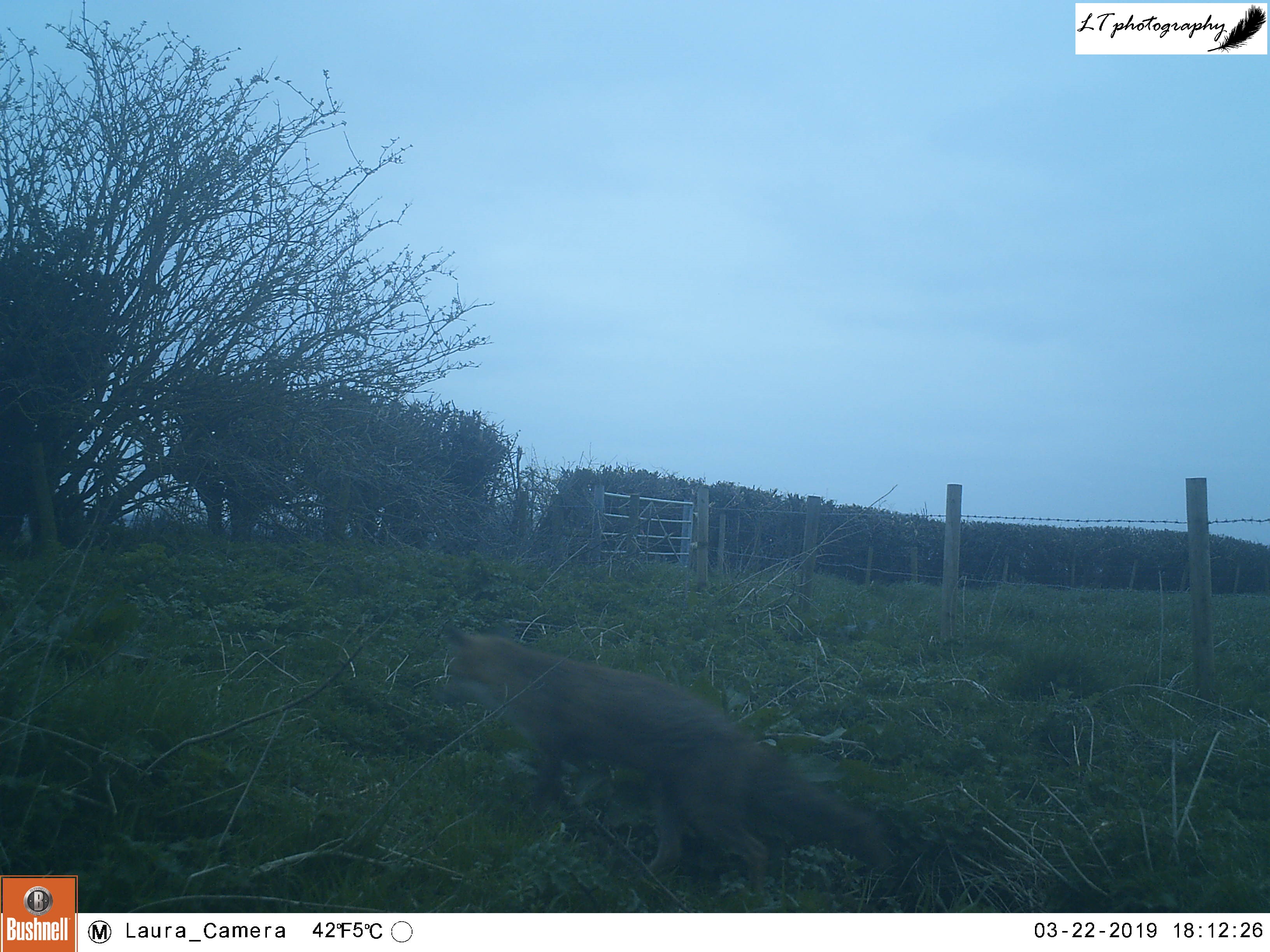
This year Foxes were also popular sights on my camera trap. These ranged from adults and cubs at their dens to being captured on the move, giving me a new insight into their lives and interactions. Roe Deer were also a popular sight on my camera trap as they moved through their habitat and spent time foraging, with does and bucks often being seen separately at these same locations. All wildlife are fantastic to be able to experience in this way though!

When Things Go Wrong!

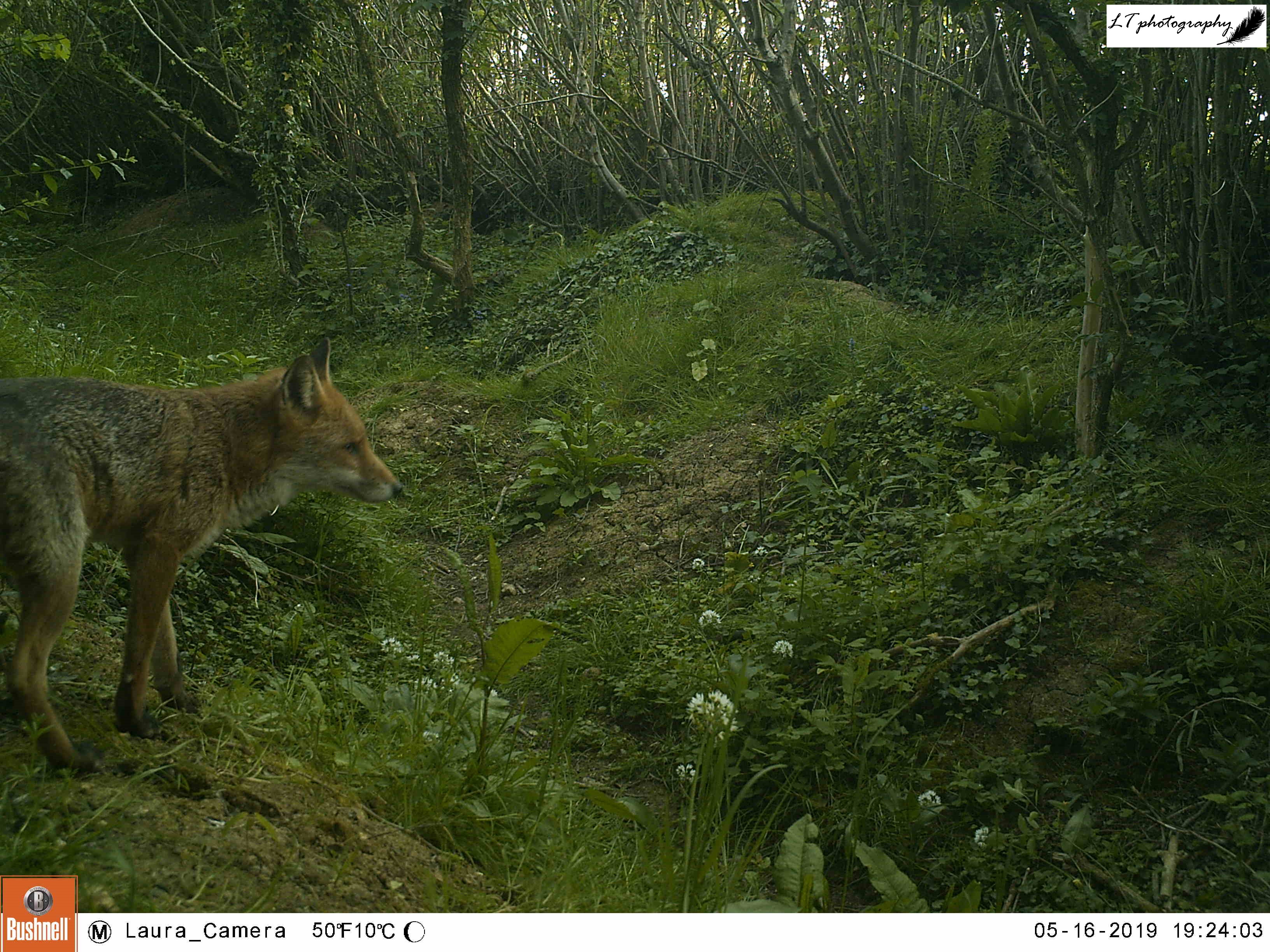
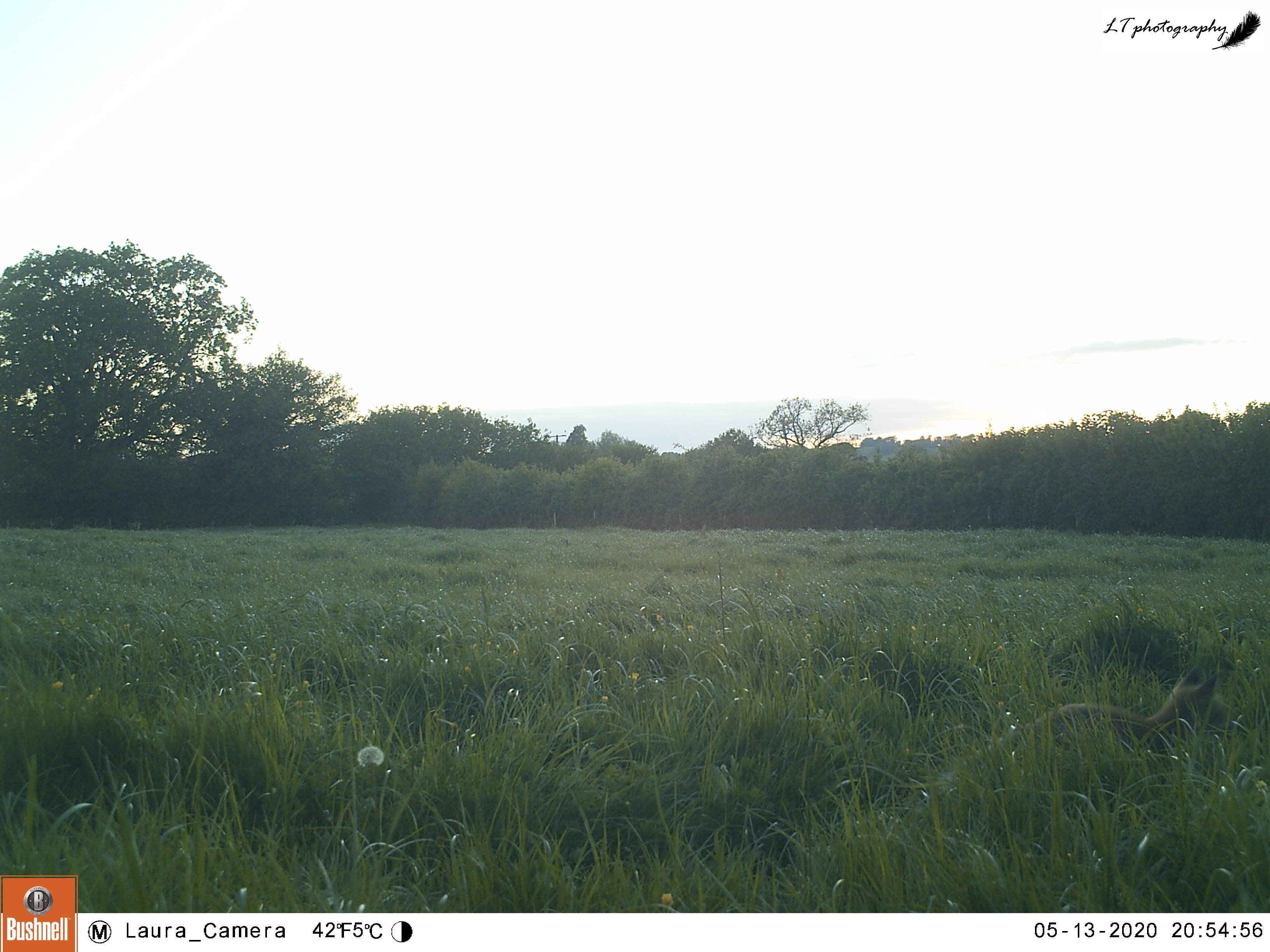
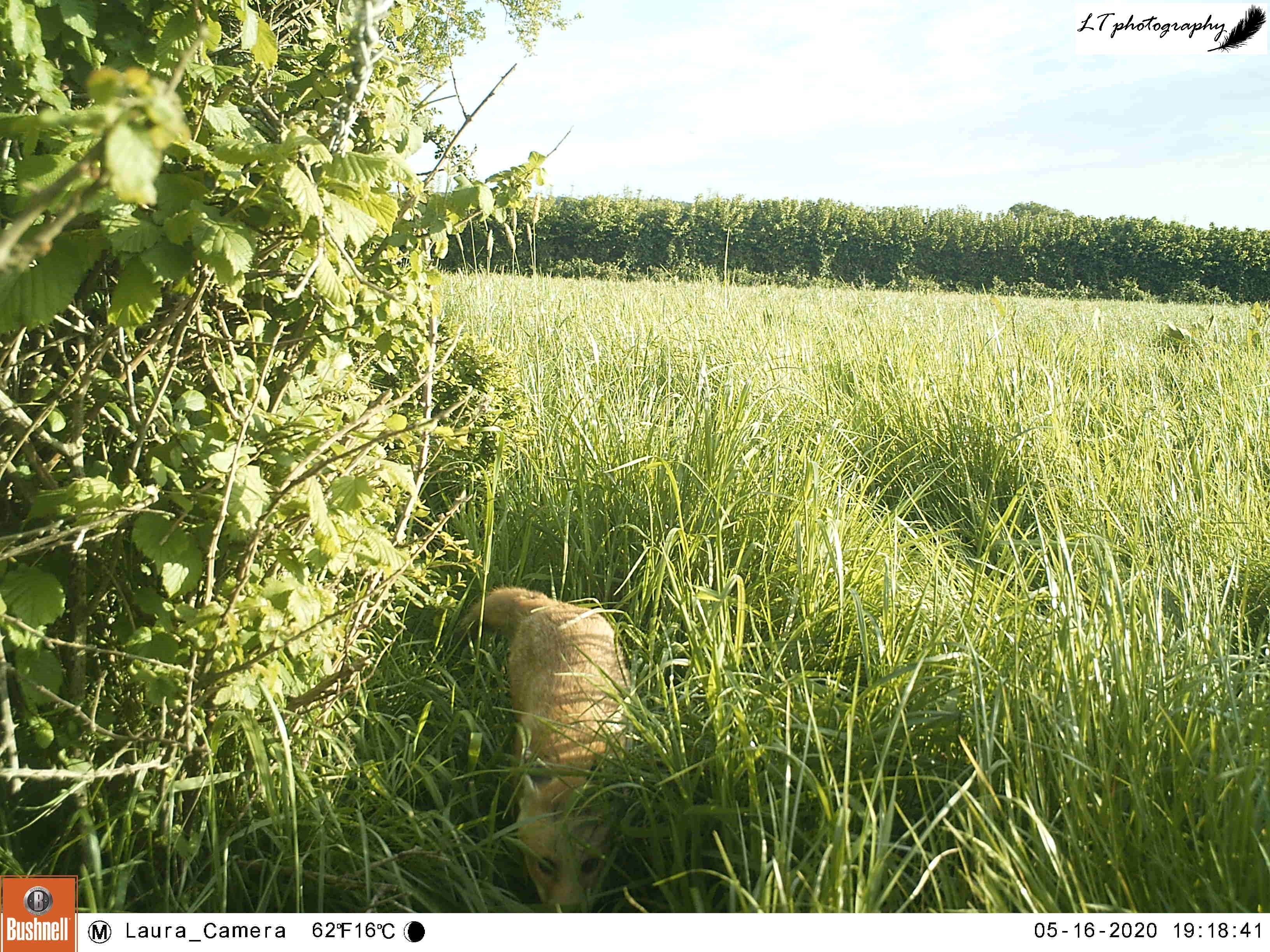
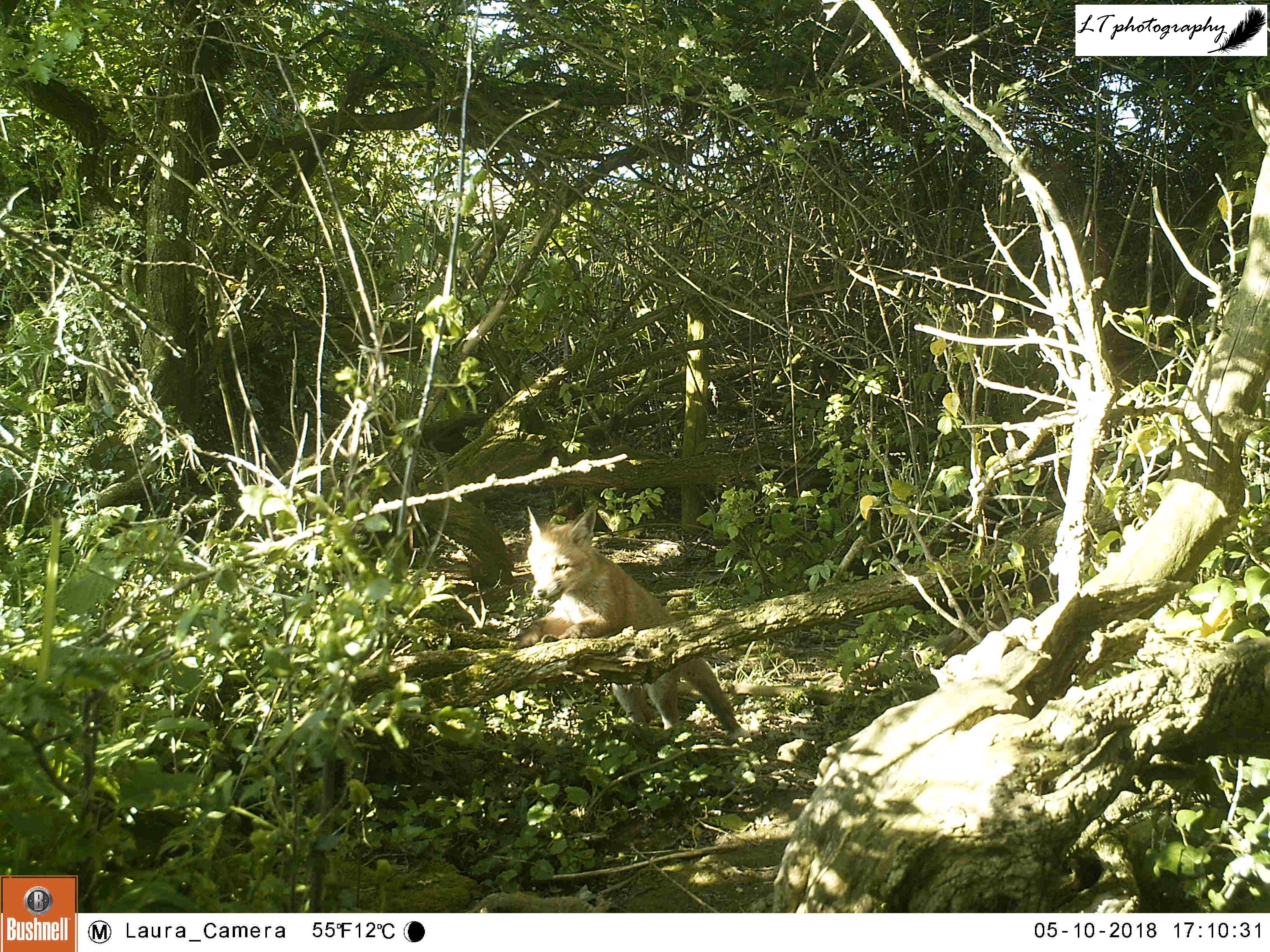
With the highs of camera trapping, there are always bound to be some lows. With many successful days camera trapping this year, my low came in the form of one project not quite going to plan! After sightings of a new fox den at the border of a hay meadow, I set out to try and get photos of this family. Over the course of two weeks I threw all my ideas and efforts at achieving my goal, but over and over again the cubs alluded me. Instead my camera seemed to spend more time capturing the local Roe deer population in this particular location! Here though are some of the glimpses I did catch of this elusive family:

The Best Bit!

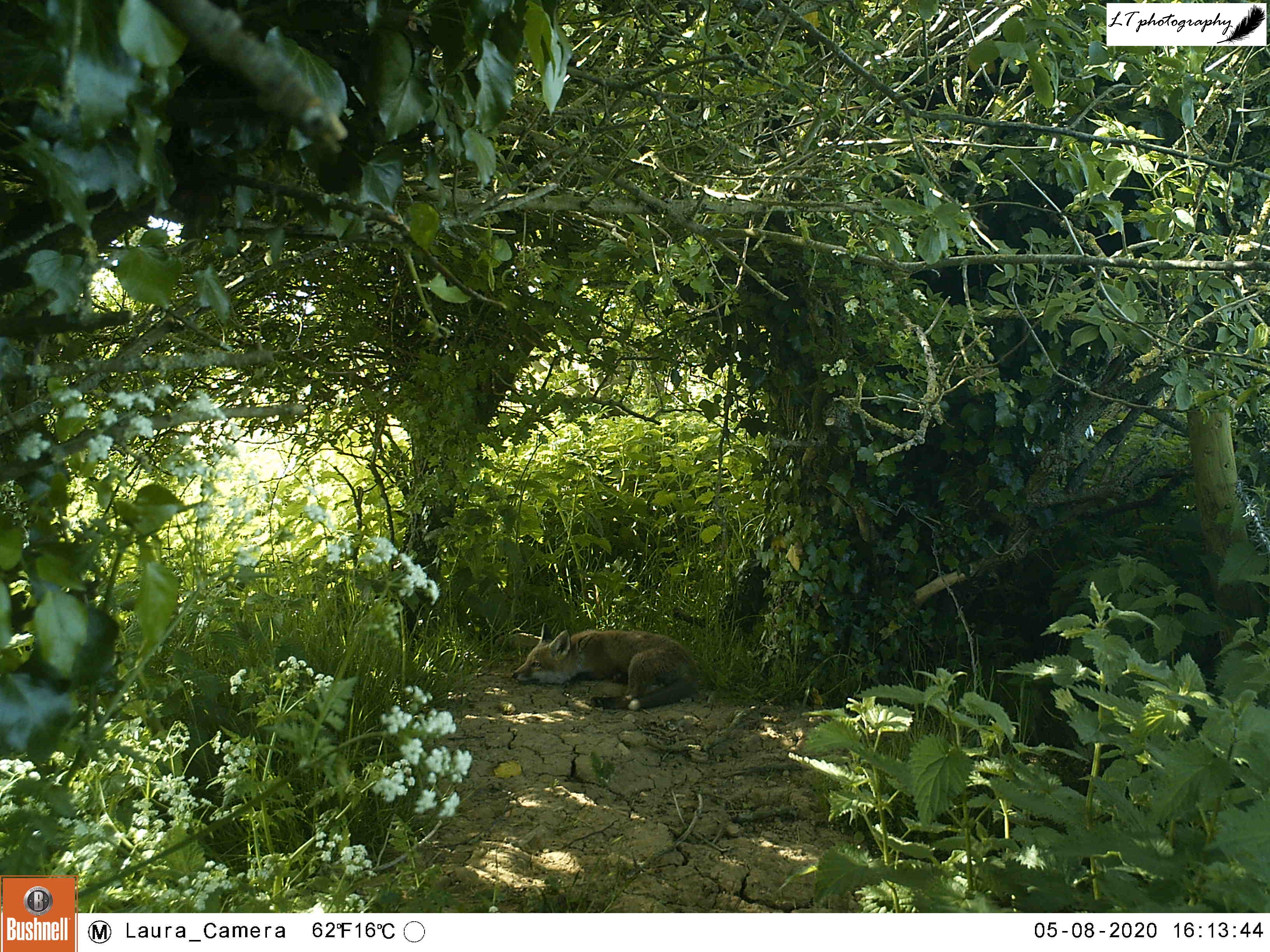
There is always going to be one highlight that stands out from a season camera trapping. For me this year my best bit came in the form of a surprise. Whilst having my camera trap out on an active Badger sett for a week in May and then in June, my camera, amongst many photos of Badgers and their cubs, caught some unexpected shots of a lone Fox cub. In my photos, most days the cub would spend its time sleeping and playing alone in the central area of a hedge above a Badger sett. Sometimes it also made an entrance at night, but it was always seen alone. It was an interesting insight into this cub’s more unusual world.

As the natural world now begins to descend into a deep slumber, get out there now and explore, allowing your surroundings to give you strength, whilst leaving nothing but footprints.

30 Days Wild 2020: My Wild Month

I have always lived a wild life. For this I have my family to thank, being raised in the middle of the beautiful Dorset countryside, immersed in everything Mother Nature has to offer. It has been my playground, my classroom, my escape, and my counsellor. It is a part of who I am. This is why I am so passionate to protect and conserve our natural world, and why I now make it my mission to share all it has to offer with the rest of the world.

So when I heard about 30 Days Wild, I just had to get involved! The month-long challenge aims to bring people closer to nature, get people learning and exploring, and make a positive difference for wildlife in the UK. This year I made it my goal to spread the word, and before the month started, I began blogging about the challenge in the hope of inspiring others to also get involved (check out How to… Get involved in the June 30 Days Wild challenge). The response was amazing!

Once June was under way, I also made 30 Days Wild a focus of each and every day for the whole of the month. I got to try some new things, learn some new knowledge, help some worthy causes, share with others about nature and wildlife, and most importantly, I got to explore and spend valuable time out in nature. I enjoyed every minute, so join me now as I take a look back at how wild my month of June really was!

Wall Chart

30 Days Wild – June 2020

Day 1 – Monday 1st (Work):

For the very first day of my 30 Days Wild, I started with a bang, showing my support for my local Wildlife Trust by becoming a member. By joining Dorset Wildlife Trust, I have joined 25,000 other members helping to conserve and safeguard wildlife in Dorset and on my doorstep. I look forward to now doing my bit!

Day 2 – Tuesday 2nd (Work):

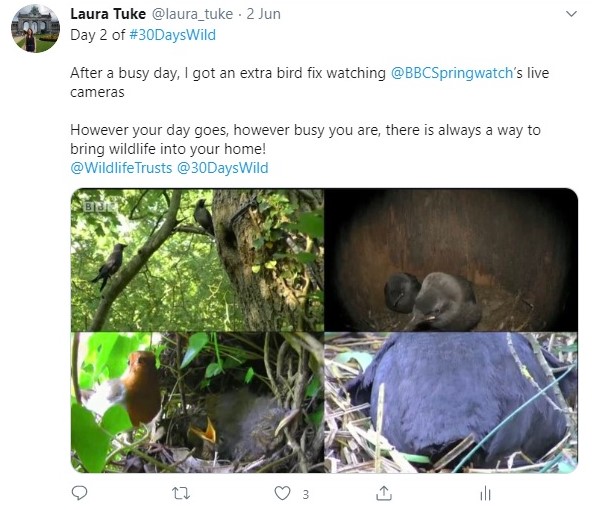
For my second day, I was faced again with the challenge of completing a Random Act of Wildness alongside a busy day at work. I achieved this though, by taking a break in the evening to watch a wild webcam in the form of BBC Springwatch’s live nest cams. It was amazing to get a different perspective of the nests, such as being right inside a Jackdaw’s nest!
Day 2

Day 3 – Wednesday 3rd (Day off):

On my first day off during the challenge, I was able to go for a long walk out in nature, seeing what I could discover on my way. Despite it being a rainy day, the wildlife did not disappoint, with lots of different birds and insects making their presence felt, from families of Long-Tailed Tits to chattering Magpies.

Day 4 – Thursday 4th (Day off):

With another day off work, I decided to combine taking in nature with another of my passions, horse riding. On a hack with my next door neighbour’s mare Marsha, I got to get some really great views of the beautiful countryside near where I live, combined with views of some great bird species, such as my favourites, the birds of prey.

Day 5 – Friday 5th (Work):

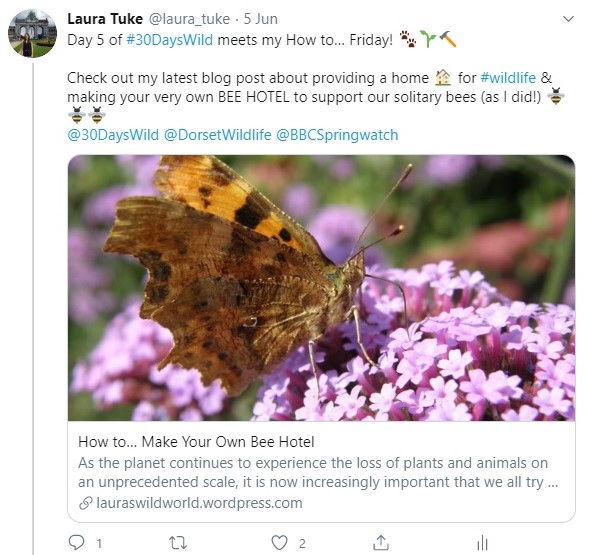
Over the last couple of months I have tried to regularly upload a new post to this blog every Friday. To combine 30 Days Wild with my recent How to… series, on this day I uploaded a piece about making a home for wildlife, and in particular a hotel for bees. To do this post, I got to make my very own hotel, which was very rewarding, so if you would like to make your own, why not check out my easy guide: How to… Make Your Own Bee Hotel
Day 5

Day 6 – Saturday 6th (Day off):

I love growing my own fruit and vegetables, and then being able to pick and eat them! So I was happy on this day off, that I got the pleasure of picking my family’s first gooseberry crop, though it took a while after to top and tail all of them! I also spent time listening to my bird songs and calls CD to do some revision before going out for a walk to test my knowledge. I now love being able to instinctively know when I can hear certain species, such as a Blackcap or Yellowhammer singing in the landscape!

Day 6

Day 7 – Sunday 7th (Work):

I spent the whole of my Sunday making a note of the species that I came across as I went about my usual day before, during and after work. I was able to realise just how lucky I am to work outside and spend so much time out in nature everyday!

I also spent the evening catching up on Springwatch with the company of one of my house cats!

Day 8 – Monday 8th (Work):

During my 30 Days Wild, I wanted to donate to a wildlife cause. I decided that one cause I wanted to support was the Marine Turtle Conservation Project, which without funding would not be able to continue their important work. It was also well timed as the 8th of June was World Oceans Day!

I as well finished my day excitingly helping with Barn Owl nest box checks in my local area, now that I am fully licensed. This included the Barn Owl box on my family’s own farm and it is definitely looking positive for them this year!

Day 9 – Tuesday 9th (Work):

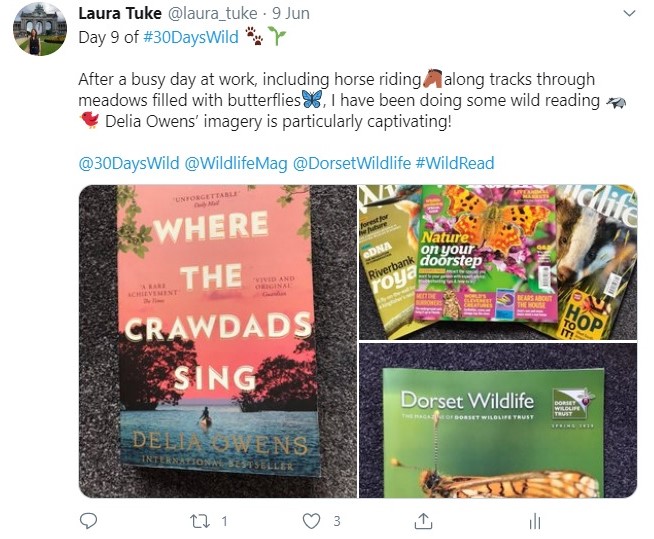
On this day, I was lucky enough to go out hacking on horseback whilst at work, and rode through some really spectacular countryside. It was one very busy day at work, so when I got home I also relaxed with some wild reading, including a great fictional book by zoologist Delia Owens called Where The Crawdads Sing. Her imagery of the North Carolina marshland is absolutely stunning!
Day 9

Day 10 – Wednesday 10th (Day off):

For my day off, I wanted to spend time really taking in the natural world around me and exploring the finer details. In this way, I got to see some incredible things from a hunting Sparrowhawk and Digger Bee nests to strong smelling Honeysuckle and mating Yellow Shell Moths. There is just so much to see if you give yourself the time to take it all in!

Day 10

Day 11 – Thursday 11th (Day off):

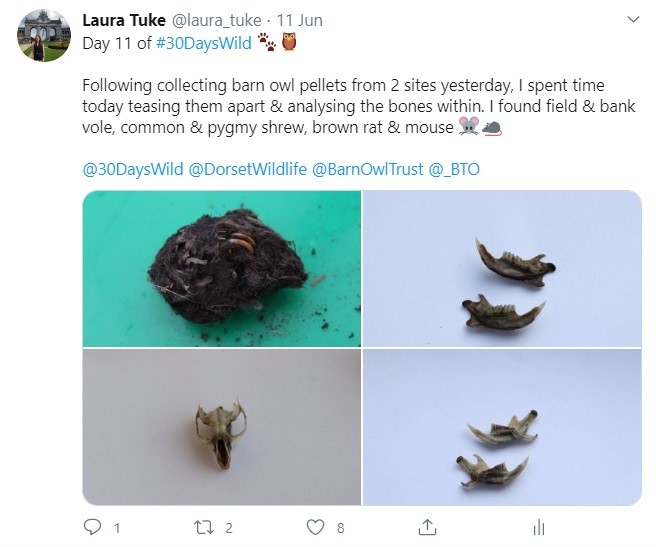
The day before during my walks, I had collected some Barn Owl pellets from beneath two nest sites, a tree and a nest box, on my family’s land. I then spent the next day soaking the pellets and teasing them apart to see what they held inside. From the nest box site, there was Field Vole, Mouse and Common Shrew bones, whereas from the tree site there was Field and Bank Vole, Common and Pygmy Shrew, and Brown Rat.

I also spent some time identifying plants that I had seen out and about, including learning to identify a Male Fern that my cat was very interested in helping me with!
Day 11

Day 12 – Friday 12th (Work):

This Friday, I once again combined 30 Days Wild with my recent How to… series, uploading a post on making small changes to your own life to help our planet. For example, walking and cycling more, thinking before you buy, and cutting your water usage. If you want to get inspired yourself, check out my post: How to… Help the planet one small step at a time.

I also spent some time on this rainy day, appreciating the beauty of the falling rain.
Day 12

Day 13 – Saturday 13th (Day off):

I spent my Saturday wild and busy. My activities ranged from identifying pollinators to organising equipment ahead of the autumn bird ringing season. I am always happiest doing something but doing something outside is even better!

Day 14 – Sunday 14th (Work):

There is nothing more valuable than your own parents passing down their knowledge to you, and with mine it is no different. I have my Mum to thank for the foundations of all my wildlife knowledge today, from bird song to plant species. This year my Mum has been teaching me about chalkland species, using the chalk mound my Mum and Dad have created themselves on our farmland. It has been so enjoyable listening to my Mum as she IDs and teaches me each and every species on the ridge!

Day 15 – Monday 15th (Work):

The ever-changing sky is a source of wonder and life. I took time over the course of a whole day, appreciating it and watching it change, from cloud watching with white fluffy and dark rain clouds to an unexpectedly beautiful sunset!

Day 16 – Tuesday 16th (Work):

One of the acitivities I definitely wanted to do during 30 Days Wild, was to make my own bird food, taking me back to my childhood. I kept it simple with lard and bird seed, and packed the food into different shaped recycled containers for some variation. I then left it in the fridge overnight with the aim of testing it the very next day!

Day 16

Day 17 – Wednesday 17th (Day off):

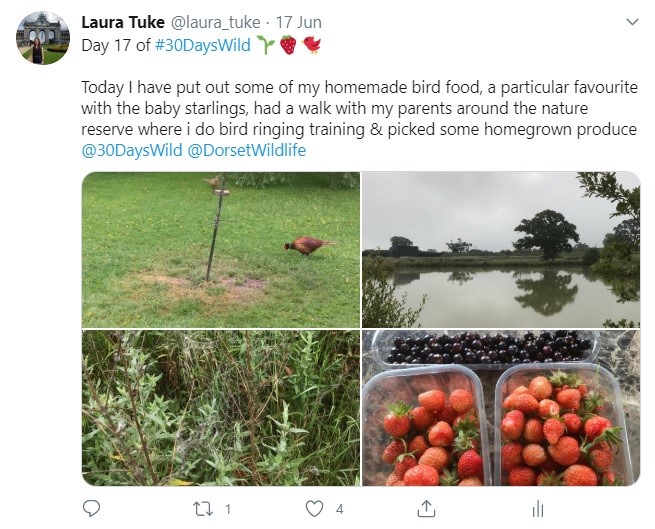
I began my day off by putting out my homemade bird food in the garden. Unfortunately it was a bit hot, and the food kept melting off its strings! It was a hit with the local fledged Starling chicks though, and eventually disappeared within 48 hours.

I also took my mum and dad to my bird ringing trainer’s private nature reserve for a a different walk. It is such a lovely place to be, and gave us all some inspiration of how we can make more homes for wildlife on our own land. To finish the day, I helped pick some of the fruit growing in my family’s garden, my favourites being the strawberries!
Day 17

Day 18 – Thursday 18th (Day off) :

People who read my blog will know that I love the woods! It’s a place I go to when I want a break from the world or just to watch the seasons change in a place where it’s at its most noticeable. So as part of my 30 Days Wild, I headed into the woods for a spot of forest bathing and a refresher. The day’s rain did not even stop me!

Day 18

Day 19 – Friday 19th (Work):

Due to my love of spring and wildlife photography, for this Friday on my blog, I uploaded a post about my favourite photos from spring 2020. It was great to reflect on my own spring and to look back on some great moments, making it easily one of my favourite posts so far this year! If you want to take a look, check out my Spring 2020: In Photos

I also headed out into my family’s land after work, to revisit a favourite camera trapping spot from this spring. Once there, I set up my camera trap again, and looked forward to seeing what I might catch this time around.

Day 19

Day 20 – Saturday 20th (Work):

After work, I signed up to the BTO’s Garden BirdWatch, which is currently free for everyone to take part, and allows me to upload what I see in my garden at home every week. I also took time out to focus on my mental health, and completed a wild guided meditation, lying on the grass in my garden. I picked this particular meditation as it incorporates taking in the sounds around you, such as the sounds of nature. It was so surreal for me to relax outside and then reopen my eyes to see lots and lots of baby starlings looking back at me!

Day 20

Day 21 – Sunday 21st (Day off):

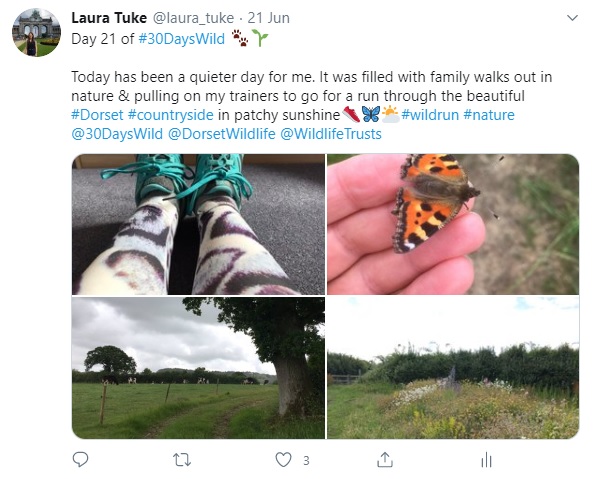
As it was Father’s Day, for my Sunday off, I got to spend lots of time with my dad. This included two walks also with my mum, where we tried to see what nature had to offer us, which included birds of prey and wonderful Skylarks. To top off an active day, I also pulled on my trainers for the first time in a couple of weeks, due to an injury, and went for a run through the countryside around my home. I just cannot get enough of being outdoors!
Day 21

Day 22 – Monday 22nd (Work):

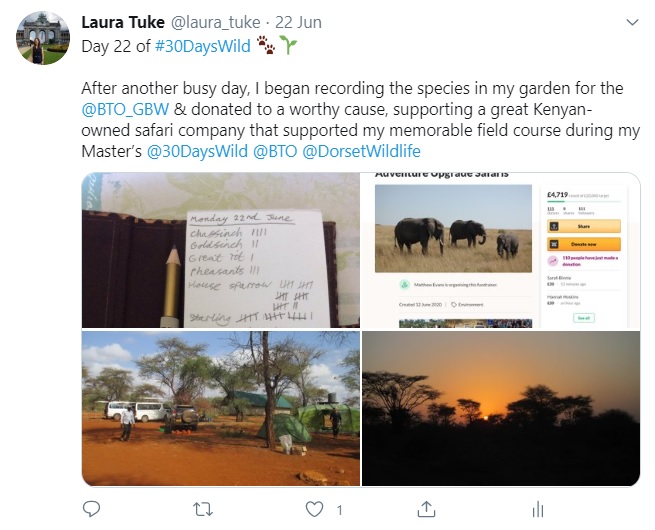
For my Monday, I completed two different Random Acts of Wildness. Firstly, I began writing down all the birds I saw in my garden during the day as part of the BTO’s Garden BirdWatch.

I then made a donation to charity. I may not have a lot of money, but at times like these I realise how lucky and fortunate I am in life. So when I saw another great cause, I had to get involved and donate!

Two years ago, during my Master’s in Conservation and Biodiversity, I got the opportunity to go on a field course to Kenya, with a lot of organisation from Adventure Upgrade Safaris. They even got me a cake for my birthday! Now without tourism, the company are struggling and without our support, they will not be able to continue for the future. They need our help to survive!
Day 22

Day 23 – Tuesday 23rd (Work):

This day was an exciting day for me! It was the day that, after work, I got to retrieve my camera trap that I had put out last Friday!

Though I had previously captured my best camera trap photo this year in this location (a fox cub), I did not know what to expect this time around. My camera trap did not disappoint though, and the photos included those of the fox cub I had previously seen, a rabbit and some really great photos of some badgers!

Day 24 – Wednesday 24th (Day off):

On a day when I really needed it, I got to spend my day off doing some things I love. My bird ringing group starts the autumn migration ringing season on the 1st of August and so to start my Wednesday, I helped with some of the preparation for the season. For example, we completed an important but often overlooked job, re-dying our mist nets with a special dye mix.

I also excitingly spent some of my day ringing Kestrel chicks and, now that I am fully licensed, helped with Barn Owl nest box checks. This led to me also getting to ring Barn Owl chicks and getting some great views of some Little Owls!

Day 24

Day 25 – Thursday 25th (Day off):

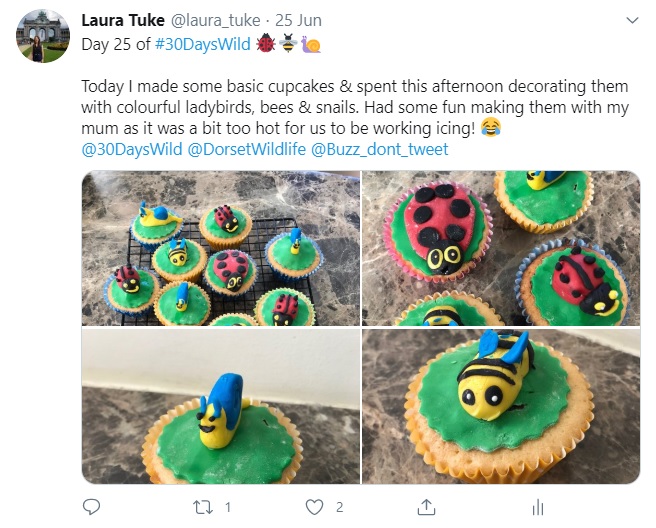
Another activity I really wanted to do during my 30 Days Wild, was to do some wild baking. I decided on making some simple vanilla cupcakes and decorating them with minibeasts in different colours.

My time spent baking was not without some drama though, as I ended up modelling icing during an afternoon of over 30 degrees heat! Despite this, I soldiered on through runny icing, with the much needed help of my mum, and had some great fun, whilst making some yummy cakes topped with interesting and colourful creatures!
Day 25

Day 26 – Friday 26th (Work):

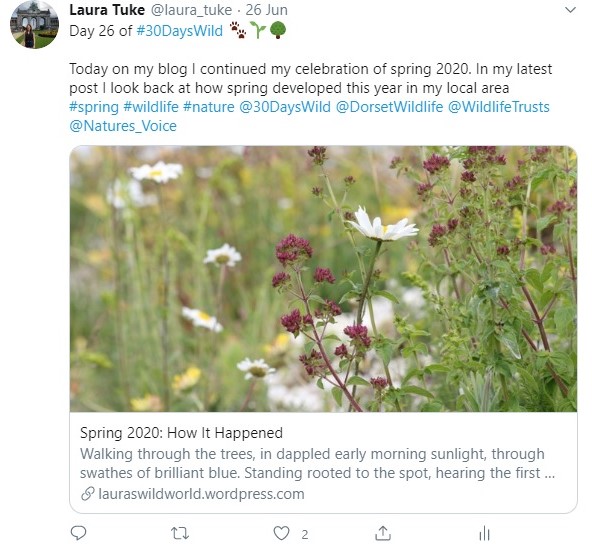
For my last Friday of 30 Days Wild, I uploaded to my blog another brand new post. This time my post followed on from last Friday’s spring upload, and focussed on how spring unfolded this year. If you want to have a read about how my extra special spring actually turned out this year, check out my Spring 2020: How It Happened.
Day 26

Day 27 – Saturday 27th (Day off):

This day was another day of relaxing in nature. This included watching and recording the birds in my garden, going for a long horse ride through the Dorset countryside, and exploring the flowers growing in my garden and on my currently ‘no mow’ lawn.

Day 27

Day 28 – Sunday 28th (Work):

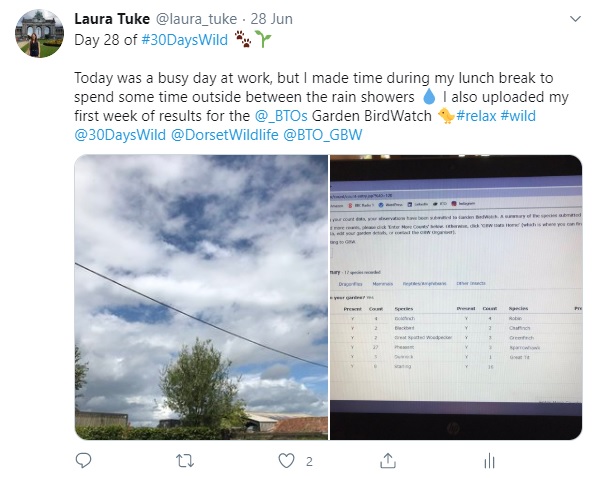
With it being especially rainy during my day at work, I made it my priority to spend my lunch break outdoors during a break in the weather. It was a much needed refresher! Also, having completed my first week of the BTO’s Garden BirdWatch yesterday, I spent my evening uploading my results to their website. It was exciting to see how the week actually went!
Day 28

Day 29 – Monday 29th (Work):

I spent this Monday rushed off of my feet at work. To keep my brain relaxed though, I came up with the plan of spending my day attempting to noticing the wildlife around me and seeing if I could find a species for each letter of the alphabet. I had a very successful day of it, alongside being very productive at work, leading to only one species missing (the letter X)!

The response to me completing this activity was absolutely amazing on Twitter. It gave me a real sense of joy to see everyone’s support, so thank you everyone!

Day 30 – Tuesday 30th (Work):

Today was the last day of June and the final day of 30 Days Wild. However much I would have liked to have finished with a bang, it would not have fit my true and busy day. Instead, today was a day of appreciating and being grateful for the natural world around me. This may be in the form of what I encountered on my travels or seen out of my window, or by taking in other people’s experiences such as through books and on twitter. I treasured them all!
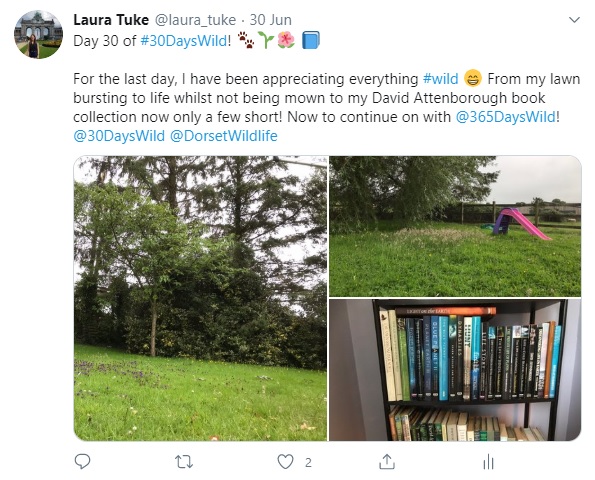
Day 30

My Highlights

This June has been a wild rollercoaster which I have absolutely loved! Spending time focussing on nature each and every day has enriched my days, relaxed me, and allowed me to connect further with the wild world around me. If I had to pick some highlights, these would include my wild alphabet becoming popular on Twitter, making wild cupcakes with my mum, expanding my knowledge of plants, ringing my first Kestrel and Barn Owl chicks, and sharing my 30 Days Wild on social media.

I have learnt and experienced so much this past month, and I am now inspired to continue making the natural world an important part of each and every day, and to share my passion with as many people as I possibly can. I hope that if you participated in this year’s challenge, that you also had a great month. Otherwise here’s to next year’s 30 Days Wild!

19_04_19_Farm_Cows_Milk_Blackthorn_3

Spring 2020: In Photos

As the world was thrown into disarray with the full force of a pandemic, our daily lives were hit by lockdown, slowing and grounding to a halt. For the natural world outside our windows though, spring was just beginning, with days warming, buds bursting, and migrants making their return. Even when our own lives were being disrupted, the natural world was carrying on.

13_06_20_Farm_Chalk_Mound_Rough_Hawkbit_Small_Tortoiseshell_Butterfly_2

For me, spring has been a real lifeline this year. With the natural world bursting with life, I was able to draw real strength from the return of the swallows, the flowering of the bluebells and the trees becoming cloaked in delicate new leaves. Every moment I could spend out in nature gave me the strength to continue as if nothing had changed, cherishing every moment for what it was. For this I am grateful, and I really appreciate that I am lucky to have the beautiful Dorset countryside right on my doorstep.

As spring begins to make its exit, I wanted to take some moments to reflect on a time that has taught me a lot, brought me some real magic through the natural world, and will be remembered for as many good memories as those eclipsed by Covid-19. To begin with, here are a selection of my favourite photos from this spring. They range from spring wonderment to heart-warming moments, that all mean something to me.

Spring 2020 in photos

1) Small Tortoiseshell Butterfly – The photo featured above was taken only last week, and reminds me of how valuable the time I spend expanding my knowledge of nature really is, including the identification of butterflies and flowers. I found this Small Tortoiseshell butterfly on a 10m long chalk mound that my parents have created for wildlife within our farmland, and it really is coming into its own this year!

16_04_20_Horseshoe_Woods_Bluebells_Spider_Dewdrop_3

2) Bluebell & Spider – When the bluebells are flowering, it has to be one of my most favourite times of the year. As the woodland floor transforms to a carpet of blue purple, I feel at my happiest and enjoy noticing new details each year, such as the spider hunting on these drooping bells.

2) 20_03_20_Farm_Goldfinch_2

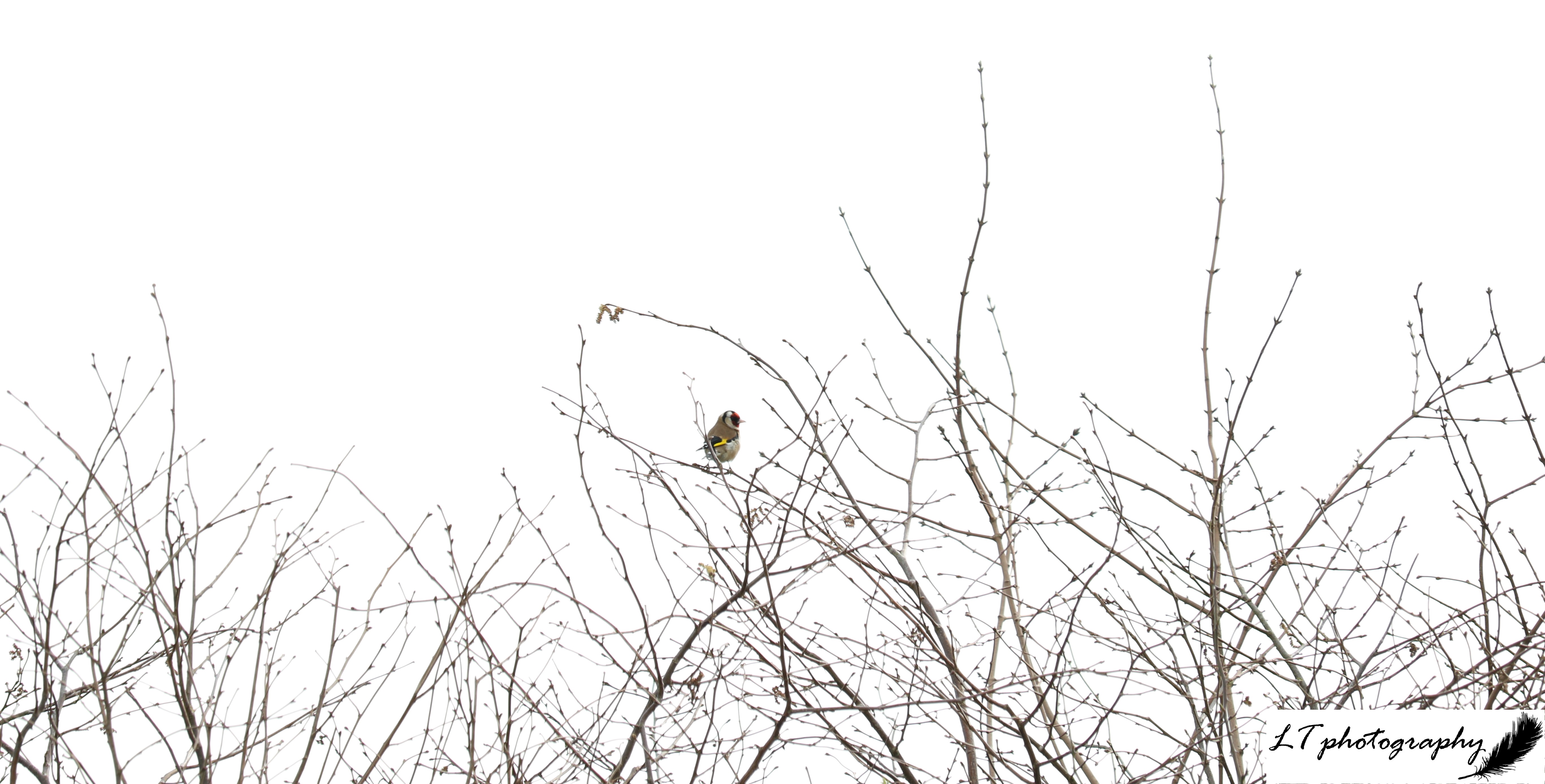
3) Goldfinch – I love the simplicity of this photo of a Goldfinch taken back in March. The bright colours of the bird vividly stand out from the swelling buds and bare twigs of the hazel in this hedgerow. It was enough to brighten a moment on a decidedly chilly spring day.

15_04_20_Farm_Flowers_Stitchwort_3

4) Stitchwort – Every flower is unique and different in its own way. With Greater Stitchwort, every flower stands out like a small white star, carpeting verges, hedgerows and woodlands alike.

07_05_20_Farm_Dandelion_Seeds_4

5) Dandelion Seeds – Now as an adult I still hold on to the child-like curiosity that a dandelion invokes. With hundreds of parachuting seeds waiting to fly, this dandelion creates a beautiful fluffy silhouette in the spring sunshine.

20_03_20_Farm_Lleyn_Lamb_3

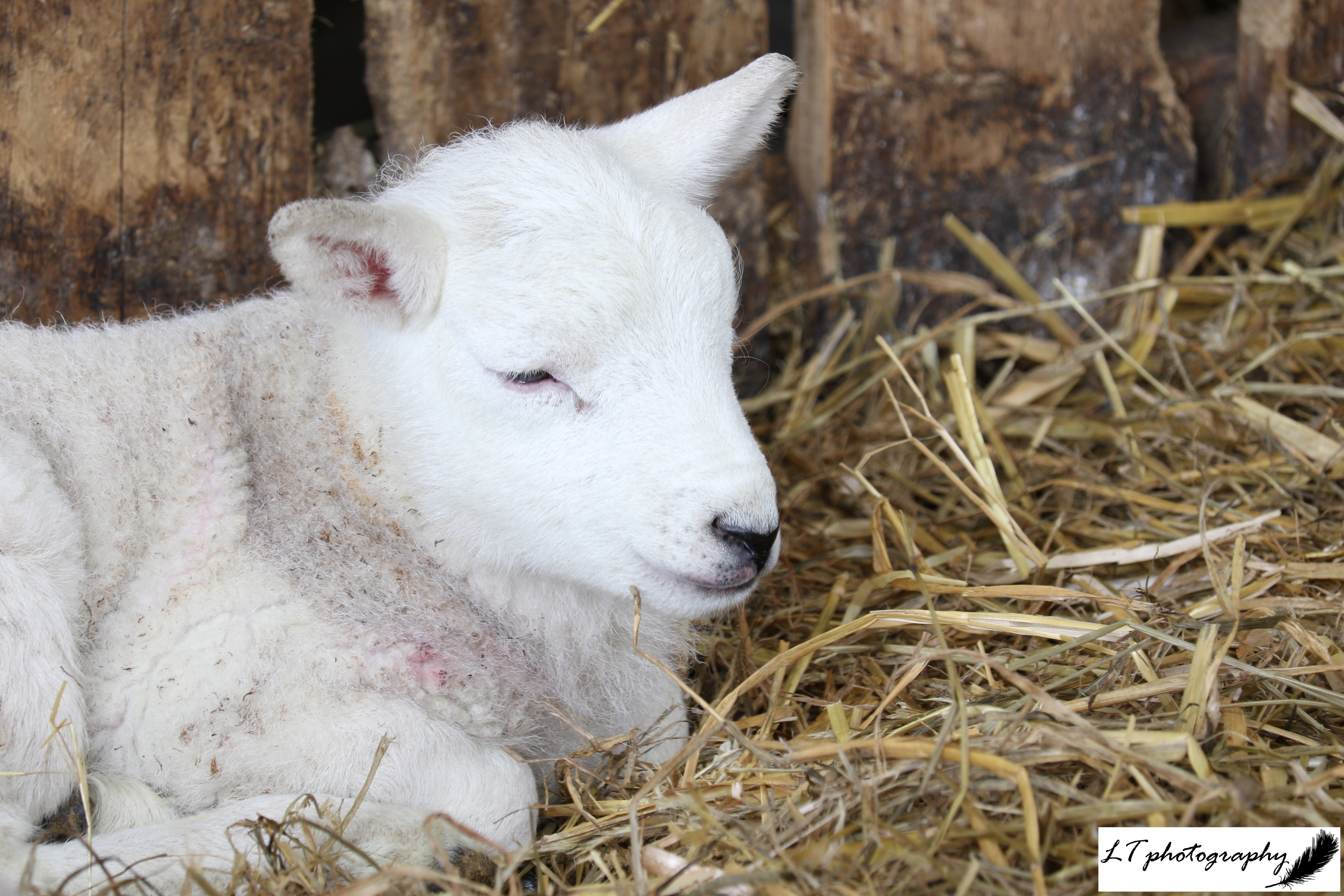
6) Lleyn Lamb – This photo is as it seems, a photo of a sleepy newborn lamb, born earlier this year. I am proud to say that I come from a farming background in the heart of Dorset. It has been this that has provided me with a spectacular backdrop to learn about the natural world around me, given me the knowledge and experiences to be able to make informed decisions about how I live my life, and given me an understanding of the important relationship between the environment and modern agriculture.

07_05_20_Farm_Wild_Garlic_Insect_3

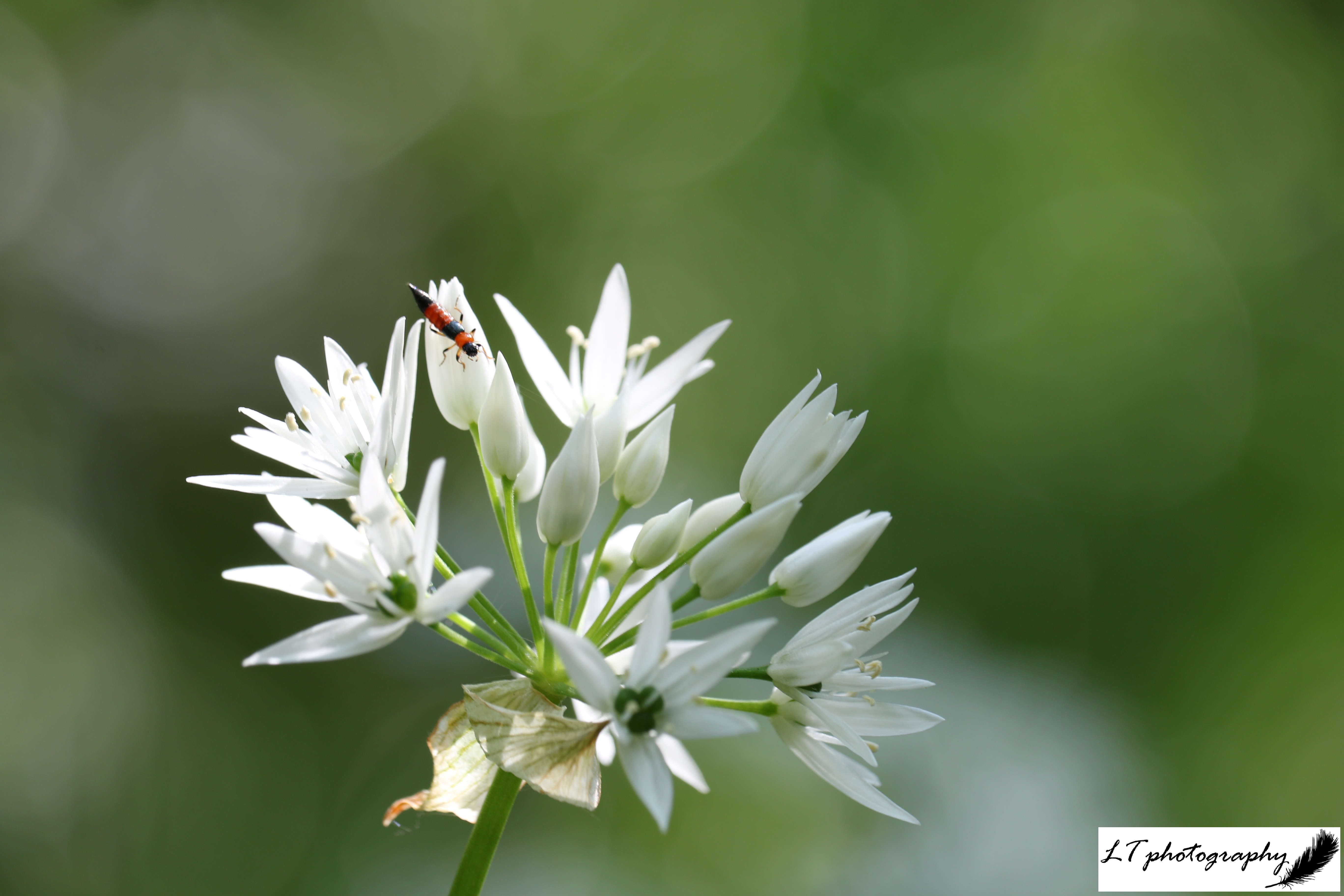
7) Wild Garlic & Insect – I love to notice the details in nature and get down to the level of the ‘small things’. This may be noticing the curl of an unfurling fern, the patterns on the petals of a tiny flower, or the jewel-like colours of an insect exploring a cluster of star-shaped wild garlic flowers.

13_05_20_Farm_Sunrise_Hangings_Gate

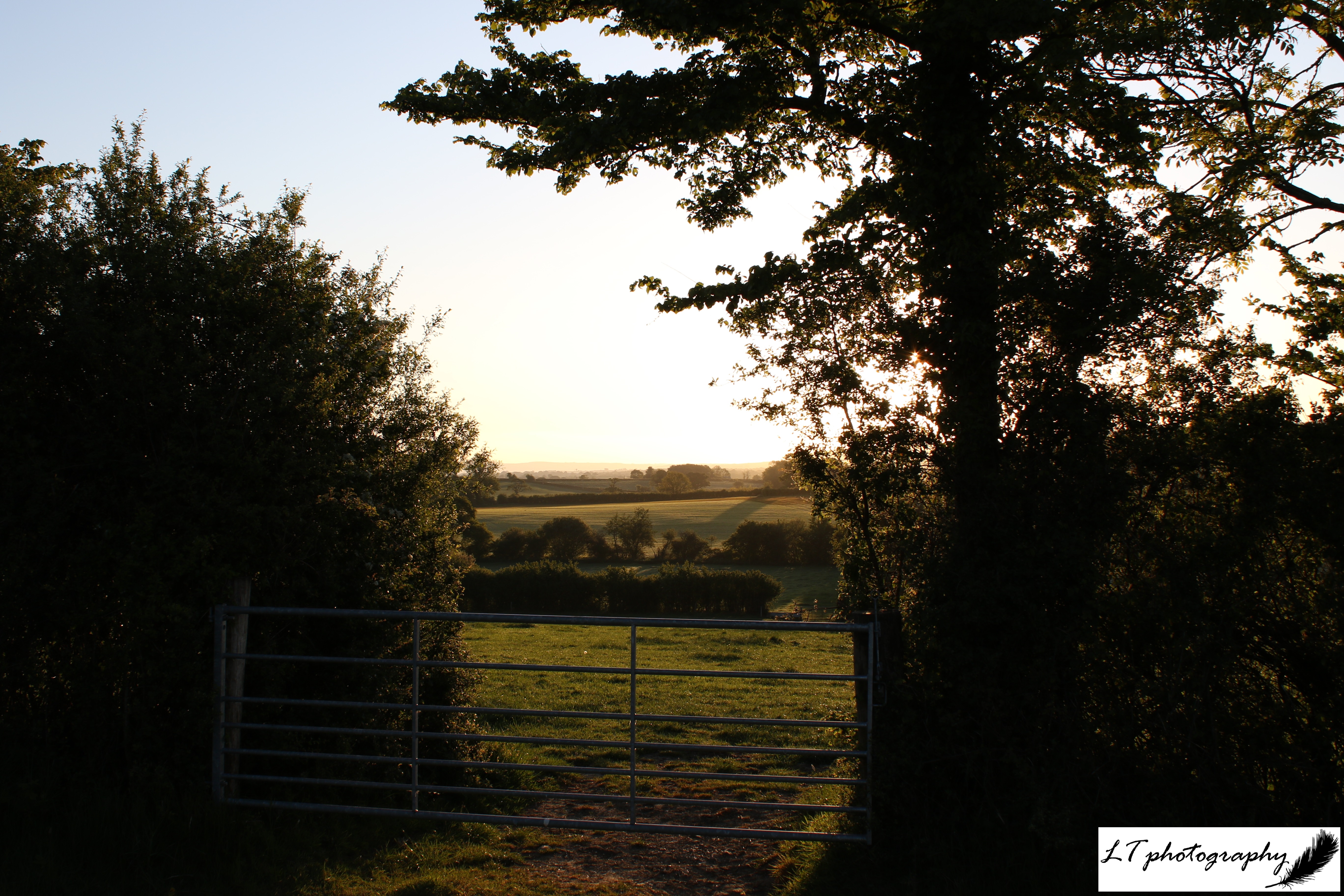
8) Sunrise – One of the best times of day has usually come and gone by the time most people have woken up in the morning. A sunrise is a golden time though to get out, listen to the birds singing and watch as the world wakes up around you. There is nothing like it!

07_05_20_Farm_Rabbit_Baby_Black_6

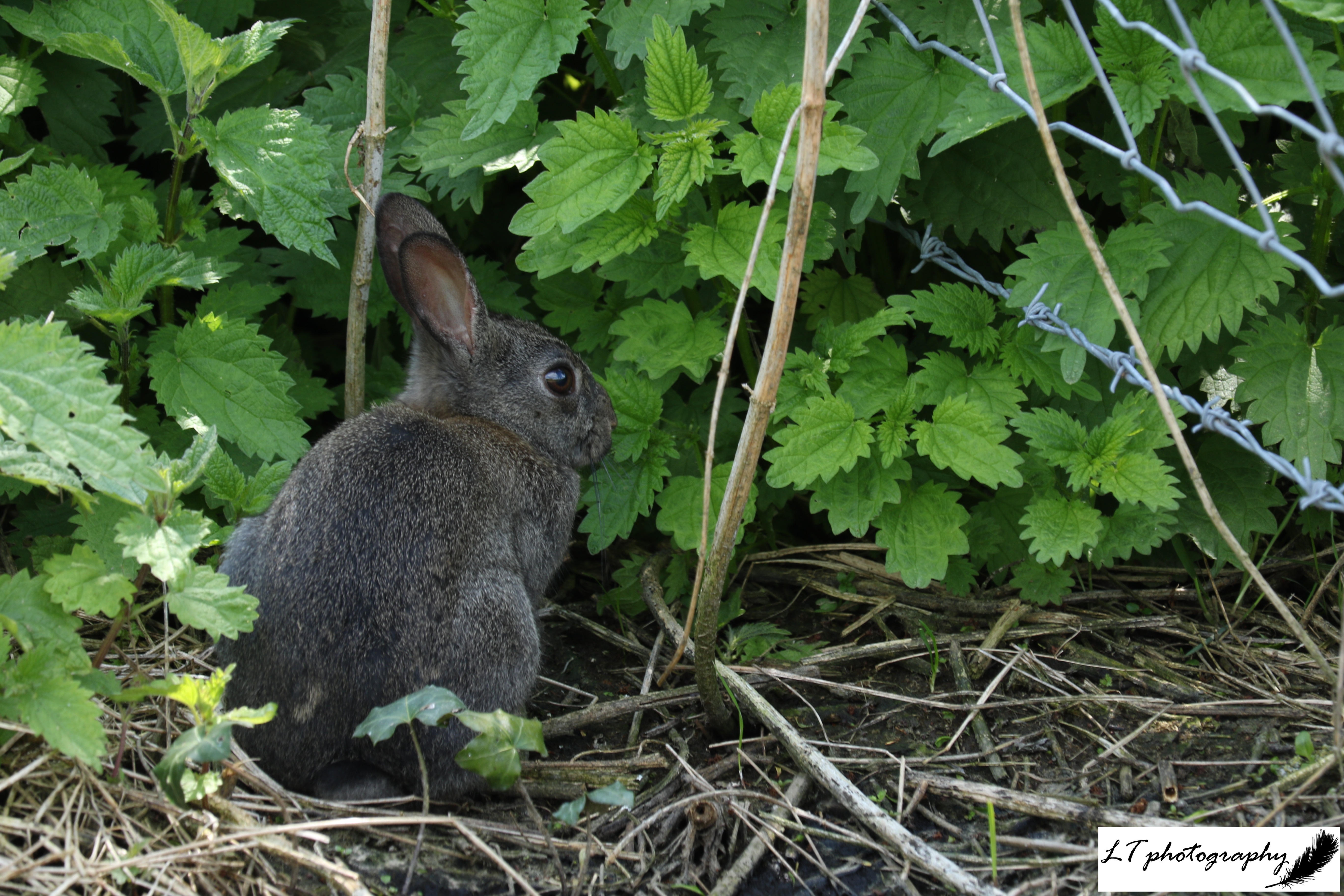
9) Dark Rabbit – One of my more unusual sightings this year has to be this rabbit, that has notably darker fur compared to the usual European rabbit. It was small in size, and though showing wild instincts, it was slightly less fearful of us humans. Everyday it could be found sunning itself in a small open area within vegetation situated behind our farm buildings.

8) 16_04_20_Horseshoe_Woods_Flower_Moschatel_8

10) Moschatel – Every year I try and learn one new species of flowering plant that can be found in our woodlands and surrounding countryside. This year it was the turn of Moschatel. An often overlooked flower due to its greenish colour, Moschatel is also known as Townhall Clock, due to its flowers having 5 faces that make it look like a cube or townhall clock in shape.

15_04_20_Farm_Bird_Chiffchaff

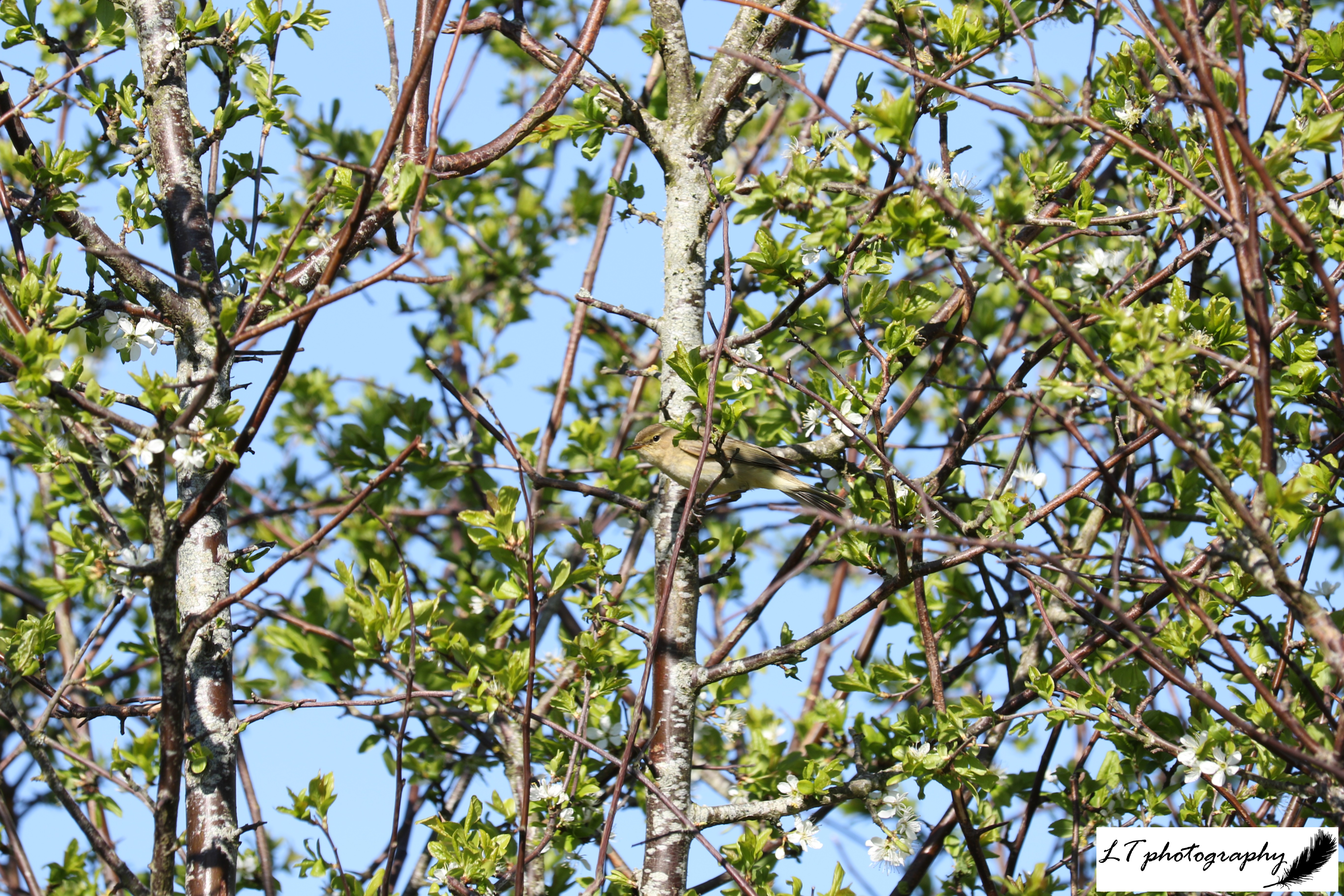
11) Chiffchaff – One of my highlights of spring every year is the return of the Chiffchaff. When I hear this bird sing for the first time each year, I feel like spring has truly arrived, so I am particularly saddened when their singing finally falls silent as autumn grips the landscape.

15_04_20_Farm_Badger_Alley_Feather

12) Feather – This photo is a good example of the beauty of detail. It is simple, but a spot of light highlights the real elegance of this contour feather, now left to lay amongst the vegetation.

15_04_20_Farm_Beef_Cows_Dream

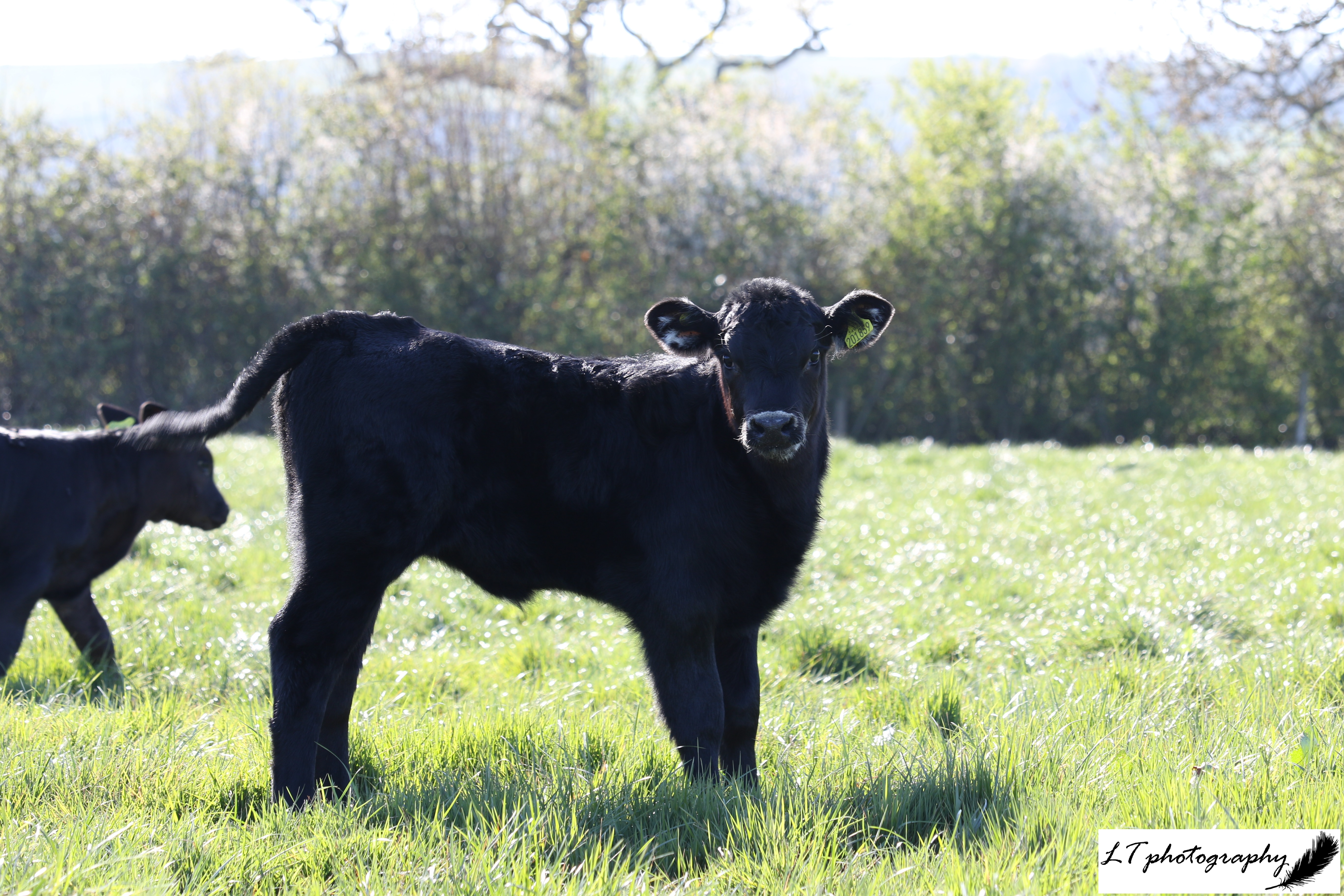
13) Aberdeen Angus Calf – This inquisitive and interestingly marked calf is another photo that connects with my farming roots. Spring is synonymous with new life, from on the farm to the wider countryside, and this little one was just one of many, precious and to be celebrated.

07_05_20_Farm_Hart's-Tongue_Fern_Spider

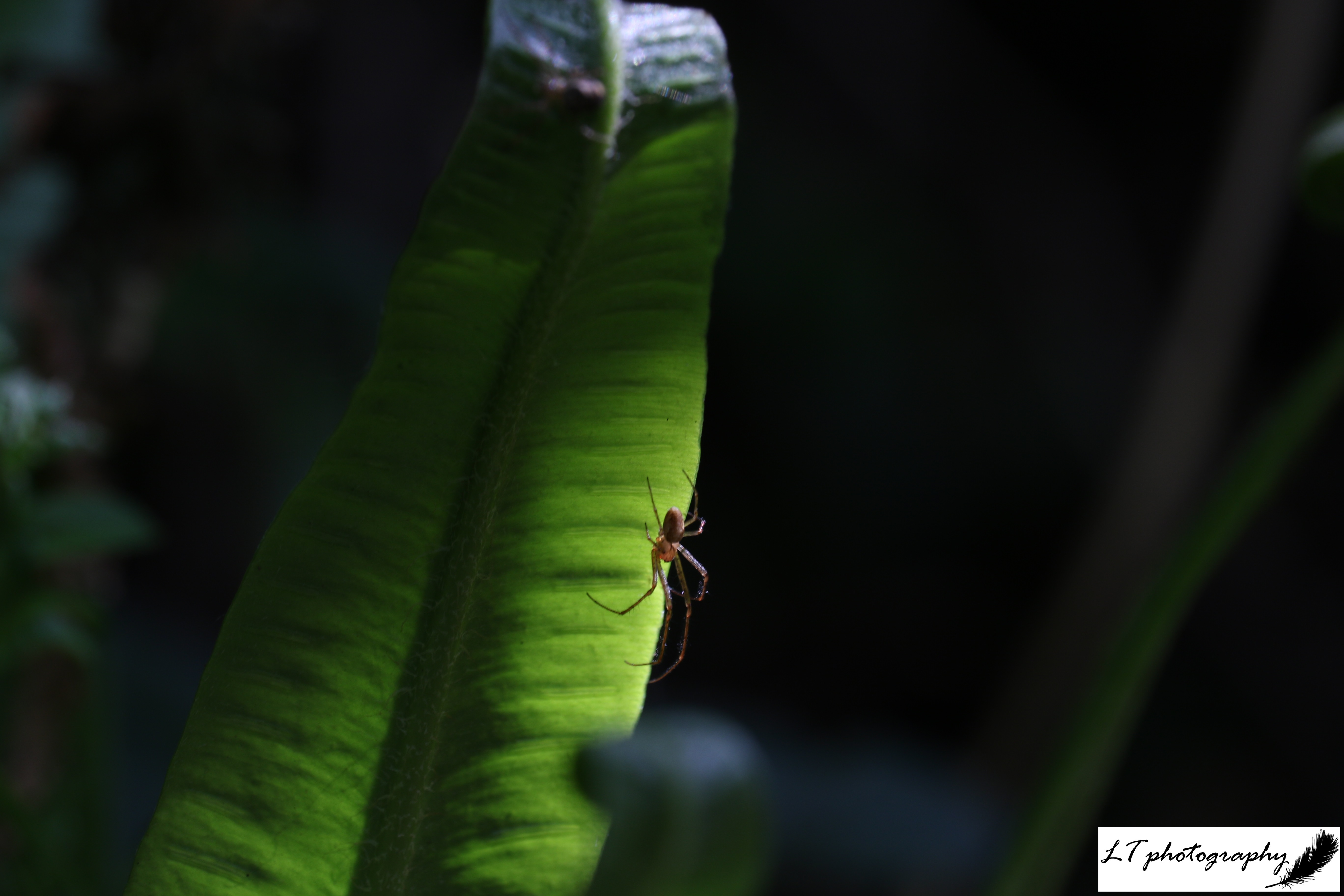
14) Spider & Hart’s-Tongue Fern – Some days I walk along in my own world and the wildlife around me merges into one. Other days the world becomes bigger though and I see every detail pop out at me, such as with this spider making its home on a Hart’s-Tongue fern.

M2E54L167-167R388B312

15) Fox Cub – As people who follow my blog or social media will already know, this spring I have had fun yet again using my camera trap on my family’s land. This has to be one of my favourite photos from this year! It was a totally unexpected surprise when this fox cub turned up on my camera trap.

13_06_20_Farm_Chalk_Barn_Owl_Pellet_Tree_Bank_Vole

16) Vole Bones – With the return of breeding barn owls to my family’s farm, I had some fun one afternoon dissecting the pellets left by these owls. It is definitely a very rewarding feeling when you are then able to identify the species the bones you find come from. Here I believe this mandible to be from a bank vole.

IMG-1149

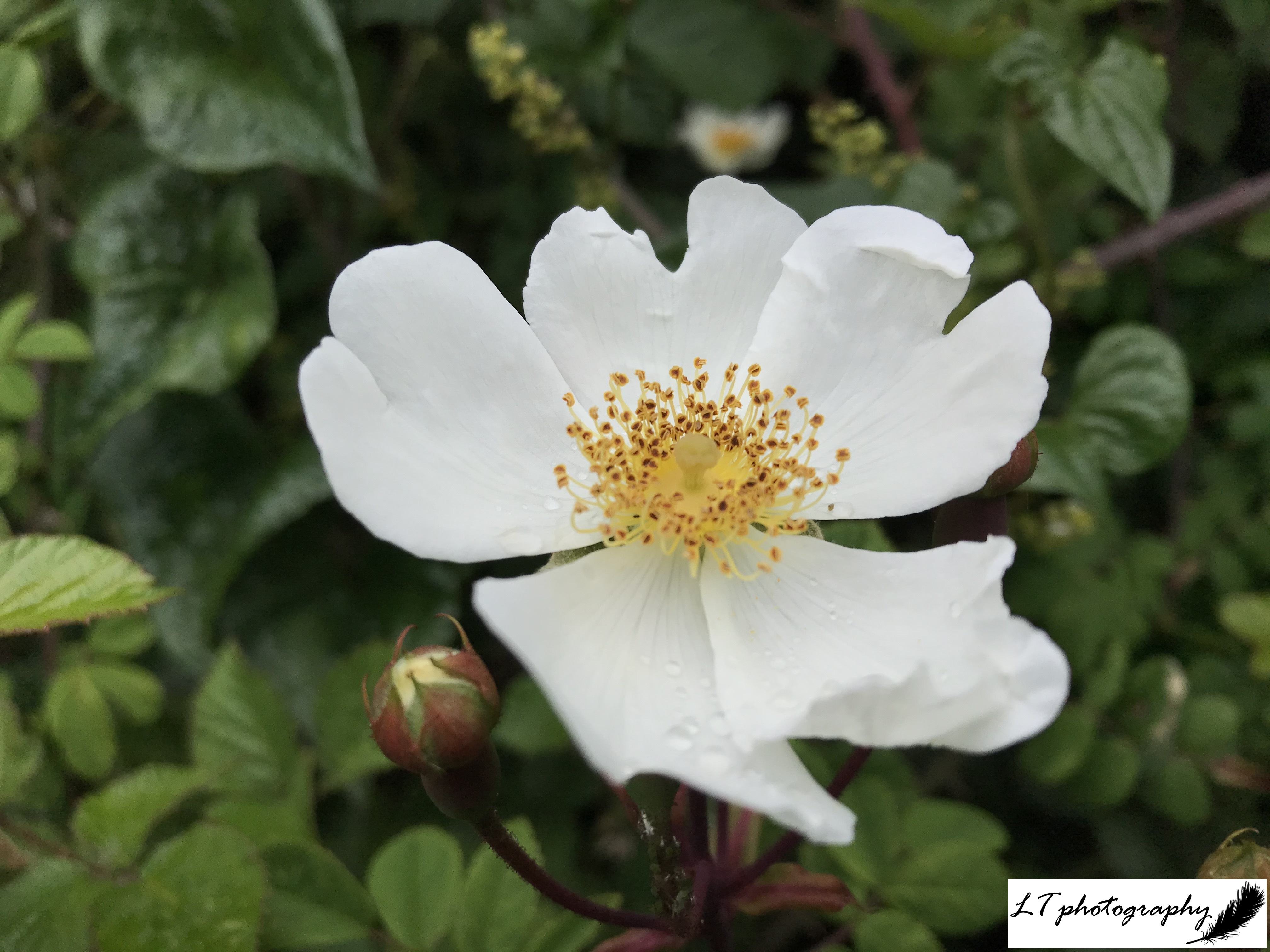
17) Field Rose – I have always loved taking photos of flowers and capturing their small details. Here a field rose, you can clearly see the reproductive organs from the stamens to the stigma.

How to…Use and Make the Most of a Camera Trap

There is nothing like the exhilaration of camera trapping. Setting up the camera trap/trail camera in a golden location, waiting with anticipation for the camera check day, and riding a rollercoaster when capturing something totally unexpected. Camera trapping is one highly addictive activity!

M2E31L53-53R392B293

So why is camera trapping so popular? Well, camera traps allow us to non-invasively open up a normally unseen world. This is a thrilling thing to be able to do, giving us the addictive ability to observe wildlife up close and personal without disturbance. In this way, camera traps can be used as an important tool to identify the presence or absence of species, monitor animal populations and record interesting behaviour.

M2E1L0-13R350B300

At home on my family’s farm, I use my camera trap to carry out surveys across our land, to find out what wildlife is present, how abundant these species are, and to experience new life in spring in all its glory. However you choose to use your camera trap, I can only say for you to have lots of fun and adventures whilst doing it!

M2E45L145-145R394B315

Buying a camera trap

So where do you start if you do not already own a camera trap? Well all off-the-shelf camera traps have similar components and operate on the same principles: a digital camera connected to an infrared sensor that “sees” warm moving objects. Camera traps typically range from £30 to £1000, meaning there is a lot of choice out there. To find the camera trap that is right for you though, you should consider these key questions:

  • How much are you willing to spend?
  • What are you going to be wanting to use it for?
  • Where are you going to be using it?
  • Do you want to use it during the daytime, night-time (black and white or colour) or both?
  • Do you want to take photos, videos or both?
  • Will you want increased capabilities, such as wireless, geo-tagging or higher detection capabilities?

The camera trap I use is a simple Bushnell model that I bought many years ago now for about £120.

How to use a camera trap to get the best from it

Camera traps have a lot of potential as they can remain operational 24/7 and can be left in the field for long periods of time. To increase your chance of camera trap success though, you need to set it up properly to maximise animal detection. Here are some handy tips to get you started:

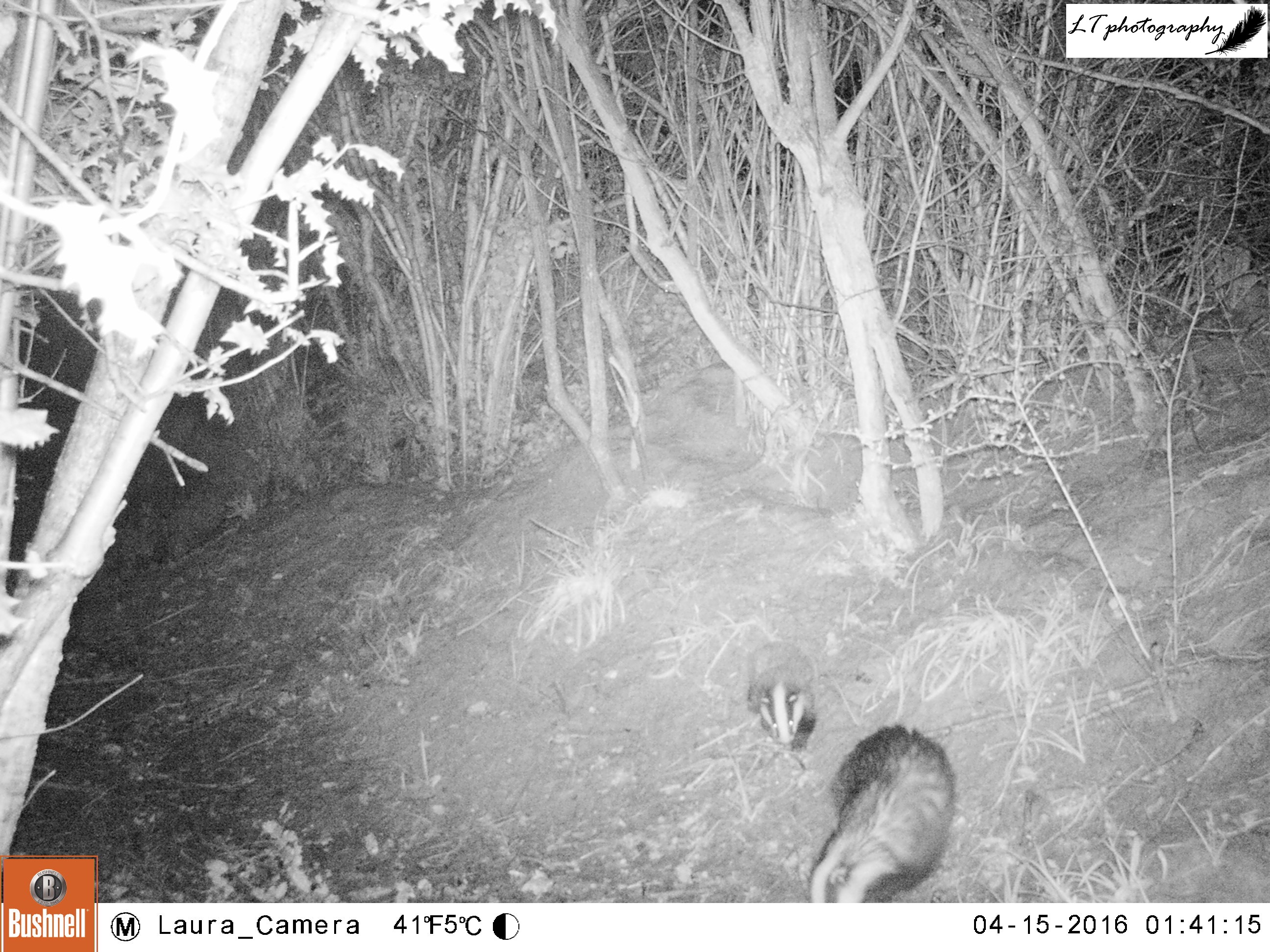
  1. Visit your chosen site before setting up your camera trap to make sure it is the best site possible.16_04_20_Farm_Badger_Alley_5
  2. Do not forget to make sure your camera has another battery life and SD card room each time you set it up.
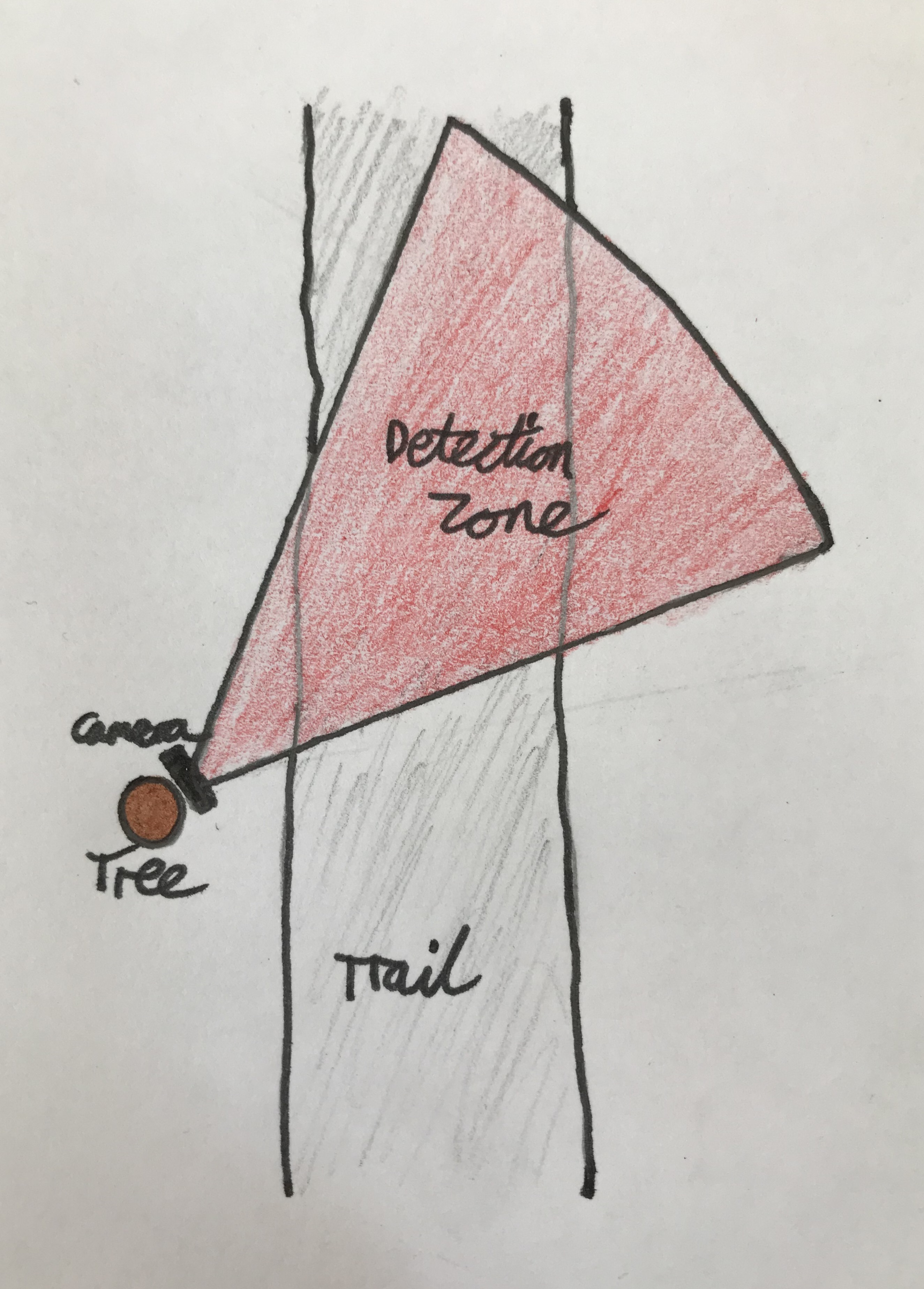
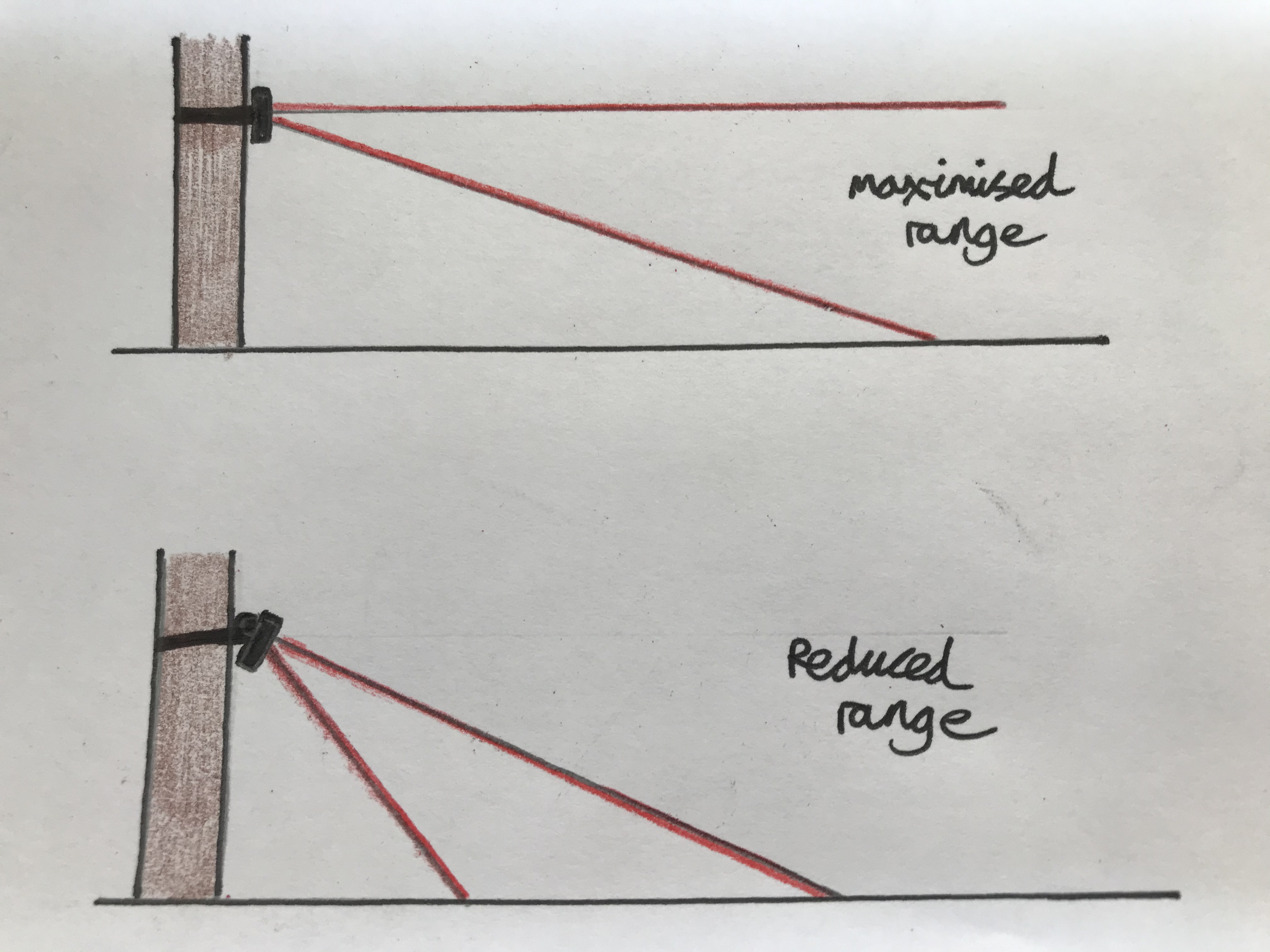
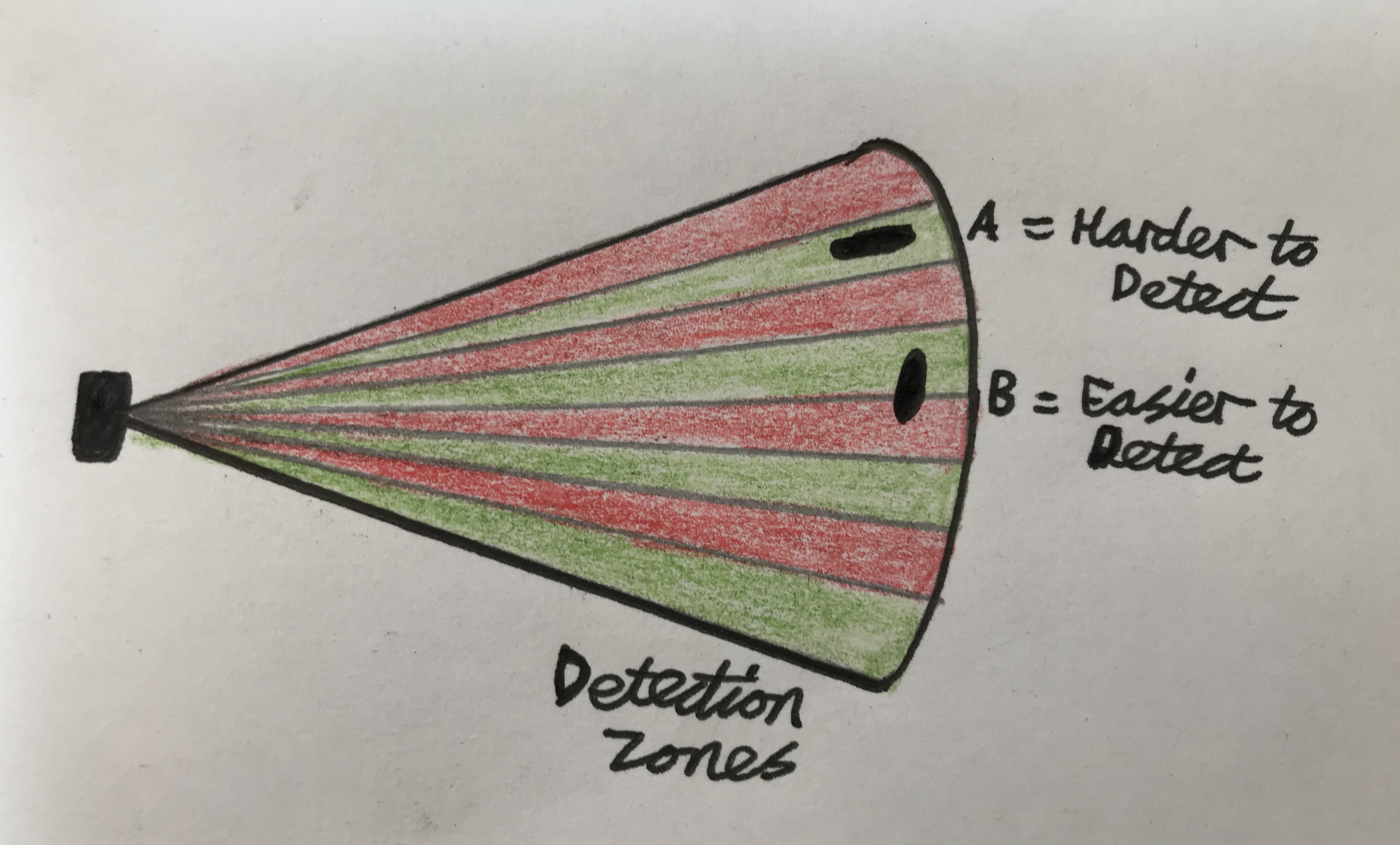
  3. Carefully select where to mount your camera trap, such as a sturdy tree or post, to make sure your camera will be supported and  positioned to take in your chosen field of view.Detection zone
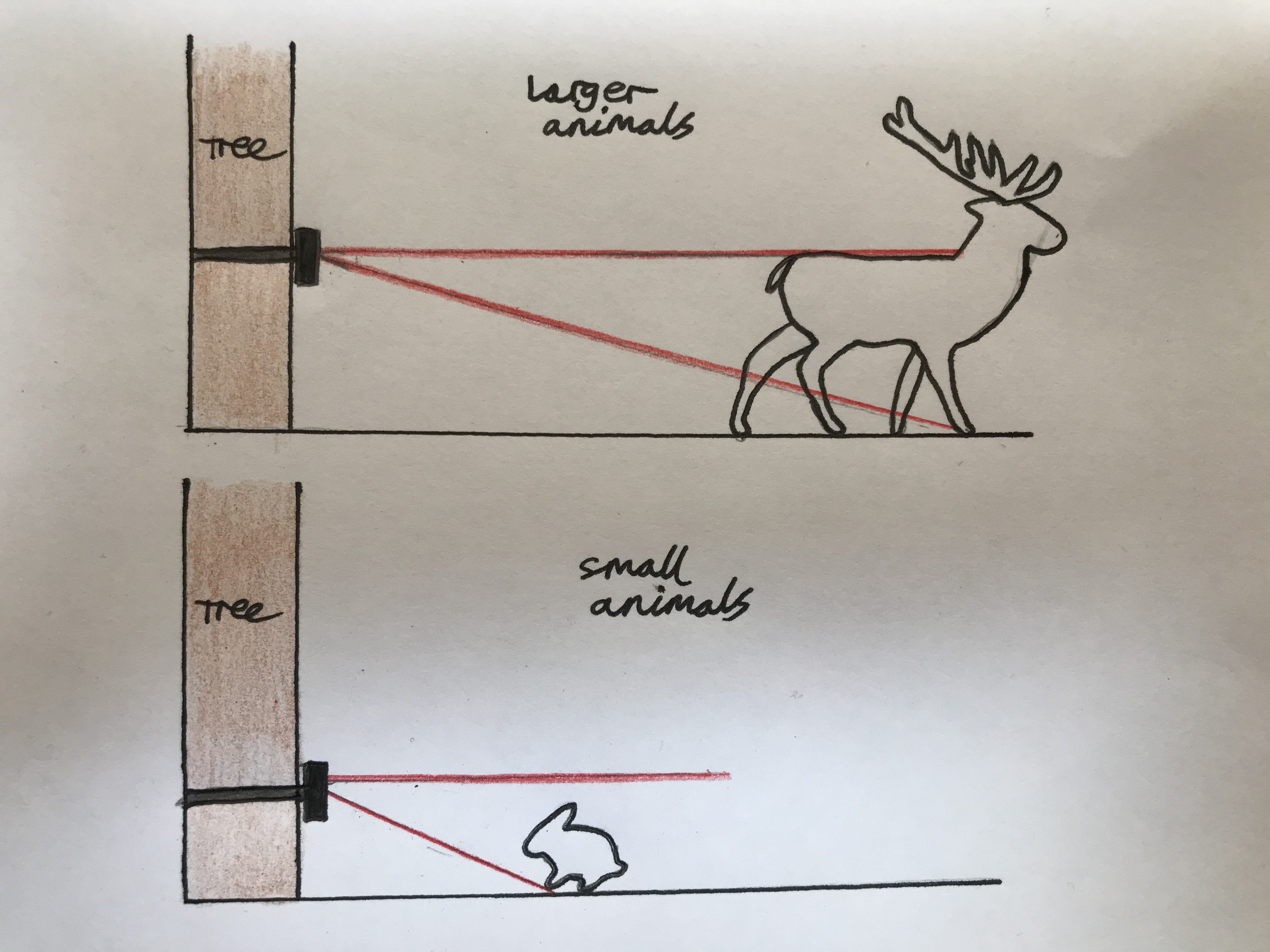
  4. Consider the height of the animal(s) you are trying to capture to increase detection and inclusion in the frame. For the best result, position your camera trap so it sits just below the target’s shoulder height.Camera Height
  5. Camera angle is as important as height when positioning the camera trap. For best result and to increase the detection range, you want the camera trap to aim horizontally at the subject. A stick is a great way to get a better angle for your camera. Camera angle
  6. Think about where you want the animal to be positioned in the frame. Larger animals are easier to detect so will be detected at longer ranges compared to smaller ones, and animals walking across the camera trap’s field of view will be more easily detected compared to walking towards it.Animal Position
  7. Try to reduce the number of false triggers by trimming back vegetation that could trigger the camera if moving in the wind. Do not remove enough to disturb your intended subjects though!
  8. And always do your research! The more you know about a site or species, the more likely you will get results.

Inspiration for camera trap sites and uses

Over the few years I have owned my own camera trap, I have used it for a number of different purposes and in a variety of locations. Here are some examples of my own work to help inspire you:

  • Abroad – In 2017, I was lucky enough to spend 2 weeks in Costa Rica on a field course for my Bachelor’s degree, and so I decided to take my camera trap along with me. This allowed me to get some cool sightings of some interesting wildlife

M2E43L24-32R350B300

  • Badger setts – A popular choice for a camera trap site is at a badger sett. With 3 established badger setts on my family’s land, I have previously had all sorts of interesting results by observing setts in this way. In particular, it has always been great to see how different species cohabit such locations.

M2E40L17-25R350B300

M2E54L167-167R388B312

M2E54L172-172R388B317

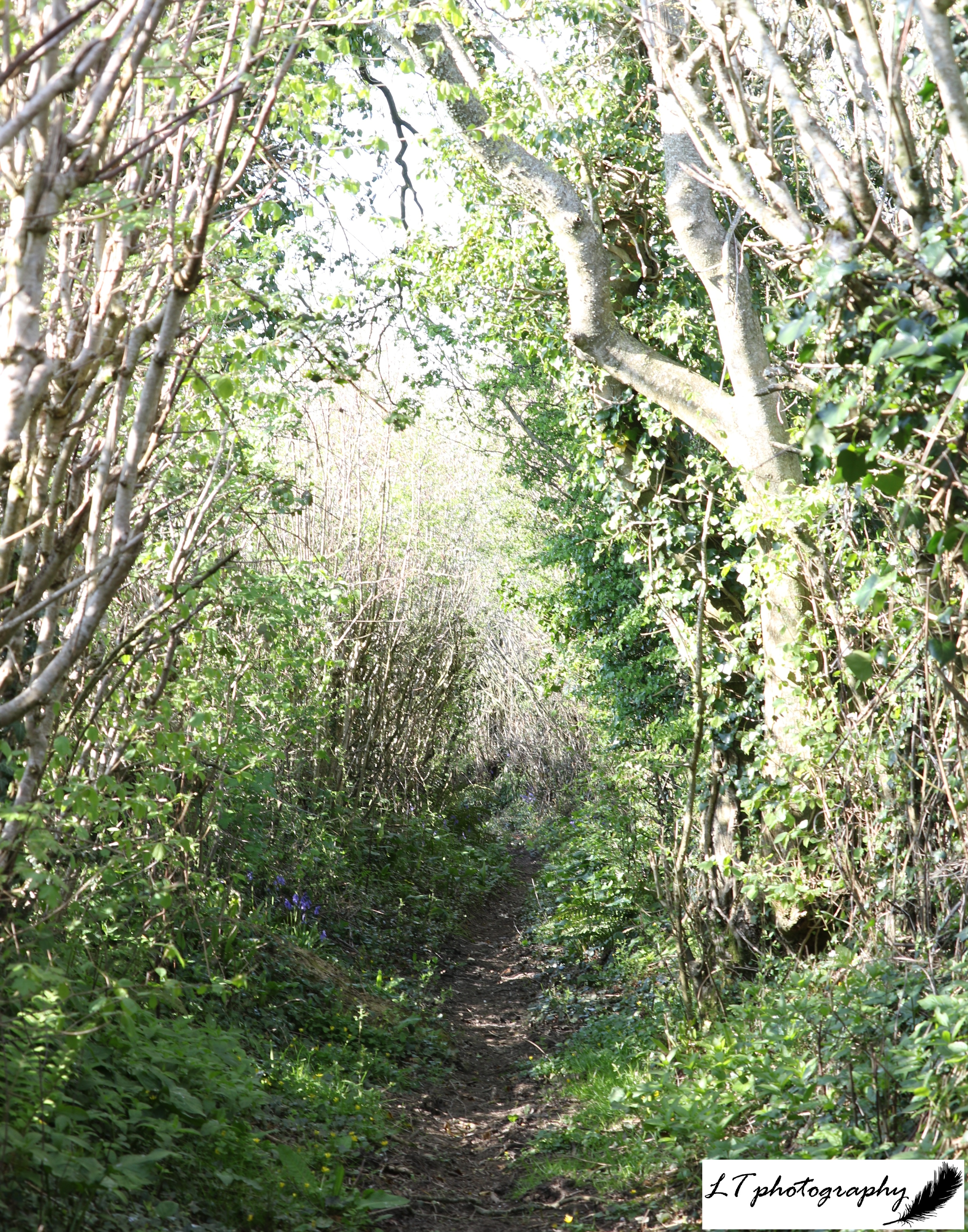
  • Paths – A great place I have found to put my camera trap is on an enclosed footpath on our land. This is because the path, fondly known as Badger Alley, is bordered either side by hedges, is in the vicinity of used and disused badger setts, and is frequently used by wildlife but infrequently by humans. Always be aware of how safe a camera trap may be on footpaths though!

M2E43L126-126R396B311

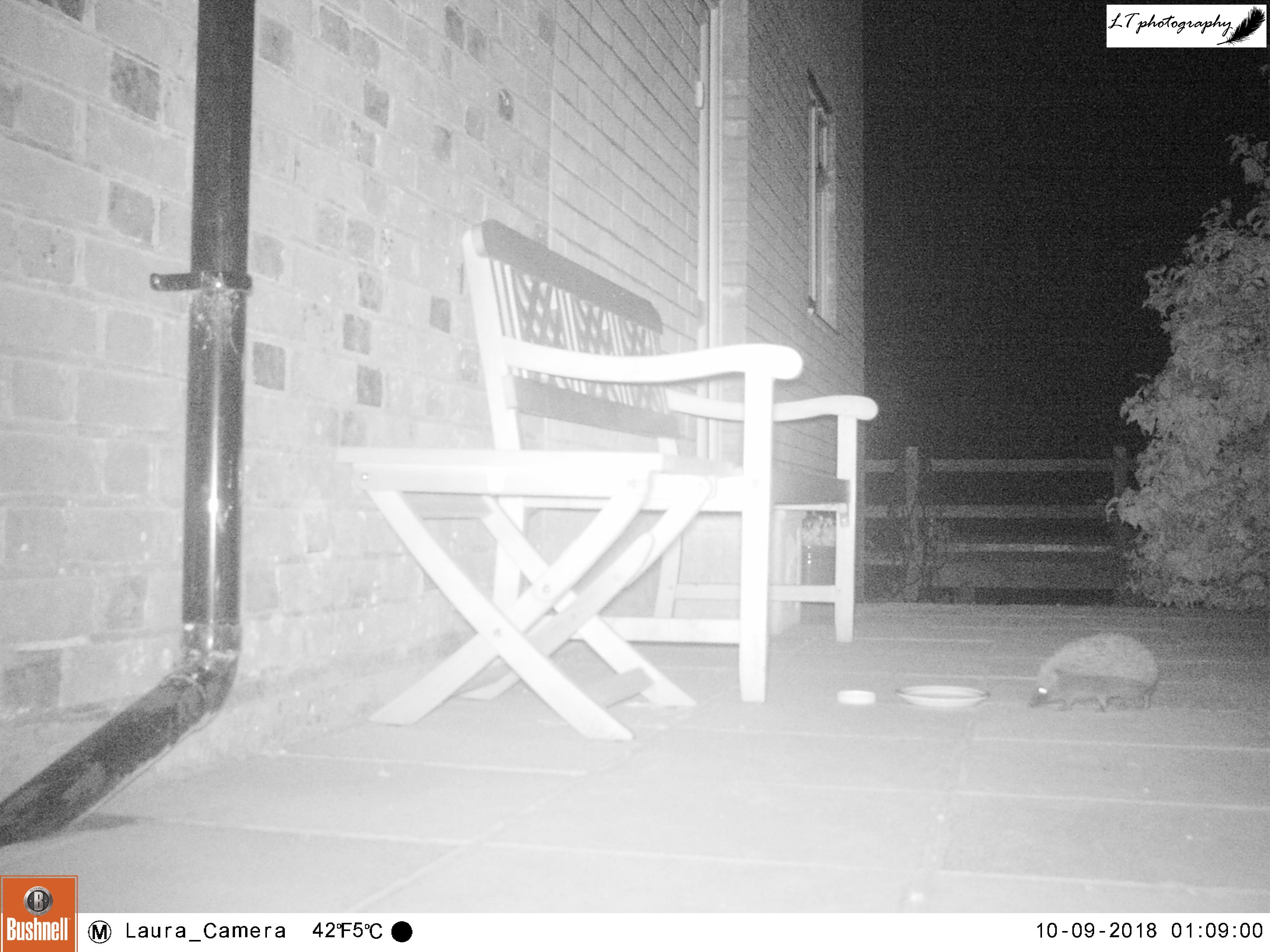
Garden – One of my all time favourite projects I used my camera trap for, was to get photos of our own special garden visitor in October 2018. I love getting to see the wildlife that is truly on our doorstep!

M2E1L0-8R350B300

  • Woodland – I have previously found that a woodland can be an interesting place to capture wildlife. The result can often be unexpected or interesting, with less of an idea of what might turn up.

M2E51L160-159R390B314

Animal trail – Another great way to try and capture the wildlife that is in your local area is to find and set up your camera trap on a well used animal trail. It is interesting to find out what animals are actually making those tracks!

Specific animals – Often when camera trapping, you want to capture a specific animal, which leads to research and setting up the camera trap in a position where this animal has been sighted. Relating to this, my other favourite camera trap project has been to capture fox cubs above ground and to observe their behaviour. This has resulted in many cute photos over the years!

M2E31L60-60R392B300

Now it’s your turn! Even if you do not own/want to own a camera trap, there are always ways around it, for example why don’t you see if you can borrow one from somewhere or someone.

Though camera trapping does not always go to plan, the results can be truly satisfying. Time to see what you can find!

For more camera trap action, check out my blog post from last year called: Spring Countryside Camera Trap Surveys

Spring Countryside Camera Trap Surveys

M2E43L126-126R396B311

A few years ago, my passion for wildlife led me to save up to buy a Bushnell Trophy camera trap, to be able to explore the wildlife that can be found in my local area. Since then I have embarked on many adventures and had many hours of fun with it, as it allows you to get an amazing undisturbed insight into the lives of more elusive wildlife.

If you are unsure what a camera trap is, it is a digital camera connected to a sensor that is activated/triggered when movement is detected in front of it. It then takes one or a series of photos, a video of select length or a hybrid of the two, that are recorded on to a memory card for later viewing. They are easy to use and can be left out in the elements for long periods of time. My camera trap was a great investment and has now given me years of pleasure at home and further afield, such as in Costa Rica.

This year, as I have been even more inspired by the coming spring, I decided to spend 10 weeks across the season (21st March to 26th May), completing camera trap surveys on my family’s land, which is set in the beautiful Dorset countryside.

For my surveys, over the 10 weeks, I chose a total of 5 camera locations which were used for varying periods of time. These locations I fondly named: copse cam, sett cam, woodland cam, alley cam and fox cam. I left the camera in each location for between 14 to 42 hours across 1-2 nights depending on my intentions at the time. Now spring has seemed to have come to an end, it is now the time for me to take a look back at a fun, exploratory 10 weeks and reflect on some of the wildlife I got the pleasure of recording.

Copse cam

March 2019

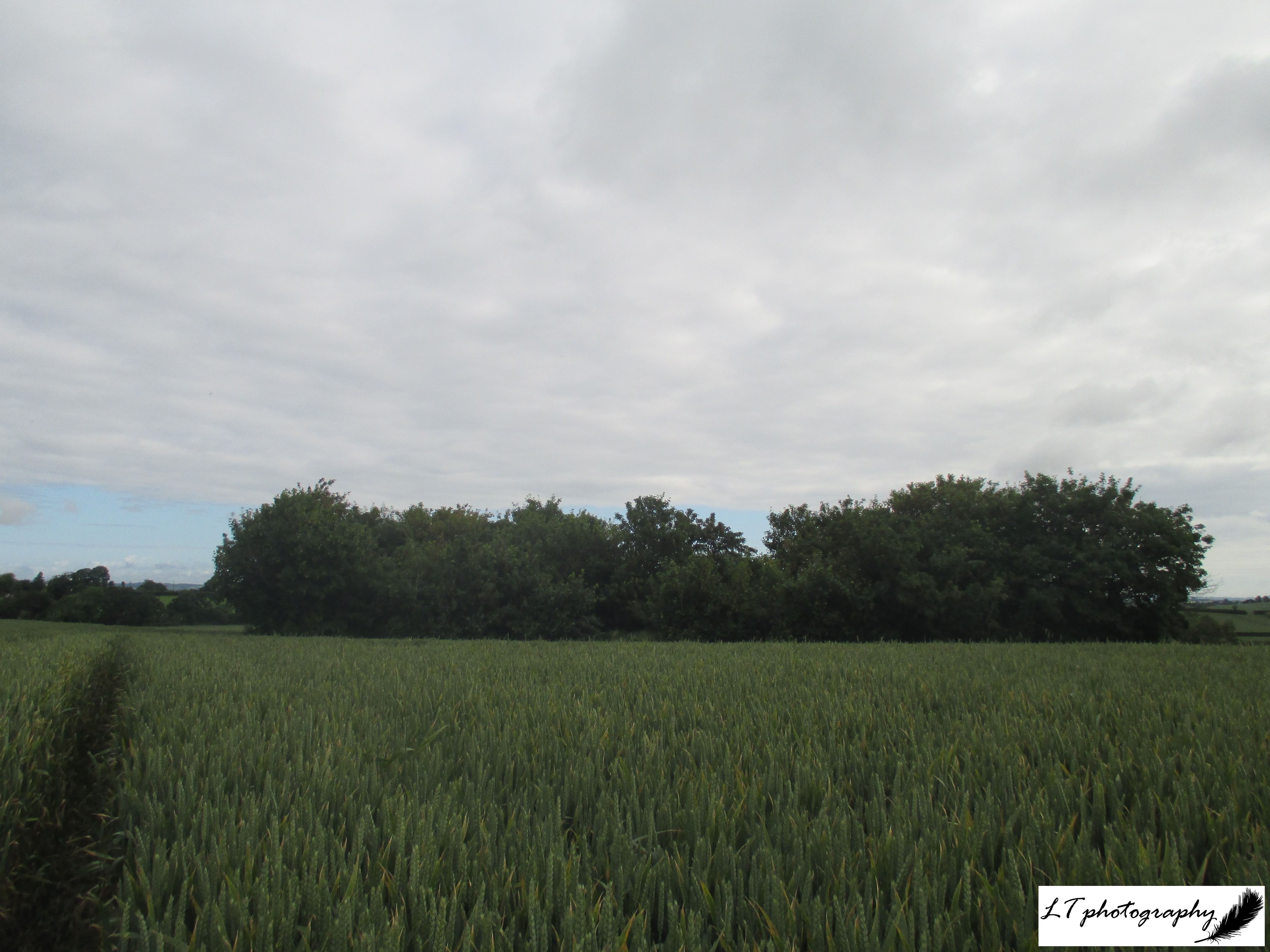
For my first camera location, I chose a small copse situated in a dip within a wheat field that has borders including hedges, trees, a river and a large badger sett. The copse shows signs of use from rabbits and species passing through. The camera was attached to the same tree each time at the centre of the copse, and was either pointed to the west or east to try and capture an idea of activity within the whole area. This location was used for 6 weeks (till 26th April) before the wheat became too long around the copse.

Copse from outside

Over the 6 weeks I used this location, 1 week the camera was not set due to bad weather, and another 2 weeks the camera was not triggered at all. Across the 3 weeks that had some success, 5 species were recorded (all singular individuals) that were:

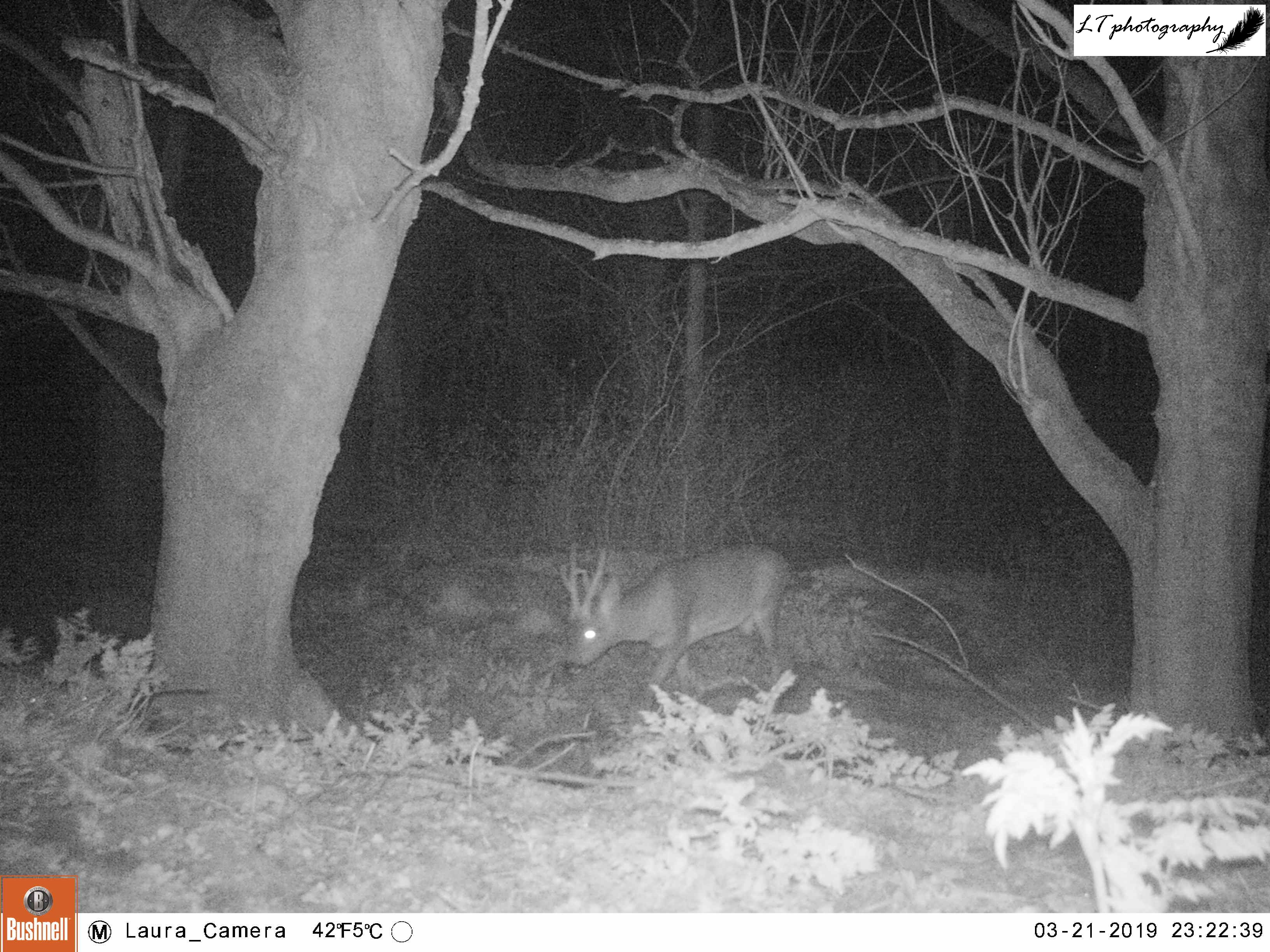
  • Male and female roe deer

Male roe deer

  • Badger

Badger

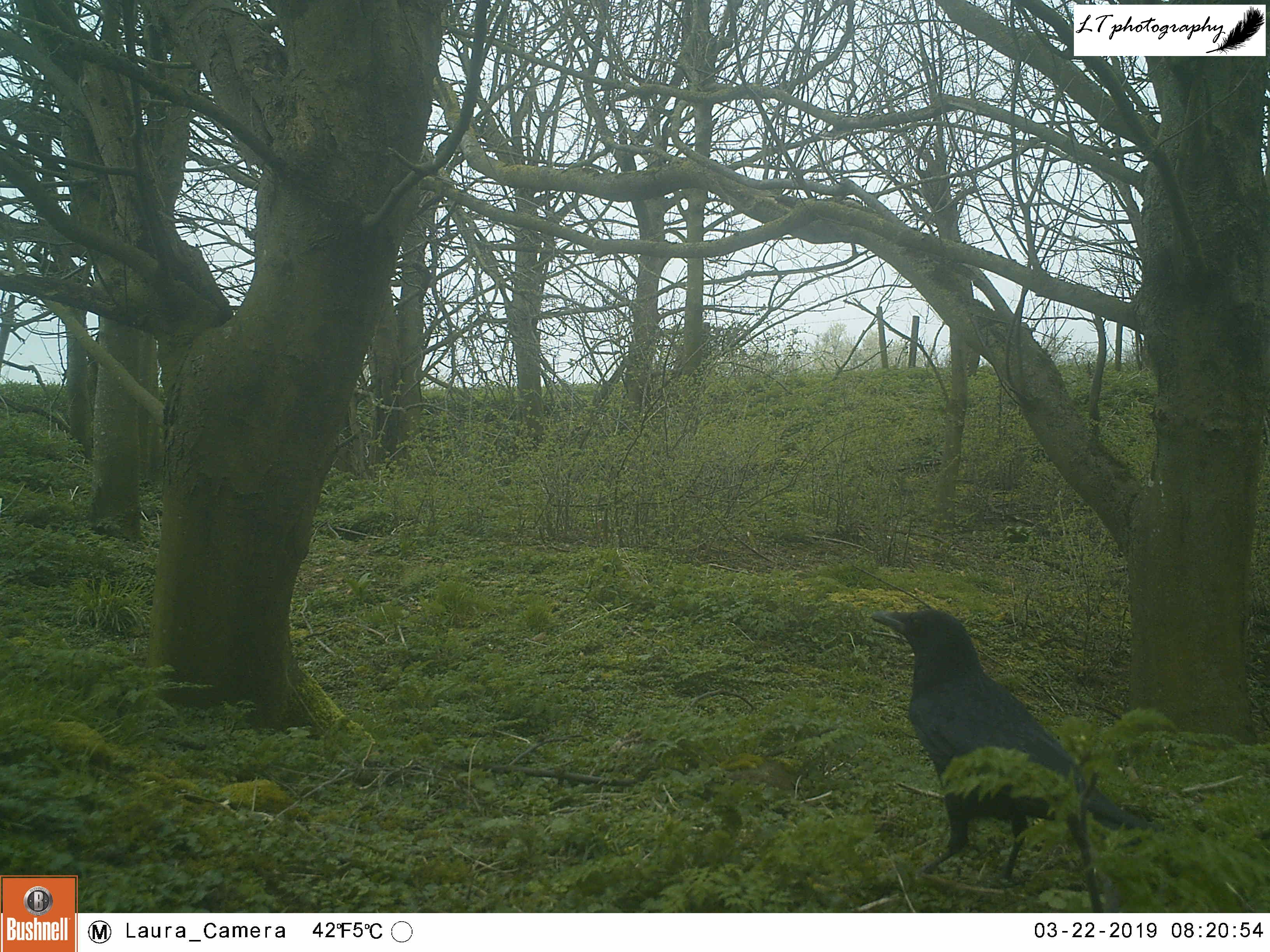
  • Carrion crow

Carrion crow

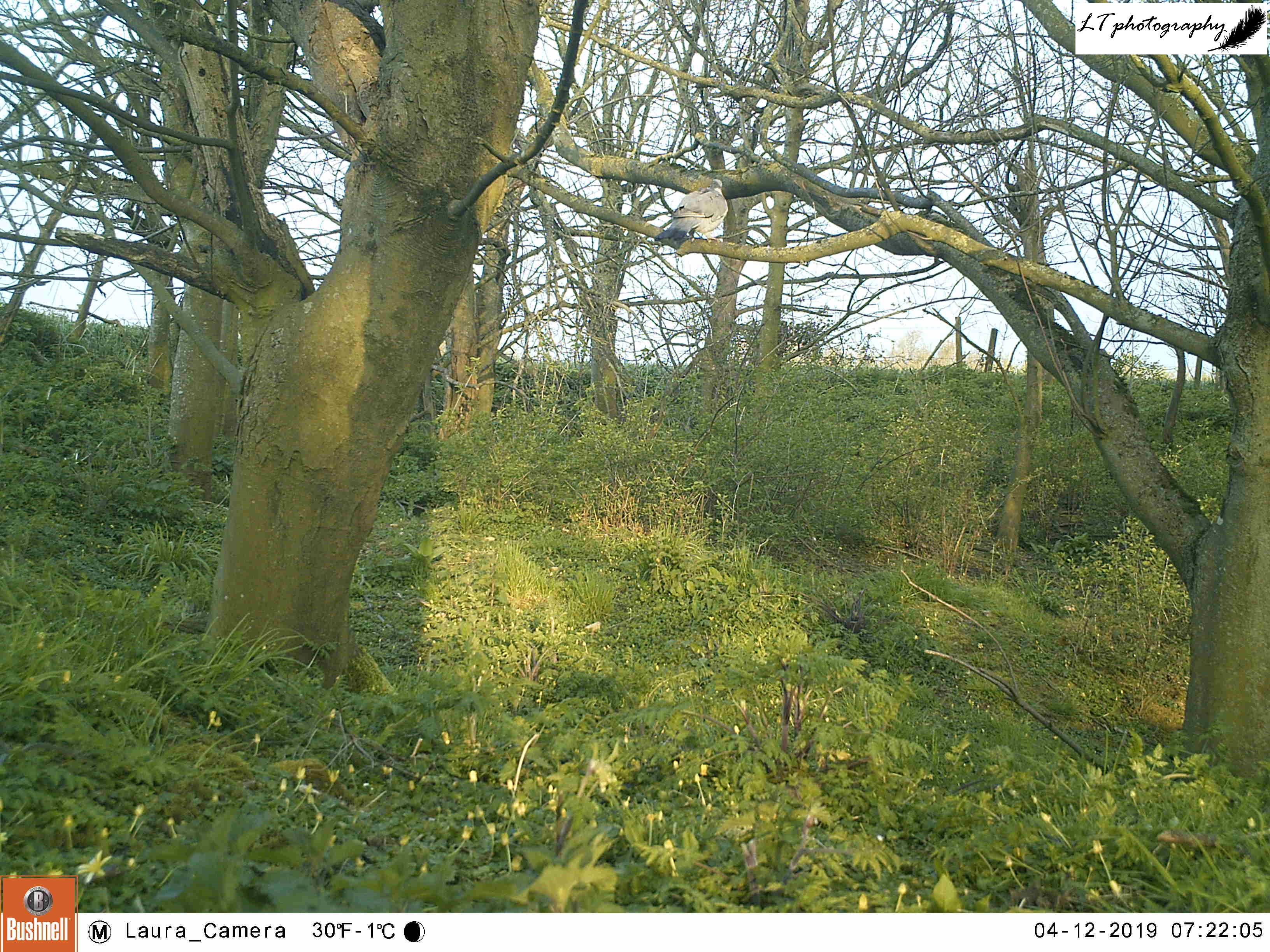
  • Woodpigeon

Woodpigeon

  • Red-legged partridge

Red-legged partridge

A range of animal behaviour was seen on the copse cam, including foraging, resting and fleeing behaviour. Unfortunately due to the growing wheat increasingly isolating the copse, the number of camera triggers, and thus survey success, dropped by 80% over the 3 weeks wildlife was seen. Despite this, I did enjoy the wildlife the camera did capture, as it gave an idea of the wildlife passing through this spot at the beginning of spring.

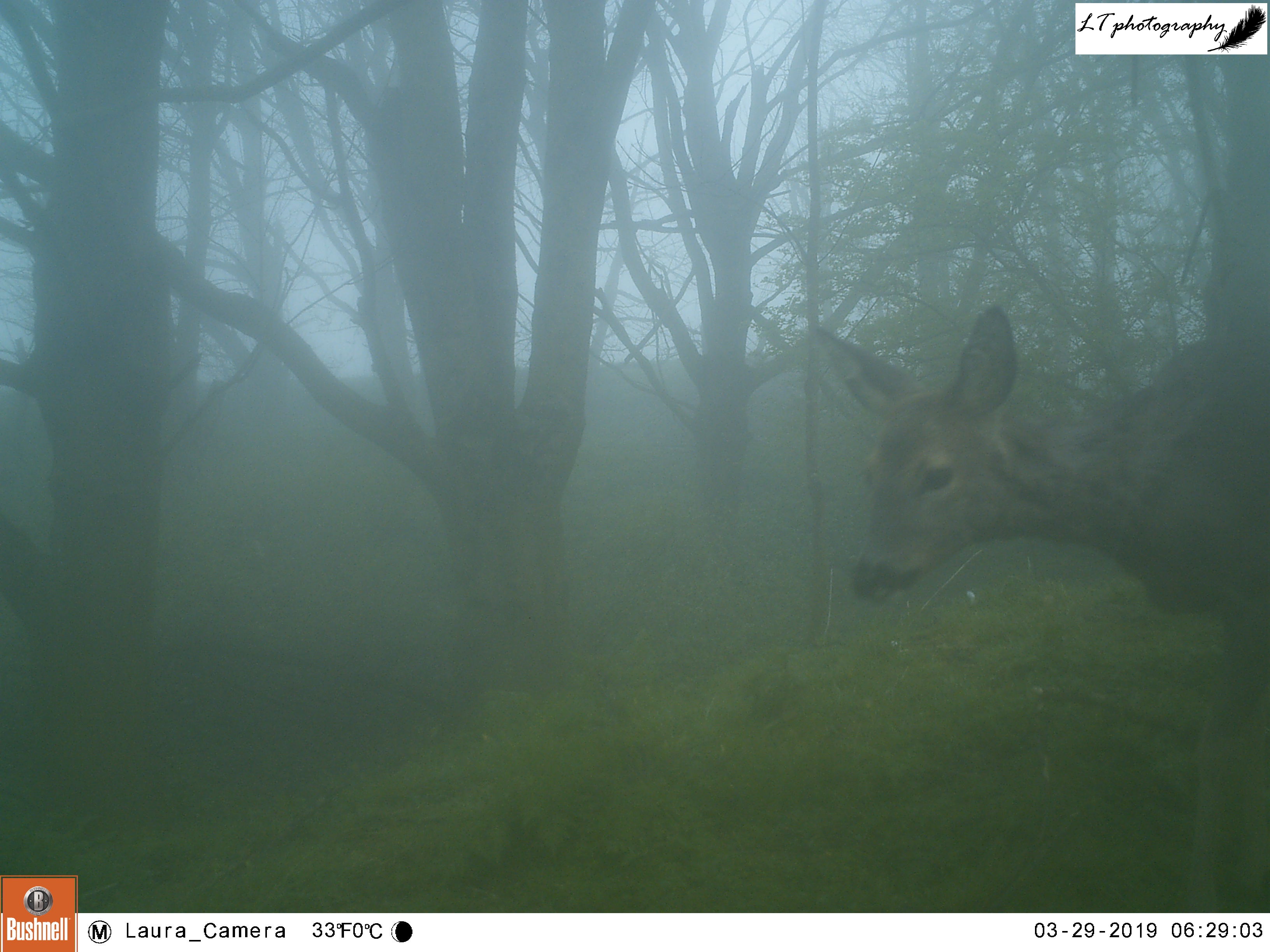
Favourite photo: an up-close and personal shot of a female roe deer. Other photos captured show that this particular female was possibly pregnant during my surveys.

Doe-eyed (female roe deer in the mist)

Sett cam

For my second camera location, I chose a large fenced off badger sett towards the east of my family’s land. The sett is on the border of agricultural grassland backed by a hedge made up of traditionally known hedge species, including blackthorn and hawthorn. The camera was attached to one of two fence posts spaced approximately a metre apart and facing into the main area of the sett in various directions. This location was used for 5 weeks (till 19th April) until the vegetation within the sett area grew to a height that obscured the view of the camera trap.

Sett in daytime

Over the 5 weeks, one week the camera was not set due to bad weather, leaving 4 weeks in which this location was used. In this time the species seen were (all singular individuals):

  • Badger

Badger

  • Fox

Fox

  • Pheasant

Male pheasant

  • Rook

Rook

The number of times the camera trap was triggered was random in relation to length of time set and survey week. Behaviours recorded included foraging and fleeing behaviour. Again, though this camera location was only used for a few weeks, it was great to see the wildlife there, in particular finally seeing badgers actively living in this sett.

Favourite photo: Though the subject of this shot is less noticeable, I love seeing in this photo the shape of a fox disappearing off along the hedge and field line in the background.

Cunning fox

Woodland cam

For my third location, I chose a small area of secondary woodland not far from my house, bordered on its edges by a private lane, meadows and more woodland. The woodland consists of wild cherry trees and predominantly oak trees. For the entire period of 10 weeks, the camera trap was moved between different trees and aimed in different directions to cover a variety of areas within the woodland.

Over the 10 weeks, the lives of 4 common species within this woodland were recorded. These were:

  • Badger (1-2 individuals in a photo)

2 badgers

  • Fox

  • Rabbit (included alongside a pheasant in a couple of shots)

Rabbit

  • Pheasant (1-2 individuals in a photo)

The number of times the camera trap was triggered was random in relation to length of time set and survey week. What is interesting though, is that foxes were seen passing through the wood over the first 5 weeks (March into April), but not in the last 5 (April into May). This differs to what was seen for badgers, where compared to the first few weeks, badgers were seen mainly in the last 4 weeks (May) and in increasing numbers, which would correspond with breeding stage and foraging tactics. It was great to see the badgers in this way.

Favourite photo: My favourite photo has to be from when I increasingly caught sight of the badgers in the woodland, as it filled me with excitement every time I saw these photos.

Badgered

Alley cam

For my fourth location, following week 6 (27th April), I chose one of my favourite sites on my family’s land, fondly known as Badger Alley. I refer to a 1-3m wide, rarely used bridle/footpath that is enclosed overhead by the tall hedges growing on either side (creating a tunnel effect). Along this path, an active badger sett and a deserted sett can be found, which are shared by other species, such as rabbits and foxes. The path is also rich along its length with a variety of plant species. In the end, I chose to position my camera trap to be able to take in part of the active sett as well as the path along side it to see what I could see.

Alley cam

Over the 5 weeks from 27th April to 25th May, the camera trap recorded a total of 6 different species, which were:

  • Roe deer

Female roe deer

  • Fox

  • Badger (1-3 individuals in a photo)

  • Rabbit (1-2 individuals in a photo)

  • Woodpigeon

Woodpigeon

  • Grey squirrel

Grey squirrel

The number of times the camera trap was triggered was random in relation to length of time set and survey week. A range of behaviours were observed in the photos, my favourite being grooming, bonding/socialising, hunting and play behaviour. It has to be sad that I particularly enjoyed using this location for my camera trap surveys!

Rabbit grooming

Favourite photos: When the badgers joined in with showing why Badger Alley was given its name!

M2E1L0-3R350B300

Fox cam (Note: date of photos are incorrect= 2019 not 2018)

For my final camera location, as a one-off (week 8: 10th May), I chose to investigate a potential fox den within the badger sett that borders the wheat field where the copse mentioned is found. This sett is fairly large, is fenced off from the adjacent wheat field whilst being backed by a wide, traditional hedgerow. In particular, a large part of the sett runs within the hedgerow itself, and in places there are open cavities at the centre of the hedge which are popularly used by wildlife.

Sett= location of fox cam

Before I chose this location, my mum had mentioned to me that she thought that she had seen signs of a female fox feeding cubs in this location, and so I decided to set up my camera with the purpose of investigating if this was true. Read on to find out the result!

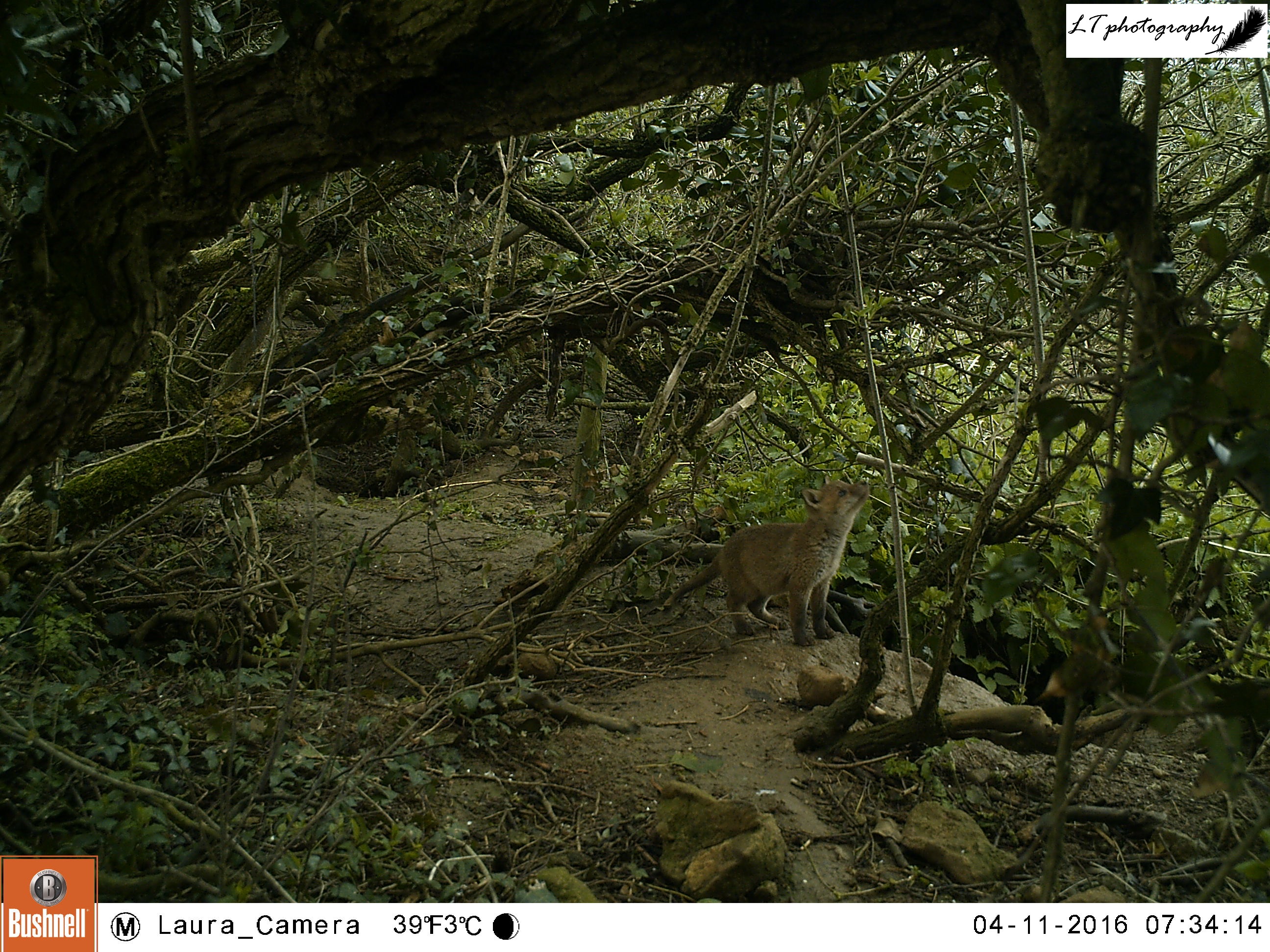
I can now reveal that this camera trap set up was a complete success! I caught a vixen and her 3 cubs on camera, as well as a cheeky magpie and an unexpected great tit. The foxes triggered the camera 127 times over 27 hrs, making for a greater insight into their behaviour, social relationships and private interactions. Very exciting!

Favourite photos: The fox cubs!

Fox cub

Sleepy cub


M2E52L162-162R389B314

Playful cubs

Summary

This spring I really enjoyed embarking on the completion of camera trap surveys and being able to analyse what species can less obviously be seen around me. In total, my camera trap caught sight of 12 different species of birds and mammals, with lots of different individuals being recorded within this.

I hope you enjoyed a small sight into my camera trapping fun and may be inspired to take exploring your local area to the next level. Camera trapping may not be for you but there are lots of other things out there waiting for you.


Winter into spring: April on the farm

April is one of my favourite months of the year on the farm. During April, the Dorset countryside begins to burst into new life. Newborn lambs bounce in the fields, newborn calves snooze in the fields in the spring sunshine, birds begin to nest and raise a new generation, and flowers carpet the woodlands.

Plants this April still followed a trend of being late, with some woodlands not becoming decked out in their full splendour during this month like in past years. Still Bluebells, wild garlic, early purple orchids and late wood anemones began to coat the woodland floor. Also, the woodland ferns began to unfurl in the woods later than usual.

During this April, trees were very much still late, with sycamore and silver birch finally bursting into leaf. Oaks were noticeably asynchronous in their bud burst, with some trees on there way to being in full leaf and others yet to start.

April saw the main crop of migrants arriving on warm winds. This year our barn swallows returned on April 6th, exactly the same date as in 2015! By the time we were fully into April, bird breeding pairs had been firmly established, and the nesting season for many bird species was fully under way. During April, more birds can be heard singing at dawn than any other time of year, which is quite magical to hear.

This year the tawny owls are breeding later than last year, but by the end of April the first hissing calls of tawny owl fledglings could be heard resonating through Dorset woodlands.

Life could be seen blooming everywhere throughout April. Dog violets and cowslips, among other species, were seen flowering along roadside banks.

WP_20160427_002

27/04/16

Brimstone butterflies, orange tip butterflies, and peacock butterflies all began to emerge during the first half of April.

Throughout April, I made myself busy amongst the mounds university revision, by setting up my camera trap at different popular sites around our farmland. It was amazing to see the first badger cubs emerge from their den, and even more special to me, was being able to watch fox cubs beginning to explore above ground with their siblings, during the second half of the month. Fox cubs have to be my highlight of beautiful April!