Colourful, radiant, buzzing with life, a piece of paradise in the summer sunshine. All words to describe a small piece of chalk habitat nestled within the heart of my family’s farm in Dorset. Amidst a clay-dominated landscape, this small creation aims to emulate the approximately 41,000 hectares of lowland chalk grassland that can still be found across the UK. This super rich habitat contains over 40 species of flowering plants in every one square metre, giving chalk grassland its reputation as the tropical rainforest of Europe! Sadly though, 50% of chalk grassland has already been lost in Dorset alone since the 1950s.


In 2017, my Dad made the decision to transform a small triangular area of land on our farm into our very own chalk paradise. Though we do not live immediately on chalk downland, it can be found to the North and South of us. This makes our location ideal to create stopover habitat or a wildlife corridor, for the myriad of species that rely on these diverse plant communities. Following bringing in 40 tonnes of quarried chalk and lots of wildflower plugs and seeds, we now have a thriving 10m by 3m and 2m in height chalk mound.


Though my family’s chalk habitat is still in its relative infancy, over time it is transforming into a wildlife haven. From Grasshoppers and Marbled White Butterflies to blue Butterflies and Carder Bees, new species are popping up each and every year. This mini habitat has also been a great place for my mum to teach me all about the plant species that call chalkland grassland home. With her inspiration, I have put together a simple guide to identifying just some of the many wildflower species that are appearing on our mound.


Chalkland Wildflowers
Wild Marjoram (Origanum vulgare)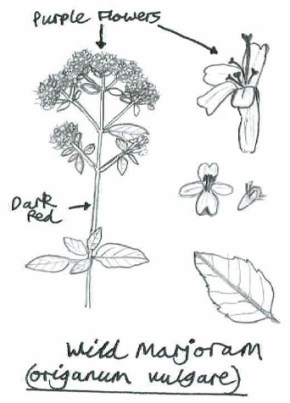
- Family: Mint
- Lifespan: Perennial (lives for several years)
- Size: Short to medium height (30-60cm)
- Stems: Erect, dark-red, downy and either round or square
- Leaves: Oval, often slightly toothed, stalked, and 1.5-4.5cm in length
- Flowers: Dark purple buds in loose clustered heads, opening to pale purple 6-8mm long flowers. Strongly aromatic. Flowers July-September
- Range: Found throughout the UK (particularly in the South), but scarcer in Scotland
- Fun Facts: This culinary herb is a symbol of happiness descended from Roman legend, with Origanum meaning ‘mountain joy’


Kidney Vetch (Anthyllis vulneraria)
- Family: Legume
- Lifespan: Annual (lives for one year) or perennial
- Size: Sprawling and medium in height (up to 60cm), but very variable
- Stems: Silkily hairy, round, and often greyish
- Leaves: In pairs, they are silky white below and green above, and are 30-60mm in length
- Flowers: Yellow, orange or a fiery red, and downy-white below. They are found in single heads (12-15mm across) or sometimes pairs. Flowers April-September
- Range: Found throughout the UK, especially around the coast
- Fun Facts: In the Middle Ages, it was known for speeding up wound healing, with vulneraria meaning ‘wound healer’. It was also once used to commonly treat kidney disorders


Wild Thyme (Thymus polytrichus) 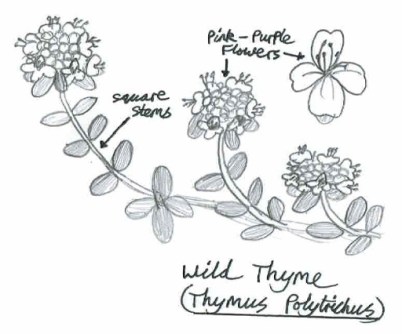
- Family: Mint
- Lifespan: Perennial
- Size: Low to the ground, forming a mat of non-flowering rooting stems (up to 10cm in height)
- Stems: Square with erect flowering stems
- Leaves: Evergreen, short stalked, very small oval 4-8mm leaves in opposite pairs
- Flowers: Faintly aromatic with pink-purple flowers in round and dense heads. Flowers May-September
- Range: Widespread in South East England, but scattered distribution elsewhere
- Fun Facts: Long regarded as the favourite flower of fairies, and associated with love. The Greek thumon though means ‘that which is included in a sacrifice’


Lady’s Bedstraw (Galium verum)
- Family: Madder/Bedstraw
- Lifespan: Perennial
- Size: Short to medium in height, often sprawling (up to 100cm)
- Stems: Four-angled, almost hairless stems
- Leaves: Dark green, long, narrow, shiny leaves in whorls of 8-12. Said to smell of new-mown hay
- Flowers: Bright golden yellow, 2-4mm wide, in clusters, with a sweet honey-like scent. Only Bedstraw species in the UK with yellow flowers. Flowers June-September
- Range: Widespread
- Fun Facts: Associated with the story of the Virgin Mary giving birth to the baby Jesus, leading to the belief that a woman lying on a mattress of Lady’s Bedstraw would have a safe and easy childbirth


Viper’s Bugloss (Echium vulgare)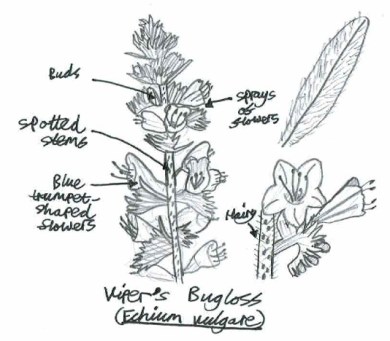
- Family: Borage/Forget-Me-Not
- Lifespan: Biennial (flowers in its second year before dying) or perennial
- Size: Medium to tall in height (up to 100cm)
- Stems: Roughly hairy and spotted (red-based bristles)
- Leaves: Narrow, oval-shaped lower leaves
- Flowers: Flowers in drooping clusters of pink buds that open to become erect, blue, trumpet-shaped, open-mouthed flowers, 10-20mm long, in branched spikes. Flowers May-September
- Range: Scattered distribution across the UK, being most common in the South
- Fun Facts: The plant’s name comes from a time when it was believed to be a cure for snake-bites, reinforced by the dead flower-heads resembling a viper’s head


Rough Hawkbit (Leontodon hispidus)
- Family: Daisy
- Lifespan: Perennial
- Size: Short to medium in height (up to 60cm)
- Stems: Very hairy, unbranched, leafless, and slightly swollen at the top
- Leaves: Form a rosette of bluntly lobed leaves at the base of the flowering stem
- Flowers: Golden-yellow, though often orange or reddish beneath, solitary and 20-40mm wide. Forms seed heads that look like dandelion clocks. Flowers late May-October
- Range: Widespread and fairly abundant across the UK, apart from in the far North
- Fun Facts: In Greek, Leontodon means ‘Lion’s tooth’, referring to the toothed leaves. The flowers are also rich in nectar and smell sweetly of honey


Greater Knapweed (Centaurea scabiosa)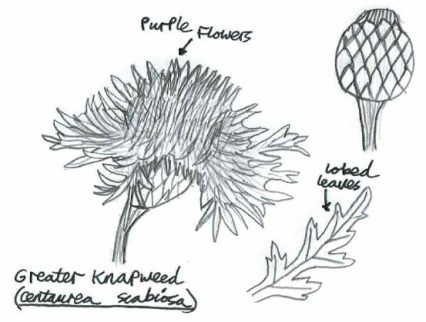
- Family: Daisy
- Lifespan: Perennial
- Size: Medium to tall in height (30-120cm)
- Stems: Erect and grooved
- Leaves: Lobed, where the lobes are positioned in pairs either side of the leaf centre. The leaves are 100-250mm long
- Flowers: Purple, solitary and 30-60mm across. Flowers July-September
- Range: Scattered across the UK, but predominantly grows in England
- Fun Facts: Commonly used to treat wounds, bruises, sores and similar conditions


Common Bird’s-Foot-Trefoil (Lotus corniculatus)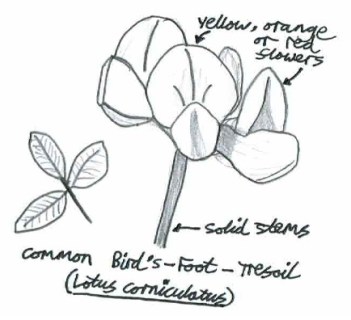
- Family: Legume
- Lifespan: Perennial
- Size: Short or medium in height and sprawling (up to 50cm)
- Stems: Solid not hollow, and trailing
- Leaves: Greyish-green, downy or hairless, and oval-shaped tapering to a point
- Flowers: Deep yellow or orange, often partly red, and 10-16mm long, often 2-7 per flower head. Flowers May-September
- Range: Widespread
- Fun Facts: It has more than 70 common folk names including Eggs and Bacon. The name Bird’s-Foot-Trefoil reflects the resemblance to a bird’s foot, and is a larval food plant of Green Hairstreak and Dingy Skipper Butterflies


Ox-eye Daisy (Leucanthemum vulgare)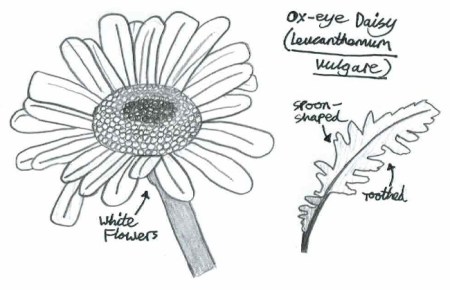
- Family: Daisy
- Lifespan: Perennial
- Size: Medium in height (20-75cm)
- Stems: Round, angled or square, erect, and slightly hairy
- Leaves: Long-stalked, dark green, spoon-shaped, toothed and in a rosette around the base of the flowering stem
- Flowers: White, 20-60mm across, solitary and on sparsely leafy stalks. Flowers May-September
- Range: Widespread
- Fun Facts: In past times, an extract was obtained by boiling the plant down, that was used in salves and medicines to cure a variety of ailments from liver disease to runny eyes. Largest native daisy species


Common Toadflax (Linaria vulgaris)
- Family: Plantain
- Lifespan: Perennial
- Size: Short to medium in height (30-80cm)
- Stems: Erect, grey-green, and hairless
- Leaves: 30-80mm long, very narrow, untoothed, and spirally arranged up the stems
- Flowers: 15-35mm long, yellow with an orange bulge and long straight spur, forming stalked spikes. Flowers June-October
- Range: Widespread
- Fun Facts: Most common Toadflax species in the UK, getting its name from previously being considered as useless, fit only for toads


Meadow Crane’s-Bill (Geranium pratense)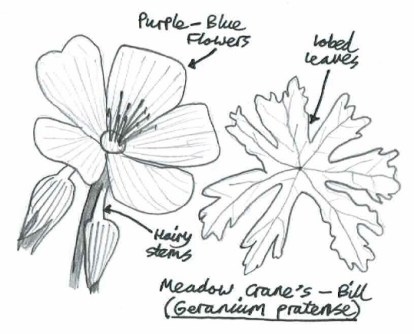
- Family: Geranium
- Lifespan: Perennial
- Size: Medium to tall in height (30-100cm)
- Stems: Hairy, erect, and often reddish
- Leaves: Have 5-9 lobes, cut nearly to the base
- Flowers: Soft violet blue, petals not notched, 15-30mm wide. Flowers June-September
- Range: Found throughout the UK, but rarer in South West England and East Anglia
- Fact: With lesser known names such as ‘Jingling Johnny’ or Loving Andrews, it is a horticultural favourite dating back to before the Elizabethan times


Black Medick (Medicago lupulina)
- Family: Legume
- Lifespan: Annual or short-lived perennial
- Size: Low in height (up to 60cm), and sprawling or erect
- Stem: Round or square and hairy
- Leaves: Trefoil, downy, and 5-20mm in length, with minute teeth
- Flowers: Bright yellow and small, with 10-50 to one short-stalked rounded head (3-8mm wide). Flowers April-October
- Range: Widespread across the UK, but sparser in Scotland
- Facts: Name means ‘plant of the Medes’, referring to an ancient Middle Eastern people, whilst lupulina means ‘hop-like’, due to similarities with Hop Trefoil


Now get out there and see what you can find!


Drawings and photos all my own







 Laura's Wild World