At this moment, as spring moves on, the natural world outside our doors is going through one of its busiest times. From birds nesting to the leaves bursting, the world around us is buzzing with the promise of new life.
During spring, one of my favourite things to do is walk in the dappled light beneath an increasing canopy, between steadfast trees and amongst undergrowth blooming with colour. Walking through a woodland is an easy way to lose yourself for a little while and give yourself a much needed lift. To connect further, an easy way on a woodland walk is to pick out the plants and animals that you can recognise around you. This can often be more difficult than first thought.
So to help you be mindful of the wonderful world out there, I have put together a simple guide to some of my favourite woodland flowering species that are easy to find during spring. It is time to get out there and explore!

Well known flowers
Primrose (Primula vulgaris)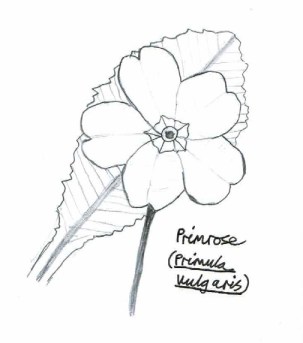
- Size: Low carpeter; up to 12cm tall
- Flowers: Pale yellow (there are pink-purple forms) with a deep yellow eye and honey-guides
- Stems and leaves: Long shaggily hairy stems with wrinkled and toothed leaves, that are hairless above and hairy below (up to 15cm long)
- When does it flower? March-May (heralds the arrival of spring)
- Where can it be found? Woods, hedgebanks and grassy places throughout Britain


Lesser Celandine (Ficaria verna)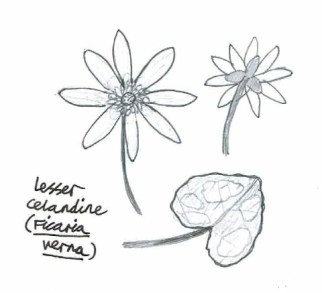
- Size: Up to 30cm tall
- Flowers: Solitary with 8-12 glossy yellow petals and 3 sepals
- Stems and leaves: Hairless with leaves that are long-stalked, heart-shaped, and dark green. Sometimes bear dark or light markings
- When does it flower? February-May
- Where can it be found? Woods, grassland, hedges, waysides, bare ground and by fresh water throughout Britain


Bluebell (Hyacinthoides non-scriptus)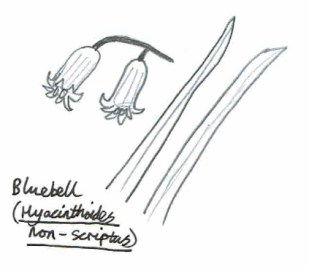
- Size: Up to 50cm tall
- Flowers: Azure blue (though sometimes pink or white) with cream-coloured anthers. Fragrant and bell-shaped with six turned-down lobes
- Stems and leaves: Long, narrow, strap-shaped, keeled leaves
- When does it flower? April-June
- Where can it be found? Carpeting woodlands, hedges, scrubland, on sea-cliffs and mountains in most parts of Britain


Common Dog-violet (Viola riviniana)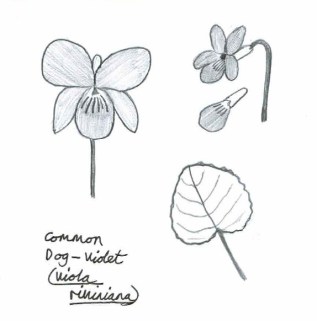
- Most common wild violet species in the UK
- Size: Up to 15cm tall
- Flowers: Unscented with petals that are blue-violet but variable, usually overlapping. Stout spur, curved upward, blunt, notched at tip and paler than petals (often creamy)
- Stems and leaves: Hairless or only slightly downy leaves and stalks. The leaves are long-stalked, heart-shaped, pointed at the tip, and as broad as they are long
- When does it flower? March-May and sometimes July-September
- Where can it be found? Woods, hedges, pastures, heaths and rocky areas throughout the British isles


- Size: Up to 15cm tall
- Flowers: Blue-violet, often white, occasionally lilac, pink or yellow. Only fragrant violet in Britain
- Stems and leaves: Leaves are heart-shaped, downy and enlarged in summer
- When does it flower? February-May
- Where can it be found? Woods and hedges over most of the British isles
Plants known to some
Wood anemone (Anemone nemorosa)
- Size: Up to 30cm tall
- Flowers: Solitary white (sometimes tinged purple) that nod when closed
- Stems and leaves: About two-thirds of the way up each slender stem is a ring of three leaves (trifoliate), each divided into three toothed segments. Rising above the leaves is the solitary flower
- When does it flower? March-May
- Where can it be found? Carpeting woodlands in spring, as well as hedge-banks and occasionally grasslands throughout Britain


Greater stitchwort (Stellaria holostea)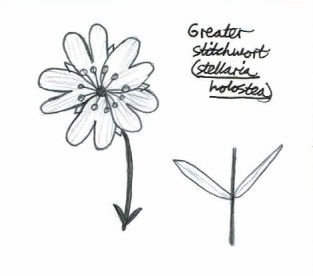
- Size: Up to 60cm tall
- Flowers: Deeply cleft white petals
- Stems and leaves: Stalkless, narrow and long-pointed leaves with a slightly grey tinge (15-60cm long)
- When does it flower? March-June
- Where can it be found? Across woodlands, hedgerows and scrub areas throughout Britain except some northern isles


Wild Garlic/Ramsons (Allium ursinum) 
- Most common and only native broad-leaved garlic
- Size: Up to 45cm tall
- Flowers: White star-like flowers
- Stems and leaves: Have leafless flowering stems. The leaves are broad, flat, lanceolate and distinctive smelling
- When does it flower? April-June
- Where can it be found? Often seen growing in large clumps in woods and shady places throughout Britain


Wild Strawberry (Fragaria vesca)
- Size: Up to 30cm tall
- Flowers: White flowers with no gaps between the 5 unnotched petals. Produce reddish fleshy strawberries that have protruding pips
- Stems and leaves: Hairy. Leaves are trefoil on long stalks and are brighter green on top and pale below. Lower leaves form a rosette
- When does it flower? April-July
- Where can it be found? Woods, scrub, and grassland throughout the British Isles
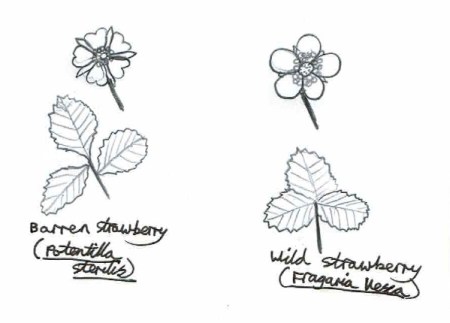
Barren Strawberry (Potentilla sterilis)
- Size: Up to 30cm tall
- Flowers: Unlike wild strawberry, there are gaps between the slightly notched white petals. Produces unstrawberry-like non-fleshy fruits
- Stems and leaves: They are hairy, but unlike wild strawberry, they have smaller, shorter stems and blue-green leaves
- When does it flower? Earlier than wild strawberry, from February-May
- Where can it be found? Woodlands, scrub, hedgebanks and other dry banks

Less known plants
Yellow Archangel (Lamiastrum galeobdolon)
- Size: Up to 30cm tall
- Flowers: Yellow and two-lipped, with the upper lip being helmet-shaped and the lower having three almost equal-sized lobes
- Stems and leaves: Hairy and patch-forming, with leafy and upright flowering stems. The leaves are long-stalked, oval in shape, dark green, irregularly toothed and borne in opposite pairs
- When does it flower? April-June
- Where can it be found? Woodlands and hedgerows in England and Wales


Early Purple Orchid (Orchis mascula)
- Size: Up to 40cm tall
- Flowers: Form a spike on a stout, upright stem. Usually some shade of purple, sometimes pinkish or white, and are three-lobed with three inner and three outer petals. The upper five petals are oval and form a hood; the lower petal extends into a long lip. Scent described as tom-cat-like
- Stems and leaves: Lance-shaped, varying from broad to narrow, and usually have round, purple-black blotches on their upper surface
- When does it flower? April-June
- Where can it be found? Frequently in woodlands, and is widespread throughout Britain


Moschatel (Adoxa moschatellina)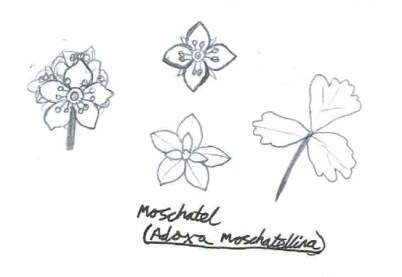
- Also known as townhall clock and is the only species in its family
- Size: Up to 15cm tall
- Flowers: Flower heads greenish, almost forming a cube with one flower on each side (5 petals each) and one flower on top (4 petals). Scent is musk-like, likened to almond or elder blossom
- Stems and leaves: Hairless with long-stalked trefoil leaves, that are positioned in one pair on each flower-stalk
- When does it flower? March-May
- Where can it be found? Woods, hedge-banks, and rocky mountain places, locally common throughout Britain


Herb-robert (Geranium robertianum)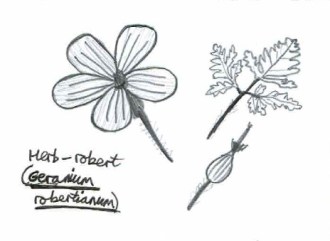
- Size: Up to 50cm tall
- Flowers: Strong smelling and deep pink, occasionally white, with rounded petals that are not notched
- Stems and leaves: Hairy with stems that are often reddish and leaves that are fern-like with 3-5 lobes
- When does it flower? April-November
- Where can it be found? Shady spots on hedgebanks, rocks and walls or in woods throughout Britain

All photos and drawings are my own


 American marram grass (Ammophila breviligulata)= Most common species
 Beach pea (Lathyrus japonicas var. maritimus)
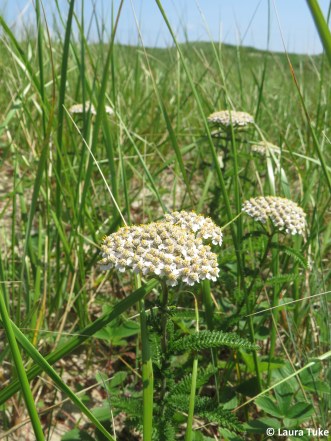 Common yarrow (Achillea millefolium var. occidentalis)
 Sea sandwort (Honckenya peploides sp. robusta)
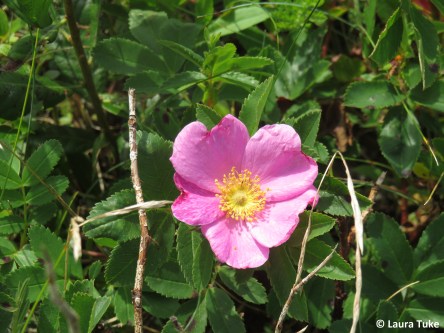 Common wild rose (Rosa virginiana)
 Lowbush blueberry (Vaccinium angustifolium)
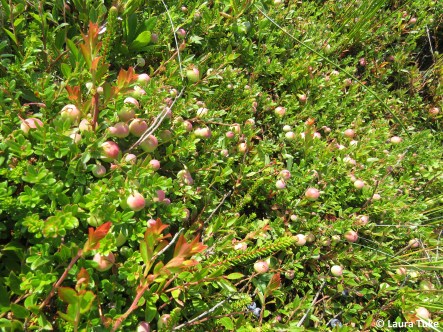 Large cranberry (Vaccinium macrocarpon)
 New York aster (Symphyotrichum novi-belgii)
 Swamp smartweed (Polygonum hydropiperoides)
 Wild strawberry (Fragaria virginiana sp. glauca)
 Small flowered evening primrose (Oenothera parviflora)
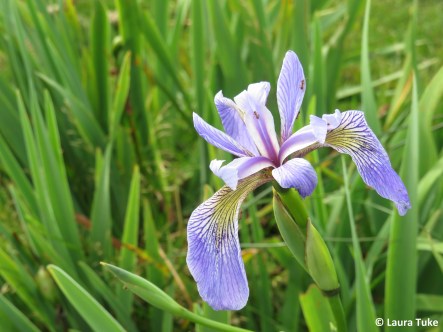 Blue flag iris (Iris versicolor)
 Hooded ladies’ tresses (Spiranthes romanzoffiana)
 Blue-eyed grass (Sisyrinchium angustifolium)
 Hedge bindweed (Calystegia sepium)
 Seaside goldenrod (Solidago sempervirens)
 Curled dock (Rumex crispus)
 Black knapweed (Centaurea nigra)


 Laura's Wild World