Spring at RSPB Radipole Lake and RSPB Lodmoor

When asking people what they like to do most during spring, answers range from watching Springwatch and doing wildlife gardening to listening to the dawn chorus and taking in wildflowers in our local green spaces. Though I do like doing all these things too, one of my favourite things to do during the spring season is to visit two of my favourite nature reserves in search of some of my top bird species.

Radipole lake nesting mallards

By getting out to local reserves, we are supporting the work of organisations such as the RSPB, immersing ourselves in the wildlife that call these reserves their home, and improving our own health and wellbeing at the same time. Take a look at my recent adventure and see if you may be inspired to visit one of your local nature reserves as spring rolls into summer!

Saturday 11th May 2019

I was first introduced to Dorset’s RSPB Radipole Lake and Lodmoor 5 years ago by my Granddad whilst on a birdwatching trip, and since I have visited many times and have even completed an internship at the reserves with the RSPB. This means I am well acquainted with Radipole and Lodmoor (2 of the 5 RSPB nature reserves found in Dorset) and they hold a special place in my heart.

For those of you who will not have heard of these nature reserves before, I will just start with a few facts about the two:

Radipole Lake

  • 21.3 miles from my homeRadipole lake urban swan
  • 83-hectares in area
  • Designated SSSI (Site of Special Scientific Interest)
  • Managed by the RSPB since 1976
  • Habitats: wetland, hedgerow, scrub, reedbeds, saline lagoons
  • Star species: kingfisher, marsh harrier, bearded tit, Cetti’s warbler

Lodmoor

  • 21.5 miles from my homeLodmoor reedbed
  • 76-hectares in area
  • Designated SSSI
  • 1.5 miles east of Radipole
  • Connected to the sea under a sea wall at the southern end
  • Habitats: freshwater reedbed, scrub, saline marsh
  • Star species: marsh harrier, bearded tit, Cetti’s warbler, common tern

What makes these two reserves extra special for me though, can be split into two parts. Firstly, they are both situated in less conventional locations than many other nature reserves, being found at the centre of the busy seaside town of Weymouth. Thus, when you step into these reserves and surround yourself with the reeds and wildlife, you would not believe that you are situated within the heart of an urban area. In this way, they are both oases for a range of wildlife and for the naturalists that visit them.

Secondly, they are both year-round homes for one of my favourite species of bird of prey, the majestic marsh harrier. I did not know that they could be found on my doorstep until my first visit to the reserves, so their discovery for me a few years back brought with it lots of excitement. Consequently, it is one of the greatest draws for me when visiting these reserves at any time of the year.

Discovery centre marsh harrier mural

So, on a sunny day in May this spring, I headed to the reserves alongside my birdwatching partner in crime, my mum, to hunt down marsh harriers during their breeding season, whilst taking in other species and a range of habitats.

Adventure with my mum


RSPB Radipole Lake Nature Reserve

Discovery centre radipole lake map

Most trips to the reserves start in the public car park outside the RSPB’s Weymouth Discovery Centre and next to the bridge into Radipole Lake Reserve. This setting feels a lot more like an urban area than a home to wildlife.

Radipole lake pigeons

Once you cross the wooden bridge from the car park into the reserve though, you are suddenly transported into a world of water, reeds, sky and trees. You are also hit by a cacophony of bird sounds ranging from species commonly heard in our gardens to water birds and warbler species, such as the sound of the noisy and distinct Cetti’s warbler. If it was not for the houses that can be seen above the reeds in the distance though, you could probably forget the reserve’s urban setting all together!
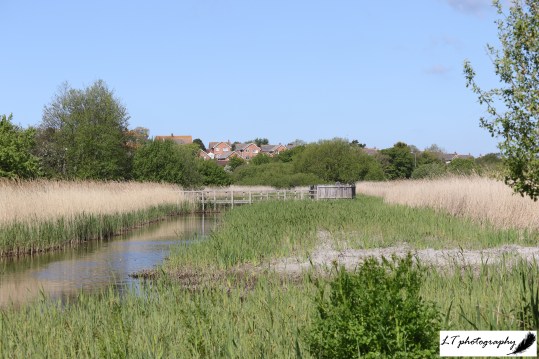
Radipole lake reeds

When my mum and I crossed the bridge we also found ourselves on a hard surface trail that gives easy access around the reserve. Starting at the discovery centre, we then followed it round the main circular discovery walk, stopping to spot birds in the trees along the sides of the trail, to identify plant species, and to look out across the reeds and open water from the main viewing platforms and spots around the reserve. In this way, we were able to pretty quickly rack up our species list and to get some great views of wildlife.

Radipole lake long-tailed tit
Radipole lake female mallard

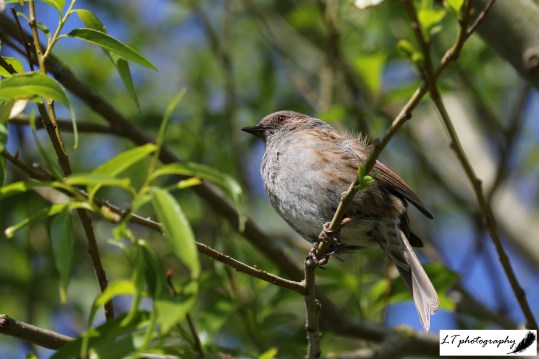
Radipole lake dunnock

My highlight of the trip to Radipole though, unsurprisingly included my star species, the marsh harrier. This began earlier on in our walk around the reserve, when my mum and I first caught a tantalising view of a male marsh harrier flying above the reeds, hunting in the distance. This made us then even more motivated to try and get a closer view of marsh harriers on this day, by heading off the main discovery trail and on to the north trail, to visit one of the best spots to watch these birds. Sat at a viewing screen in the sunshine, hot drinks and biscuits in hand, our luck paid off and we had the pleasure of enjoying one of our best ever hours watching marsh harriers at the reserve.

Following a short wait, the hour started with my mum spotting our earlier male marsh harrier hunting above the reeds, though still a good distance away from where we sat. We watched him through binoculars for a little while, before he disappeared from our view.

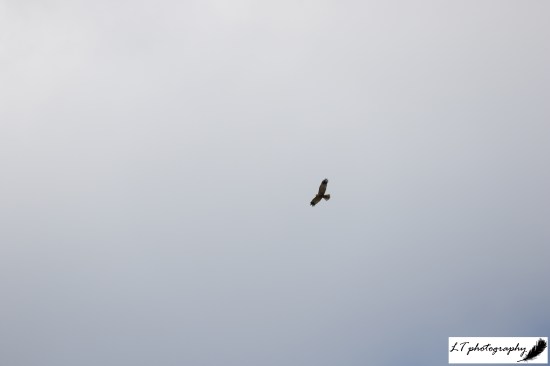
This sighting from the viewing screen was not our last though. After a longer wait, our viewing experience was suddenly taken up a notch. The same male that we had been watching previously suddenly popped up within 15 metres of the viewing screen, giving us amazing views of him. He then gave us a real show hunting and flying backwards and forwards in front of us before flying higher and higher till he was directly above our heads. This allowed us to really experience this bird in action and gave me the opportunity to at least try and photograph him in his natural habitat. We only made our own departure from the reserve once the male had finally moved off once again.
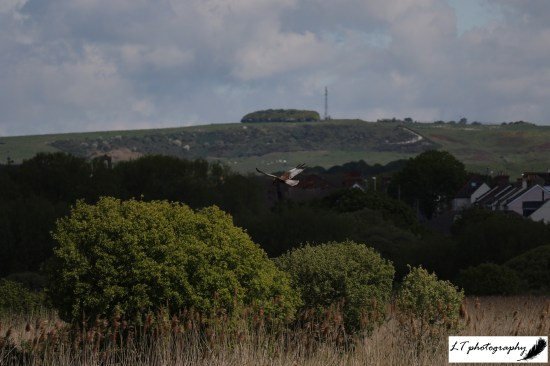
Radipole lake marsh harrier

Radipole lake marsh harrier 2

Radipole lake marsh harrier 3

From our couple of delightful hours on this reserve, we counted 30+ bird species, with our top 6 being:

  1. Cetti’s warbler
  2.  Swift (first swifts of the year)Radipole lake swifts
  3. Great-crested grebe
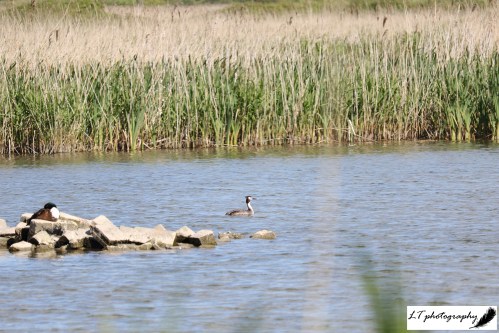
    Radipole lake great-crested grebe
  4. Marsh harrier 
  5. Little grebe
  6. Sedge warbler

Other photos:

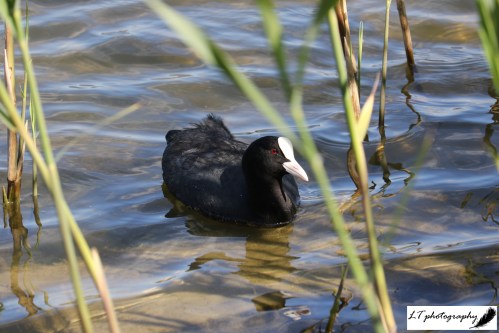
Radipole lake coot

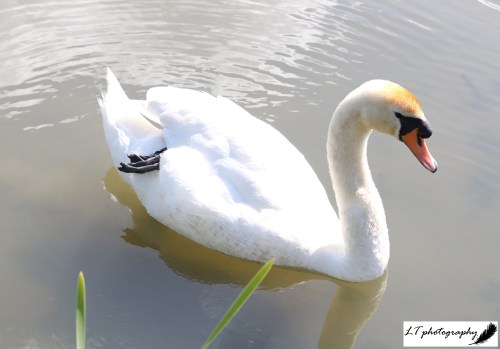
Radipole lake mute swan


RSPB Lodmoor Nature Reserve 

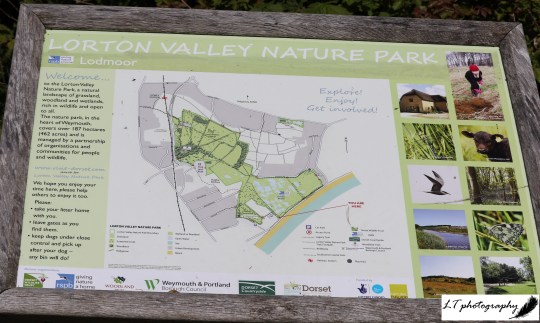
Lodmoor map

On this day in spring, following a stop for lunch sat on the seafront in the glorious sunshine, my mum and I chose to park at Weymouth’s public Overcombe car park on the eastern side of Lodmoor nature reserve. From here we planned to walk a clockwise loop around the reserve’s main trail and see what species we could see that call the reserve their home.

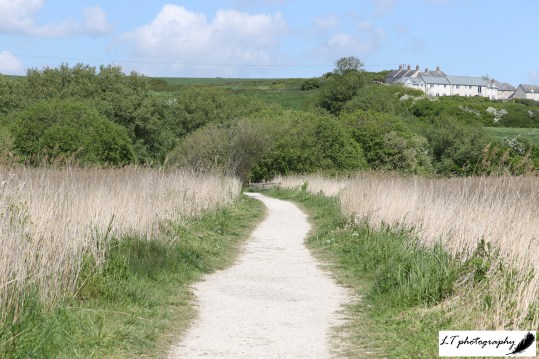
Lodmoor reed trail

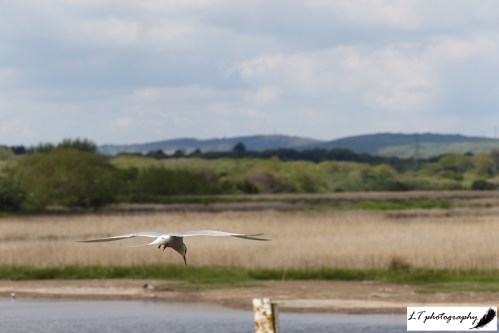
In this way we first walked along the main road that borders the southern side of the reserve and splits Lodmoor from the seafront, stopping at breaks in the reeds and hedges to see what birds we could see on the marsh area. On one of these stops, we finally got to take in one of Lodmoor’s star species, breeding common terns. At the reserve, islands in the lagoons/marsh are managed each year to provide areas for the terns to breed safely away from many predator species. In sight of these islands, we got some really fantastic views of the terns hunting over the water.

Lodmoor commen tern nesting islands

Lodmoor Common tern 2

Though most of the best areas for birdwatching are situated along the side of the main road and near the tern nesting islands, my mum and I of course continued our walk on the main trail around the reserve, taking in as many species as we could. Unfortunately, this year we did not catch any sightings of the marsh harriers that can be found breeding at this site, but the reserve still did not disappoint us. In particular, we spotted 24+ bird species, with our top 6 sightings being:

  1. Oystercatcher Lodmoor oystercatcher and shelducks
  2. Shelduck Lodmoor shelduck
  3. Bar-tailed godwit
  4. Black-tailed godwit
  5. Common ternLodmoor Common ternLodmoor Common tern 3
  6. Gadwall

Other photos:

Lodmoor canada geese

Summary

My trip to the reserves may not be everyone’s cup of tea for a day out, but I had a thoroughly enjoyable day in the sunshine, spending time with my mum and being completely distracted from work and day-to-day life. I also got to take in some incredible flora and fauna, as well as a tranquil and vivid environment.

So how was my hunt for the marsh harriers? Though I did not get the pleasure of seeing marsh harriers at both reserves, watching the male at Radipole Lake for a long period of time felt like a real success. They are a striking species that I can easily pick out from others, and with birds of prey being my favourites, it is easy to see why I enjoy watching them so much.

The highlight of my trip obviously was the marsh harriers, but also was being able to spend the day doing something I love with one of my favourite people. We all should take a little time out of our busy lives to do things we enjoy and that uplift us, allowing us to take care of ourselves in the right way. Anything to do with enjoying spring outdoors does this for me and allows me to de-stress.

As I come to the end of this blog post, with the end of my trip, I do hope that I may have inspired you to take a trip to your local nature reserve, even if it is just to take a walk, see something new, have an adventure or appreciate your local plants and animals. Nature reserves are a free and easy form of entertainment for all, so why don’t you escape to one today?
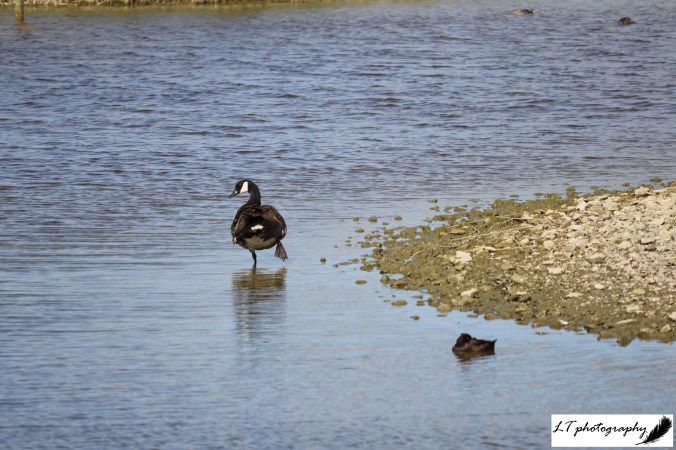
Radipole Lake Canada Goose

40 years of the RSPB’s Big Garden Birdwatch: How can you get involved?

Next weekend the RSPB is holding its annual Big Garden Birdwatch. Many people may have heard of this event before and may have even participated in it (if so thank you), but many people may have never heard of it before though. Either way, with the event celebrating its 40th anniversary this year, I wanted to take a moment to look back at the Birdwatch’s interesting history, wide-ranging impact and more importantly how you could get involved this year to help make it the biggest year yet!

For those of you who may not know, the RSPB (standing for the Royal Society for the Protection of Birds) was founded in 1889 by ornithologist Emily Williamson with the aim of stopping birds being exploited for fashion. Over the following 130 years, the RSPB has grown in size and popularity, and among other things, has acquired at least 209 nature reserves, raised lots of money for conservation projects and created many popular events such as the annual Big Garden Birdwatch. Following its start as an event aimed at children in 1979 in collaboration with Blue Peter, the Birdwatch has now been running for an amazing 40 years, with the hope of many more years to come.

With over half a million people taking part each year now, the Big Garden Birdwatch has officially become the world’s largest wildlife survey. Clocking up over 8 million watch hours and more than 130 million bird sightings, the survey has amassed four decades worth of valuable results for the RSPB. What happens each year to these results though? Well once collated into one big data set they are analysed to monitor trends, and allow us to understand the state of British wildlife such as to identify species declines, and to help protect and conserve it.

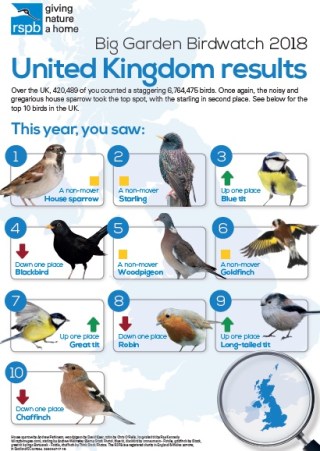
To give you an idea of some of the basic results the Birdwatch can provide, lets take a look back at some of last year’s results published by the RSPB. To start, the top 10 garden birds in the UK and Northern Ireland in 2018 were found to be:

2018 big garden birdwatch results

(c) RSPB

  1. House sparrow
  2. Starling
  3. Blue tit
  4. Blackbird
  5. Woodpigeon
  6. Goldfinch (11% rise from 2017)
  7. Great tit
  8. Robin
  9. Long-tailed tit
  10. Chaffinch

The 2018 survey also showed big increases from the past year in the number of sightings of winter visitors, such as siskins and bramblings, and a 5% increase in greenfinch sightings. Despite house sparrows being the most commonly seen species in our gardens in 2018, since its beginning, the Big Garden Birdwatch has seen house sparrow sightings drop year on year, with a 57% decline over 40 years.

In relation to the survey itself though, since 1979 participants have increased in number from approximately 34,000 children to more than half a million individuals of all ages. Whatever your experience or knowledge of birds and wildlife, this is one event where anyone can now get involved. In addition to helping out the RSPB, this survey could also have wide ranging benefits for yourself too. For example it could:

  • Allow you to take a moment to appreciate what is in your garden or local green space
  • Aid your mental health by spending time out in nature and/or being mindful of your local wildlife
  • Allow you to get involved in citizen science where your involvement could have a big difference for scientific knowledge and species conservation
  • It is a bit of fun!

So, if you are interested in the world’s largest wildlife survey, how could you get involved? First, go to the ‘Bird Garden Birdwatch 2019’ section of the RSPB website and either request a free postal pack, download a counting form and bird ID guide or decide to complete the Birdwatch online. Then pick a day between 26th-28th January to sit and watch the birds in your garden or local green space. Follow the rules for counting the birds, and when your hour is complete either send your results to the RSPB by post or online. How you do your Birdwatch though is entirely up to you. It’s simple!


img_0749

As a result, the Big Garden Birdwatch has now helped to inspire many new generations of birdwatchers and I can say that I am included among them. This was evident at the age of 12, when I decided to write a piece for my local magazine trying to get more people (even then) involved in the Birdwatch. Though my knowledge, writing and understanding of the world has come a long way over the last 11 years, my passion for wildlife, its conservation and its communication have remained the same. So why not listen to 12 year old Laura, do the same as me, and take part in this year’s Big Garden Birdwatch!

big garden birdwatch article

This blog post has been written independently from the RSPB, but all RSPB Big Garden Birdwatch resources and facts used in this blog post, such as seen in the photos of the resources included in the postal pack I received, are entirely the property of the RSPB


A different kind of Christmas: December trip to RSPB Arne

For most people Christmas outings may involve activities such as shopping, ice-skating, visiting Santa or taking in Christmas light displays. This year to get into the festive spirit though, I decided to do something a little bit different. Why? Well this month is a great time to get outside in the cold (and the wet!) and take in some of the winter residents and migrants that can currently be found in the UK. What better way to escape at this time of year than to get out in nature!

My choice of destination was simple: RSPB Arne nature reserve in Dorset. This reserve covers more than 565 hectares, has many designations such as being a Site of Special Scientific Interest and is home to a mosaic of habitat types ranging from heath to ancient oak woodland. As a result RSPB Arne is famous to British naturalists for its rich biodiversity and spectacles of nature, which include the colourful ladybird spider (as featured on Autumnwatch in 2016) and all 6 UK species of native reptile. Situated approximately 25 miles away from my home, this gem for the wildlife enthusiast is becoming a firm favourite of mine.

Well what was the real aim of my visit this Christmas? Though birds of prey such as marsh and hen harriers are always at the top of my ‘must-see’ list, I have to admit that December is THE time to see waders at Arne. In fact, neighbouring Poole Harbour hosts one of the largest flocks of wintering avocet in the UK, which is a real spectacle to see.
So, with the weather on my side for one day in mid-December, I made the journey over to the the isle of Purbeck for a day of no pressure bird watching and walks with spectacular views. Having visited Arne a handful of times before, I started my day by setting out on Arne’s seasonal raptor walk in the slim hope that I might catch sight of a wintering harrier or falcon. Though it did result in a kestrel being added to the day’s species list, it was my only raptor sighting of the day in the end.

OLYMPUS DIGITAL CAMERA

The seasonal raptor walk was not fruitless though, as sitting in the reed bed hide at the end of the walk I was treated to my very first sighting of a highly charismatic bird. Despite having seen flashes of this bird in the past, I had never seen it up close and perched before. So it took me by surprise when I caught sight of the shape of this small bird with its distinctive short tail, large head, and long bill only a couple of metres in front of me in the hide. To my excitement it was a kingfisher and following this sighting I had the pleasure of watching it hunt in the pools of the reed bed for quite awhile longer!

OLYMPUS DIGITAL CAMERA

Following seeing my kingfisher, the rest of the day was spent walking the Coombe Heath trail and yellow Shipstal trail to catch sightings of waders around Middlebere Lake and Arne bay.

To highlight some of the species I ended up seeing on my walks, here’s a little ’12 waders and waterfowl of Christmas’:

  1. Mallard
  2. Little egret
  3. Common shelduck
  4. Eurasian oystercatcher
  5. Brent geese
  6. Common redshank
  7. Lapwing
  8. Eurasian wigeon
  9. Pied avocet
  10. Common greenshank
  11. Eurasian curlew
  12. Eurasian spoonbill

OLYMPUS DIGITAL CAMERA

At the end of my day exploring Arne in the dry and escaping a busy life, I have to admit that it was just what I needed during the festive period. Filled with wintering wildlife and tranquil landscapes, ‘traditional Christmas’ only permeated my outing through visits to the reserve’s cafe and shop, which were both fully embracing the festive season.

Though my day at Arne may not characterise most people’s festive period, it fitted with the meaning of my own Christmas, made up of things that I cherish such as family, nature and focussing on my own mental wellbeing. Taking an opportunity to concentrate on and celebrate such things is what defines Christmas to me, amongst modern traditions. So all I can say now is remember what means most to you at this time of year and have a very MERRY CHRISTMAS!

Sable Island’s Birds vs. Invertebrates

The wonders of nature are endless – Walt Disney

When people think of Sable Island, they may think of a windswept island of sand, the island’s famous feral horses, or its involvement in maritime stories. More overlooked is Sable’s vibrant collection of fauna and flora, the latter having previously been touched upon in my ‘Guide to Sable Island’s habitats and plants’. When considering Sable’s fauna though, the most abundant can be split into its birds and its invertebrates.

Birds

Juvenile gull

Over Sable’s recorded history, at least 340 bird species have been observed on the island. These species span from American kestrel (Falco sparverius) to ruby-throated hummingbird (Archilochus colubris) to red-breasted nuthatch (Sitta canadensis), the last being one species I got to see myself this summer on Sable.

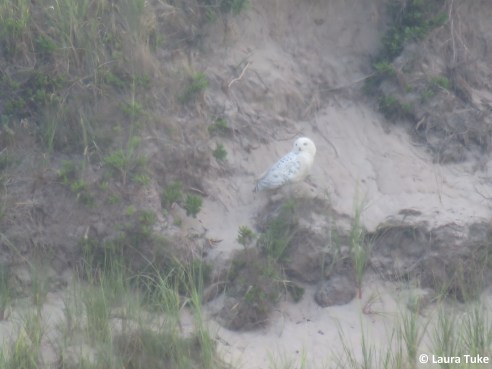
More than 45% of bird species that have been observed on Sable though, are termed as vagrants. This means that they have strayed from their usual range, for example arriving on the island due to being blown off course by strong winds during migration. As a result, I had the pleasure of seeing one iconic species during my stay this summer; a snowy owl (Nyctea scandiaca), floating like a ghost between the island’s dunes.

Snowy owl 3

Snowy Owl

Many species also use the island as a stopover site during their migration, for example waders, raptors and warblers. Regular migrant species include willet (Catoptrophorus semipalmatus), sooty shearwater (Puffinus griseus), grey-cheeked thrush (Catharus minimus) and:

Yellowlegs

Yellowlegs

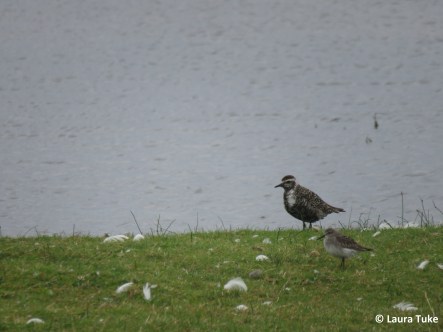
Female American Golden Plover and sandpiper

Female American golden plover (Pluvialis dominica) (sandpiper in foreground)

Ruddy turnstone

Ruddy turnstone (Arenaria interpres)

Sanderling

Sanderling (Calidris alba)

Whimbrel

Whimbrel (Numenius phaeopus)

White-rumped sandpiper

White-rumped sandpiper (Calidris fuscicollis)

Of the 340+ species seen on Sable though, more than 30 have been recorded as breeding on the island. Regular breeders include:

  • Arctic tern (Sterna paradisaea)
  • Common tern (Sterna hirundo)
  • Roseate tern (Sterna dougallii)
  • Herring gull (Larus argentatus)
  • Great black-backed gull (Larus marinus)
  • Ipswich sparrow (Passerculus sandwichensis princeps)= endemic
    • Subspecies of Savannah sparrow and of conservation concern

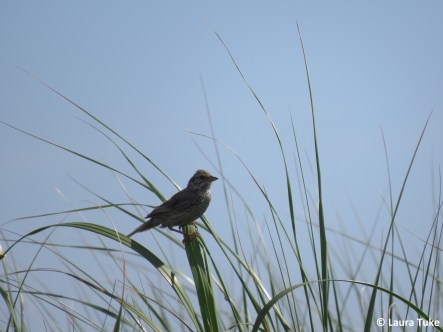
Ipswich sparrow

  • Leach’s storm-petrel (Oceanodroma leucorhoa)
  • American black duck (Anas rubripes)
  • Mallard (Anas platyrhynchos)
  • Red-breasted merganser (Mergus serrator)
  • Northern pintail (Anas acuta)
  • Least sandpiper (Calidris minutilla)
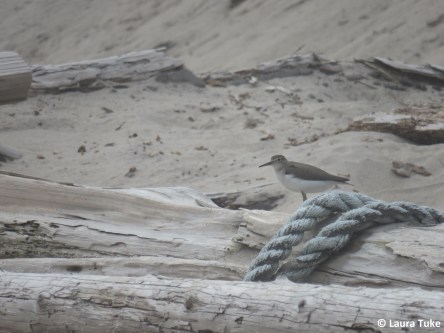
  • Spotted sandpiper (Actitis macularia)

Juvenile spotted sandpiper

Invertebrates

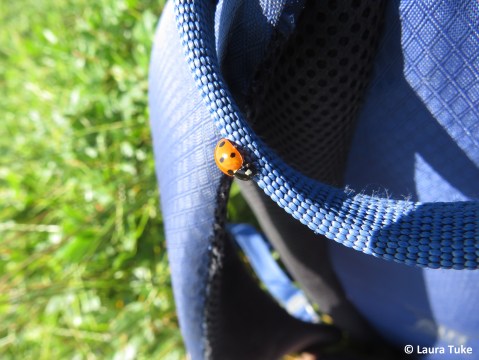
In comparison to the 340+ bird species that have been recorded on Sable Island, 875+ invertebrate species have been identified on and in its marine proximity. Species include the monarch butterfly (Danaus plexippus), painted lady (Vanessa cardui), seven-spot ladybird (Coccinella septempunctata), and round-tipped cone-headed grasshopper (Neoconocephalus retusus).

Six spot ladybird

Seven-spot ladybird (Coccinella septempunctata)

Six spot ladybird larvae

Seven-spot ladybird larvae

Sable Island also has some endemic invertebrate species. These include the Sable Island leaf beetle (Pyrrhalta sablensis), the Sable Island sweat bee (Lasioglossum sablense)and three moth species (Agrotis arenariusOrgyia leucostigma sablensis and a Papaipema species).

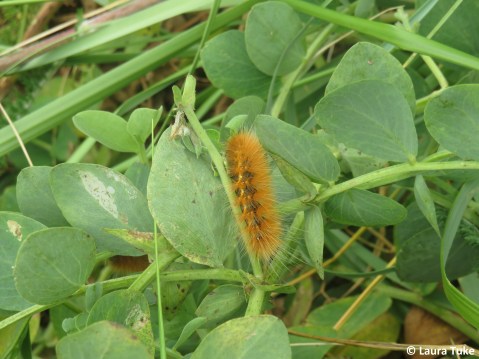
Though I did not get enough time on Sable Island to delve too deeply into the world of the invertebrates, I did enjoy seeing new species and identifying the many caterpillars I saw, such as:

Apple sphinx moth caterpillar

Apple sphinx moth caterpillar (Sphinx gordius)

Virginian tiger moth caterpillar

Virginian tiger moth caterpillar 2

Two variants of Virginian tiger moth caterpillars (Spilosoma virginica)

Introducing Sable

We had been flying nearly an hour when a smudge first appeared on the horizon of the ocean stretching before us. Though shrouded in fog, it was clear that we were finally nearing  our destination, the remote island that would be my home for the next 4 weeks, Sable Island.


Flying

First recorded by European explorers during the early 1500s, Sable Island is a large crescent-shaped sandbar situated approximately 156km from the nearest landmass (Nova Scotia, Canada). Sitting on the edge of the eastern North American continental shelf, the island was probably formed from deposits left by retreating glaciers at the end of the last ice age. Currently at about 49km in length, 1.25km in width and up to 30m in height above sea level, the island is experiencing decreases in size over time and shifting eastwards.

Sable Island

Map images from Google Maps

Though fabled by many, Sable Island is known for its abundance of wildlife and colourful history. In particular, the island is famous for being the ‘Graveyard of the Atlantic’, with 350+ shipwrecks resting off its shores, the latest originating from 1999 (the Merrimac). Despite people living on Sable from time to time since its discovery, during the 19th century it was these shipwrecks and the establishment of lighthouses and lifesaving stations that led to the start of continuous human presence on the island. The lifesaving stations persisted till they were decommissioned in 1958, but a meteorological station was set up at the start of the 20th century that is still functioning on the island today.

Sable shipwreck map

Map from the NS Department of Education

Today Sable Island is now under the management of Parks Canada, following its designation as a National Park Reserve in 2013. This designation recognises Sable for its impressive dune system and rich biodiversity, including endemic species and the world’s largest grey seal breeding colony. Despite this and the island’s many bird, invertebrate and plant species, you will find that the island’s population of feral horses is what captures most the public’s imagination. These horses were what I first saw when the green strip of Sable flanked by sandy beaches first came fully into view from the plane and its these horses that I was here to visit.

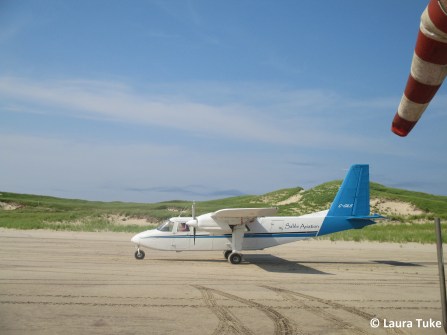
Following my first sight of the island, we were soon bumping down on to the landing strip on the island’s sandy south beach. After months of planning and much hard work, I had finally arrived!

Sable Aviation Plane


For Further Reading:

  • Sable Island: Explorations in Ecology and Biodiversity – Edited by Bill Freedman

Barmy about barn owls: Owl pellets

Currently we have at least one pair of resident barn owls on our 250 acre Dairy Farm, with one notable pair being seen amongst our farm buildings and fields closest to the centre of the farm.

On 26/05/16, I found a barn owl pellet within our straw barn, which was at least 1 month old. Through my interest in barn owls and the other species living on our farm, I then soaked the pellet and teased it apart to find the small mammal bones within.

The pellet was filled with lots of bones, such as shoulder blades, hipbones, femurs and humeri.

From the skulls and jaw bones found in the pellet, I was able to identify the four skulls to species level. Two skulls were from common shrews…

…and two skulls were from field voles.

It was really interesting to be able to get closer to the small mammals that can be found on our farm, whatever the level of species abundance. It also gave me the opportunity to brush up on my skull and bone identification skills with the help of an RSPB owl pellet identification guide, which can highly recommend to others

(https://www.rspb.org.uk/Images/Owlpellets_tcm9-133500.pdf). 

I also recommend to others to get out at this time of year and to find your own owl pellets to learn more about the owls and prey species in your local area.

Winter into spring: April on the farm

April is one of my favourite months of the year on the farm. During April, the Dorset countryside begins to burst into new life. Newborn lambs bounce in the fields, newborn calves snooze in the fields in the spring sunshine, birds begin to nest and raise a new generation, and flowers carpet the woodlands.

Plants this April still followed a trend of being late, with some woodlands not becoming decked out in their full splendour during this month like in past years. Still Bluebells, wild garlic, early purple orchids and late wood anemones began to coat the woodland floor. Also, the woodland ferns began to unfurl in the woods later than usual.

During this April, trees were very much still late, with sycamore and silver birch finally bursting into leaf. Oaks were noticeably asynchronous in their bud burst, with some trees on there way to being in full leaf and others yet to start.

April saw the main crop of migrants arriving on warm winds. This year our barn swallows returned on April 6th, exactly the same date as in 2015! By the time we were fully into April, bird breeding pairs had been firmly established, and the nesting season for many bird species was fully under way. During April, more birds can be heard singing at dawn than any other time of year, which is quite magical to hear.

This year the tawny owls are breeding later than last year, but by the end of April the first hissing calls of tawny owl fledglings could be heard resonating through Dorset woodlands.

Life could be seen blooming everywhere throughout April. Dog violets and cowslips, among other species, were seen flowering along roadside banks.

WP_20160427_002

27/04/16

Brimstone butterflies, orange tip butterflies, and peacock butterflies all began to emerge during the first half of April.

Throughout April, I made myself busy amongst the mounds university revision, by setting up my camera trap at different popular sites around our farmland. It was amazing to see the first badger cubs emerge from their den, and even more special to me, was being able to watch fox cubs beginning to explore above ground with their siblings, during the second half of the month. Fox cubs have to be my highlight of beautiful April!


Winter into spring: March on the farm

With the month of March comes the arrival of spring, symbolising the start of another year’s new growth and a transition following the bleaker winter months. March has often been associated with the saying ‘comes in like a lion, goes out like a lion’, referring to the weather. This was true about this March, with wild weather and strong winds featuring at the beginning of March, before the weather becoming more calm as the month progressed.

As traditional, during March, wildfowl made a sudden departure, fox cubs were born, buzzards established breeding orders, hawthorn and elder broke into leaf, small tortoiseshells emerged, nest building began, small warblers such as chiffchaffs returned from Africa, crocuses flowered, summer visitors began to return, and winter migrants began to migrate to their summer territories.

Though primroses, daffodils, celandines and blackthorn first flowered during February, it was nice to see all these flowers still blooming throughout March. Song birds during March could be heard singing, and the first woodland flowers began to come out at the end of March. The traditional ‘Mad’ March hares also made an appearance, with females resisting the advances of amorous males.

The beginning of Spring is symbolised by lengthening days and increasing temperatures. At the end of March, with the clocks going forward an hour, lengthening days were fulfilled, but this year the increasing temperatures did not make an appearance during March. After the stormier weather at the beginning of March, a cold spell set in, halting the advancement of Spring. This was symbolised with sycamore and silver birch being late coming into leaf, wood anemones and ferns being late to come out in the woods, and Blackbirds nesting late.

On the farm, new lives began during March. Aberdeen Angus suckler cows gave birth to their calves and three of our four mules gave birth to lambs, highlighting one of my favourite parts of the farming calendar.

My highlight of March was beginning to use my new Bushnell camera trap to photograph and video the wildlife on the farm, including the local badgers.

Winter into spring: February on the farm

February is often described as the bleakest month, with the land still gripped in winter and the coldest temperatures often being reached. It cannot be ignored though, that February also brings the promise of coming spring, with the feeling in the air beginning to change, as the month progresses.

Some mornings a light frost can be woken up to, but still frosts are less frequent this winter, than they used to be.

Plants are beginning to stir in February, with catkins (male flowers) hanging from hazel trees, celandines appearing, pussy willow flowering, primroses flowering, and gorse flowering in the hedgerows.

This year on our farm though, blackthorn is flowering early in February, along with horse chestnut trees already coming into bud and the buds beginning to burst.

Animals are beginning to become more active in February, with brown hares becoming easier to see in the fields, rabbits becoming ‘frisky’, female foxes being pregnant, and grey squirrels giving birth in their drays. Also, badgers are beginning to give birth to cubs too, with the most obvious sign of this being remains of grass seen around the entrance tunnels to setts, left from where badgers have dragged grass down into their setts to make nests.

As well at this time of year, starling flocks begin to disperse, as individuals head back to their breeding ranges and rooks begin to build their nests in preparation for breeding. The drumming sound of great spotted woodpeckers can now be heard more frequently, as males defend their territories against other males and attempt to attract a female. This is the same with the dawn chorus, as in February it begins to pick up, due to males defending their territories and advertising themselves to available females.

Conditions were mild towards the end of February this year, leading to insects, such as honeybees and butterflies beginning to become active.

In relation to the farm side of life, in February our four sheep were brought inside in preparation for iconic spring lambing at the end of March.

My highlight of February, was beginning to hear blackbirds singing at dawn and dusk as the month came to an end, which is a traditional sign that winter is over.

Winter into spring: January on the farm

January is often a cold and bare month, no leaves on the trees and an atmosphere of dormancy. But I say, if you just look closely enough, beauty is still there to be found.

January is the month when snowdrops begin to spring from the earth, hinting at the new life that is to come with spring.

Trees stand bare and leafless, showing off their magnificent skeletal shapes.

The last of the autumn’s berries still laden the hedgerows throughout January this year, in particular bright red rose hips.

As well, windfalls still lie beneath the apple trees from last years crop, ready for the taking. Badgers make frequent trips to the orchard to take advantage of the food source, and all that can be seen as evidence of these raids, are the discarded left overs of apples out in the nearby fields.

IMG_1226

Many gulls feed on the farmland fields during the daytime, with the flocks being mainly made up of herring gulls and great-black backed gulls. Usually also during the winter, flocks of starlings feed around the farm, but they only appeared for the first time this winter, near the beginning of January. Currently they can be seen flocking on the fields to feed or chattering away in the trees around our farm buildings. As well, iconic of this time of year, fieldfares and redwings can be seen feeding in the fields.

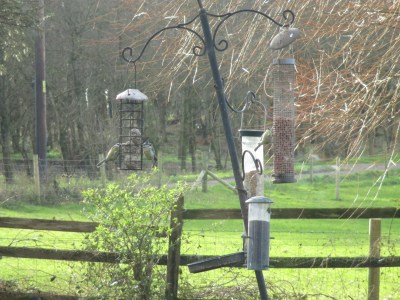
During the daytime, lots and lots of birds visit the bird feeders in the garden, to feed on peanuts and mixed seed. These bird species include, blue tits, chaffinches, great tits, goldfinches, house sparrows, dunnocks and great spotted woodpeckers.

IMG_1239

During the night at this time of year, tawny owls can be heard calling, as they attempt to rekindle pair bonds before the breeding season begins from February onwards. Also, female foxes can be heard calling to males, as they become receptive for mating.

Some mornings are woken up to a frost covered landscape. It makes things look particularly magical with the ground sparkling in the morning sunshine. With changes in winter weather though, these mornings have become rare in Dorset during this winter.

This January, change is in the air. Not the change of tradition, but change that feels wrong. Daffodils began to shoot from the beginning of January and primroses appeared in the hedgerows.

My highlight of January 2016 has to be, seeing a lone kestrel hunting close to our house everyday. A magnificent sight to see a bird hovering, still in mid air, before swooping down to catch a vole.