Winter into spring: February on the farm

February is often described as the bleakest month, with the land still gripped in winter and the coldest temperatures often being reached. It cannot be ignored though, that February also brings the promise of coming spring, with the feeling in the air beginning to change, as the month progresses.

Some mornings a light frost can be woken up to, but still frosts are less frequent this winter, than they used to be.

Plants are beginning to stir in February, with catkins (male flowers) hanging from hazel trees, celandines appearing, pussy willow flowering, primroses flowering, and gorse flowering in the hedgerows.

This year on our farm though, blackthorn is flowering early in February, along with horse chestnut trees already coming into bud and the buds beginning to burst.

Animals are beginning to become more active in February, with brown hares becoming easier to see in the fields, rabbits becoming ‘frisky’, female foxes being pregnant, and grey squirrels giving birth in their drays. Also, badgers are beginning to give birth to cubs too, with the most obvious sign of this being remains of grass seen around the entrance tunnels to setts, left from where badgers have dragged grass down into their setts to make nests.

As well at this time of year, starling flocks begin to disperse, as individuals head back to their breeding ranges and rooks begin to build their nests in preparation for breeding. The drumming sound of great spotted woodpeckers can now be heard more frequently, as males defend their territories against other males and attempt to attract a female. This is the same with the dawn chorus, as in February it begins to pick up, due to males defending their territories and advertising themselves to available females.

Conditions were mild towards the end of February this year, leading to insects, such as honeybees and butterflies beginning to become active.

In relation to the farm side of life, in February our four sheep were brought inside in preparation for iconic spring lambing at the end of March.

My highlight of February, was beginning to hear blackbirds singing at dawn and dusk as the month came to an end, which is a traditional sign that winter is over.

Winter into spring: January on the farm

January is often a cold and bare month, no leaves on the trees and an atmosphere of dormancy. But I say, if you just look closely enough, beauty is still there to be found.

January is the month when snowdrops begin to spring from the earth, hinting at the new life that is to come with spring.

Trees stand bare and leafless, showing off their magnificent skeletal shapes.

The last of the autumn’s berries still laden the hedgerows throughout January this year, in particular bright red rose hips.

As well, windfalls still lie beneath the apple trees from last years crop, ready for the taking. Badgers make frequent trips to the orchard to take advantage of the food source, and all that can be seen as evidence of these raids, are the discarded left overs of apples out in the nearby fields.

IMG_1226

Many gulls feed on the farmland fields during the daytime, with the flocks being mainly made up of herring gulls and great-black backed gulls. Usually also during the winter, flocks of starlings feed around the farm, but they only appeared for the first time this winter, near the beginning of January. Currently they can be seen flocking on the fields to feed or chattering away in the trees around our farm buildings. As well, iconic of this time of year, fieldfares and redwings can be seen feeding in the fields.

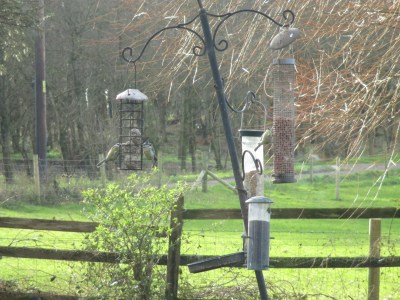
During the daytime, lots and lots of birds visit the bird feeders in the garden, to feed on peanuts and mixed seed. These bird species include, blue tits, chaffinches, great tits, goldfinches, house sparrows, dunnocks and great spotted woodpeckers.

IMG_1239

During the night at this time of year, tawny owls can be heard calling, as they attempt to rekindle pair bonds before the breeding season begins from February onwards. Also, female foxes can be heard calling to males, as they become receptive for mating.

Some mornings are woken up to a frost covered landscape. It makes things look particularly magical with the ground sparkling in the morning sunshine. With changes in winter weather though, these mornings have become rare in Dorset during this winter.

This January, change is in the air. Not the change of tradition, but change that feels wrong. Daffodils began to shoot from the beginning of January and primroses appeared in the hedgerows.

My highlight of January 2016 has to be, seeing a lone kestrel hunting close to our house everyday. A magnificent sight to see a bird hovering, still in mid air, before swooping down to catch a vole.

Brilliant barn owls

When I arrived back home a week ago from my first year of uni, I was told that my friend had seen a pair of barn owls on my home farm. These owls were seen to be using a barn owl box that had been put up by my Dad a couple of months ago. As barn owls had been seen by my family and myself on our dairy farm before, this year my Dad had decided he wanted to give them a helping hand, in the hope that they would use our box to breed. The news that it was possibly being used already, excited me. Consequently, I wanted to see for myself that the box was actually in use, and planned a barn owl box stake out the following evening.

I headed to where the box was situated at 20:45 and positioned myself in a cubicle barn across from the box, where I could look through a gap up at the box and surrounding possible perches. Patiently I waited, with no sign of either adult birds, though I could hear an individual screeching noise coming from the box, which made me aware that an adult bird was present.

After a period of only blackbirds, magpies and pheasants being heard, I heard a screech come from the nest box, followed by an adult female barn owl flying out of the entrance hole of the box, and landing on a metal roof truss a couple of metres from the box. After a few minutes of the female scoping her surroundings, she flew a couple of metres further, perching on a second roof truss. There she preened her feathers, stretched and defecated, before returning back to the nest box.

It was amazing to actually got to see the female up close, closer than I had ever seen one before. From this sighting, I could deduce that the female was going through the processes of incubation, though I cannot say at what point the female started sitting. On my walk back home from the barn, I disturbed the male who had been sat on a bank of grass not too far off from the barn.

I am looking forward to keeping an eye on the pairs’ process, and a family friend who is a licensed bird ringer is hoping to make a visit to us at the end of June to check the barn owl box. If there are chicks and they are big enough, he is hoping ring them. I cannot wait!