Winter into spring: April on the farm

April is one of my favourite months of the year on the farm. During April, the Dorset countryside begins to burst into new life. Newborn lambs bounce in the fields, newborn calves snooze in the fields in the spring sunshine, birds begin to nest and raise a new generation, and flowers carpet the woodlands.

Plants this April still followed a trend of being late, with some woodlands not becoming decked out in their full splendour during this month like in past years. Still Bluebells, wild garlic, early purple orchids and late wood anemones began to coat the woodland floor. Also, the woodland ferns began to unfurl in the woods later than usual.

During this April, trees were very much still late, with sycamore and silver birch finally bursting into leaf. Oaks were noticeably asynchronous in their bud burst, with some trees on there way to being in full leaf and others yet to start.

April saw the main crop of migrants arriving on warm winds. This year our barn swallows returned on April 6th, exactly the same date as in 2015! By the time we were fully into April, bird breeding pairs had been firmly established, and the nesting season for many bird species was fully under way. During April, more birds can be heard singing at dawn than any other time of year, which is quite magical to hear.

This year the tawny owls are breeding later than last year, but by the end of April the first hissing calls of tawny owl fledglings could be heard resonating through Dorset woodlands.

Life could be seen blooming everywhere throughout April. Dog violets and cowslips, among other species, were seen flowering along roadside banks.

WP_20160427_002

27/04/16

Brimstone butterflies, orange tip butterflies, and peacock butterflies all began to emerge during the first half of April.

Throughout April, I made myself busy amongst the mounds university revision, by setting up my camera trap at different popular sites around our farmland. It was amazing to see the first badger cubs emerge from their den, and even more special to me, was being able to watch fox cubs beginning to explore above ground with their siblings, during the second half of the month. Fox cubs have to be my highlight of beautiful April!


Winter into spring: March on the farm

With the month of March comes the arrival of spring, symbolising the start of another year’s new growth and a transition following the bleaker winter months. March has often been associated with the saying ‘comes in like a lion, goes out like a lion’, referring to the weather. This was true about this March, with wild weather and strong winds featuring at the beginning of March, before the weather becoming more calm as the month progressed.

As traditional, during March, wildfowl made a sudden departure, fox cubs were born, buzzards established breeding orders, hawthorn and elder broke into leaf, small tortoiseshells emerged, nest building began, small warblers such as chiffchaffs returned from Africa, crocuses flowered, summer visitors began to return, and winter migrants began to migrate to their summer territories.

Though primroses, daffodils, celandines and blackthorn first flowered during February, it was nice to see all these flowers still blooming throughout March. Song birds during March could be heard singing, and the first woodland flowers began to come out at the end of March. The traditional ‘Mad’ March hares also made an appearance, with females resisting the advances of amorous males.

The beginning of Spring is symbolised by lengthening days and increasing temperatures. At the end of March, with the clocks going forward an hour, lengthening days were fulfilled, but this year the increasing temperatures did not make an appearance during March. After the stormier weather at the beginning of March, a cold spell set in, halting the advancement of Spring. This was symbolised with sycamore and silver birch being late coming into leaf, wood anemones and ferns being late to come out in the woods, and Blackbirds nesting late.

On the farm, new lives began during March. Aberdeen Angus suckler cows gave birth to their calves and three of our four mules gave birth to lambs, highlighting one of my favourite parts of the farming calendar.

My highlight of March was beginning to use my new Bushnell camera trap to photograph and video the wildlife on the farm, including the local badgers.

Winter into spring: February on the farm

February is often described as the bleakest month, with the land still gripped in winter and the coldest temperatures often being reached. It cannot be ignored though, that February also brings the promise of coming spring, with the feeling in the air beginning to change, as the month progresses.

Some mornings a light frost can be woken up to, but still frosts are less frequent this winter, than they used to be.

Plants are beginning to stir in February, with catkins (male flowers) hanging from hazel trees, celandines appearing, pussy willow flowering, primroses flowering, and gorse flowering in the hedgerows.

This year on our farm though, blackthorn is flowering early in February, along with horse chestnut trees already coming into bud and the buds beginning to burst.

Animals are beginning to become more active in February, with brown hares becoming easier to see in the fields, rabbits becoming ‘frisky’, female foxes being pregnant, and grey squirrels giving birth in their drays. Also, badgers are beginning to give birth to cubs too, with the most obvious sign of this being remains of grass seen around the entrance tunnels to setts, left from where badgers have dragged grass down into their setts to make nests.

As well at this time of year, starling flocks begin to disperse, as individuals head back to their breeding ranges and rooks begin to build their nests in preparation for breeding. The drumming sound of great spotted woodpeckers can now be heard more frequently, as males defend their territories against other males and attempt to attract a female. This is the same with the dawn chorus, as in February it begins to pick up, due to males defending their territories and advertising themselves to available females.

Conditions were mild towards the end of February this year, leading to insects, such as honeybees and butterflies beginning to become active.

In relation to the farm side of life, in February our four sheep were brought inside in preparation for iconic spring lambing at the end of March.

My highlight of February, was beginning to hear blackbirds singing at dawn and dusk as the month came to an end, which is a traditional sign that winter is over.

Winter into spring: January on the farm

January is often a cold and bare month, no leaves on the trees and an atmosphere of dormancy. But I say, if you just look closely enough, beauty is still there to be found.

January is the month when snowdrops begin to spring from the earth, hinting at the new life that is to come with spring.

Trees stand bare and leafless, showing off their magnificent skeletal shapes.

The last of the autumn’s berries still laden the hedgerows throughout January this year, in particular bright red rose hips.

As well, windfalls still lie beneath the apple trees from last years crop, ready for the taking. Badgers make frequent trips to the orchard to take advantage of the food source, and all that can be seen as evidence of these raids, are the discarded left overs of apples out in the nearby fields.

IMG_1226

Many gulls feed on the farmland fields during the daytime, with the flocks being mainly made up of herring gulls and great-black backed gulls. Usually also during the winter, flocks of starlings feed around the farm, but they only appeared for the first time this winter, near the beginning of January. Currently they can be seen flocking on the fields to feed or chattering away in the trees around our farm buildings. As well, iconic of this time of year, fieldfares and redwings can be seen feeding in the fields.

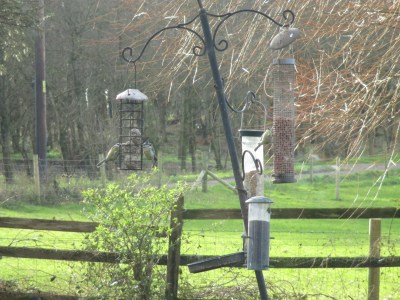
During the daytime, lots and lots of birds visit the bird feeders in the garden, to feed on peanuts and mixed seed. These bird species include, blue tits, chaffinches, great tits, goldfinches, house sparrows, dunnocks and great spotted woodpeckers.

IMG_1239

During the night at this time of year, tawny owls can be heard calling, as they attempt to rekindle pair bonds before the breeding season begins from February onwards. Also, female foxes can be heard calling to males, as they become receptive for mating.

Some mornings are woken up to a frost covered landscape. It makes things look particularly magical with the ground sparkling in the morning sunshine. With changes in winter weather though, these mornings have become rare in Dorset during this winter.

This January, change is in the air. Not the change of tradition, but change that feels wrong. Daffodils began to shoot from the beginning of January and primroses appeared in the hedgerows.

My highlight of January 2016 has to be, seeing a lone kestrel hunting close to our house everyday. A magnificent sight to see a bird hovering, still in mid air, before swooping down to catch a vole.

Brilliant barn owls

When I arrived back home a week ago from my first year of uni, I was told that my friend had seen a pair of barn owls on my home farm. These owls were seen to be using a barn owl box that had been put up by my Dad a couple of months ago. As barn owls had been seen by my family and myself on our dairy farm before, this year my Dad had decided he wanted to give them a helping hand, in the hope that they would use our box to breed. The news that it was possibly being used already, excited me. Consequently, I wanted to see for myself that the box was actually in use, and planned a barn owl box stake out the following evening.

I headed to where the box was situated at 20:45 and positioned myself in a cubicle barn across from the box, where I could look through a gap up at the box and surrounding possible perches. Patiently I waited, with no sign of either adult birds, though I could hear an individual screeching noise coming from the box, which made me aware that an adult bird was present.

After a period of only blackbirds, magpies and pheasants being heard, I heard a screech come from the nest box, followed by an adult female barn owl flying out of the entrance hole of the box, and landing on a metal roof truss a couple of metres from the box. After a few minutes of the female scoping her surroundings, she flew a couple of metres further, perching on a second roof truss. There she preened her feathers, stretched and defecated, before returning back to the nest box.

It was amazing to actually got to see the female up close, closer than I had ever seen one before. From this sighting, I could deduce that the female was going through the processes of incubation, though I cannot say at what point the female started sitting. On my walk back home from the barn, I disturbed the male who had been sat on a bank of grass not too far off from the barn.

I am looking forward to keeping an eye on the pairs’ process, and a family friend who is a licensed bird ringer is hoping to make a visit to us at the end of June to check the barn owl box. If there are chicks and they are big enough, he is hoping ring them. I cannot wait!